Key Points
- Nvidia has launched an Israeli research group targeting genomics, drug development and advanced materials.
- The unit sits within the global CTO office and is recruiting dozens of researchers.
- The expansion moves Nvidia beyond AI infrastructure toward direct participation in scientific research.
The latest
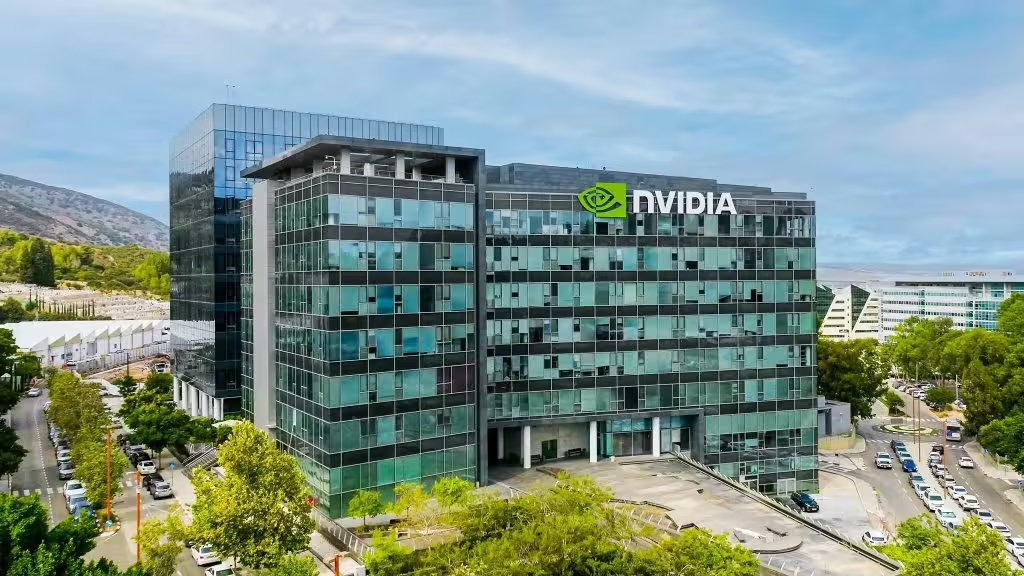
Nvidia has begun operating its Applied AI Architecture group from its Israeli development center, extending the company’s local research beyond computing infrastructure and hardware. The unit is part of Nvidia’s global Chief Technology Officer office, led by CTO and former Mellanox co-founder Michael Kagan. Directed by Dr. Nati Daniel, it is hiring researchers in Israel and plans to add dozens during the coming year.
Details
- Scientific remit: The group is expected to work across genomics, drug discovery and advanced materials. Its aim is to apply AI not only to automate existing tasks, but also to identify patterns and possibilities that are difficult for researchers to find efficiently. The approach extends techniques used in language and image models to biological and physical data.
- Genomic partnership: Nvidia is collaborating with Sheba Medical Center and Mount Sinai Hospital in New York on a Genomic Foundation Model. The project is designed to interpret large genomic datasets, including relatively poorly understood parts of the human genome, with potential applications in disease research, earlier diagnosis, prevention and personalized medicine.
- Drug investment: Nvidia’s Israeli team is participating in its global collaboration with Eli Lilly. The companies plan to invest about $1 billion over five years in AI-driven drug discovery and development, combining genomic and sequencing data with chemistry, biology and cellular systems. AI could narrow the search space and identify promising directions faster, but does not replace laboratory experiments or clinical validation.
- Materials program: Israeli researchers are also involved in GENMAT, an international initiative backed by about €6 million from the EU’s Horizon program. It unites companies, universities and research institutions to use AI in discovering and developing materials for aviation, automotive manufacturing and pharmaceuticals. Models can analyze knowledge and predict candidates before physical production, potentially reducing years of experimentation.
- Israeli foundation: Nvidia’s major local base expanded after its $7 billion acquisition of Mellanox in 2020. Founded in Israel by Kagan and Eyal Waldman, Mellanox strengthened Nvidia’s networking and data-center capabilities as the company broadened beyond graphics processors. Nvidia now employs thousands in Israel, where universities, hospitals, startups and the semiconductor industry provide potential research partners.
Background
The first phase of the AI boom centered on models handling language, images, code and other digital content. Scientific AI shifts that focus toward biological, chemical, physical and materials data. For Nvidia, deploying its own computing infrastructure in these fields moves the company further into the research applications enabled by its hardware.
What’s next
Over the coming year, the clearest measure of the group’s build-out will be Nvidia’s planned recruitment of dozens of researchers in Israel. Progress will also be reflected in the genomic model with Sheba and Mount Sinai, the Eli Lilly program and GENMAT’s materials work.