Key Points
- Iran has restored about half of the production capacity damaged at South Pars, up from roughly 40% in late August.
- Repairs span platforms, processing plants and pipelines, with all planned restoration work due before winter.
- Recovery is critical for household heating, electricity generation, industrial output, exports and Iran’s wider economic resilience.
The latest
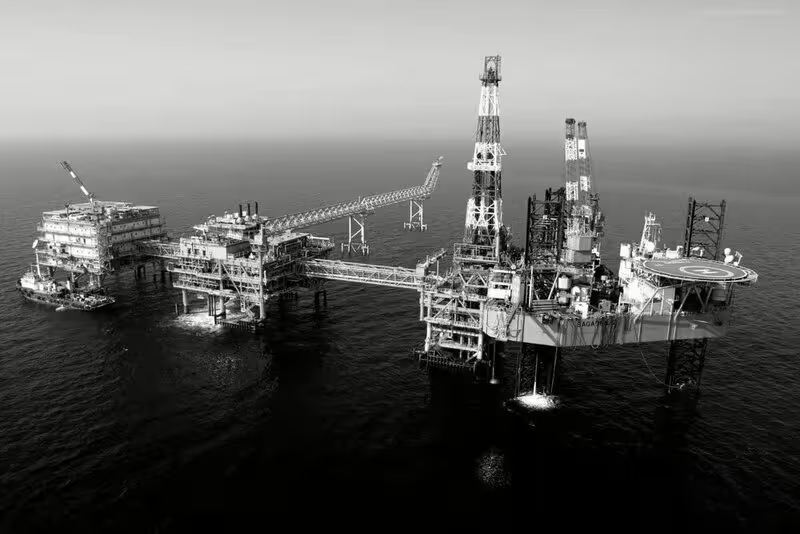
Iran has restored about 50% of the production capacity damaged at the South Pars gas field, Deputy Oil Minister Ahmad Zeraatkar said, as Tehran races to repair its most important domestic gas asset before winter. The recovery has accelerated since late August, when Zeraatkar said roughly 40% of damaged capacity had returned. Around half of the affected capacity therefore remains to be restored.
Details
- Winter pressure: Zeraatkar said all planned restoration work would be completed before winter, when Iranian gas consumption rises sharply. Households, power plants and industries compete for the same supply, and protecting residential users can require reduced deliveries to industrial consumers or generators.
- Domestic dependence: Most South Pars gas is consumed inside Iran, supporting household heating, electricity generation and industrial production rather than primarily serving exports. The field is consequently central to both energy security and the economy during peak seasonal demand.
- Shared reservoir: The offshore field forms part of the world’s largest natural gas reservoir and is shared with Qatar’s North Field. Qatar’s side is a major source of liquefied natural gas, giving disruptions broader relevance for Gulf infrastructure and global markets.
- Strike impact: Israel struck South Pars in March in an attack coordinated with the United States, The Times of Israel reported. Damage also hit processing infrastructure in Asaluyeh, the coastal industrial hub where much of the field’s gas is processed.
- Output loss: Iranian authorities said in August that energy infrastructure damage had cut daily gas output by approximately 95 million cubic metres. Some lost production was offset by redirecting capacity to other processing facilities, underscoring the need to restore plants, pipelines and associated infrastructure.
- Economic exposure: Gas shortages can constrain electricity generation and force steel, cement, aluminium and petrochemical producers to reduce output. That can weaken industrial production and exports, adding pressure to an economy already affected by the war and restrictions on energy exports.
- Regional trade-off: After the March strike, Iranian gas flows to Iraq were temporarily halted as Tehran redirected available supplies toward domestic consumption. Qatar, the UAE and other regional governments warned that attacks on energy facilities could threaten regional stability and global energy security.
Background
Iran’s energy system entered the conflict with structural weaknesses, including years of underinvestment and limited capacity to manage seasonal demand swings. Even after nominal capacity returns, processing bottlenecks, equipment shortages, maintenance needs and damaged infrastructure can continue to restrict actual output.
What’s next
The next test is the start of winter, by which Tehran says all planned restoration will be completed. The key indicators will be capacity restored beyond 50%, contained domestic shortages, and uninterrupted supplies to power plants, industries and regional customers.