Key Points
- Syrian president says Israel must leave post-Assad positions before talks on new security arrangements.
- Direct negotiations involving Washington came close to 90% agreement over the past year, al-Sharaa said.
- Success could open a path to lasting peace and economic ties, while failure would prolong border tensions.
The latest
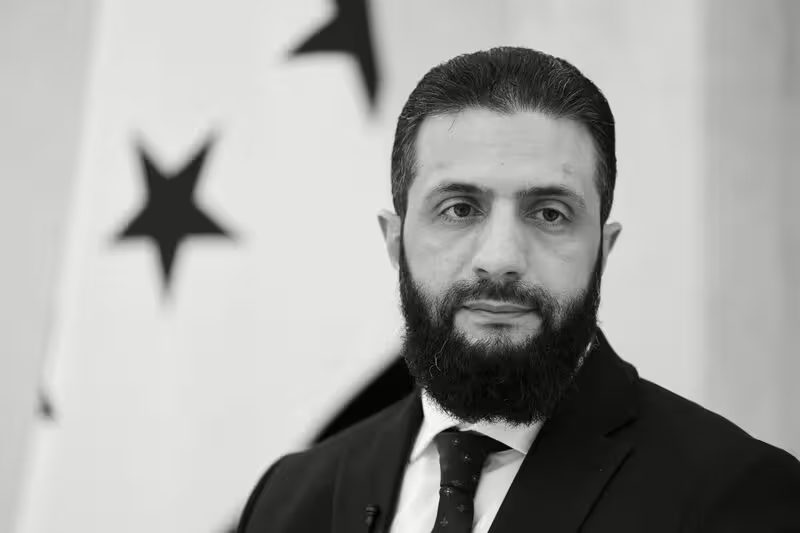
Syrian President Ahmed al-Sharaa said Tuesday that Israel must withdraw from positions taken in southern Syria after Bashar Assad’s government fell in December 2024 before the sides negotiate broader security arrangements, outlining a sequence he said could lead to “lasting peace.” Speaking at an Atlantic Council panel in New York before his scheduled United Nations General Assembly address, al-Sharaa said direct Syrian-Israeli talks with US involvement had reached “almost 90%” agreement at one stage over the past year.
Details
- Withdrawal sequence: Al-Sharaa called for Israel to return to positions tied to the 1974 disengagement agreement. “Then we get into discussions on security arrangements,” he said, adding that successful arrangements could lead to lasting peace. The central divide pits Damascus’s demand for withdrawal first against Israel’s emphasis on security conditions after Assad’s fall.
- Golan dispute: Al-Sharaa said the Golan Heights were Syrian territory under UN recognition and “there is no discussion.” Israel captured the territory in the 1967 Six-Day War and extended Israeli law there in 1981. The United States recognized Israeli sovereignty in 2019, while the UN continues to regard it as occupied Syrian territory.
- Competing security cases: Al-Sharaa acknowledged the trauma of the October 7, 2023 Hamas attack but rejected allowing it to determine broader Israeli policy toward Syria. He cited more than 70,000 deaths in Gaza and questioned Israeli bombings, arrests, and strikes on Syrian airports and military sites. Israeli officials describe operations in Syria as necessary to block armed groups, weapons transfers, and an October 7-style attack from Syrian territory.
- Regional repositioning: Al-Sharaa pointed to Syria’s growing relationships with the United States, Britain, Gulf states, Iraq, and Lebanon, saying the unsuccessful relationship was with Israel. “I believe the problem is with Israel, not with Syria,” he said. He also pledged institution-building and constitutional recognition of Kurdish cultural and linguistic rights.
- Economic opening: He called for “mutual respect and good economic and trade relations.” A stable southern Syria could facilitate regional infrastructure, trade, and energy links involving Israel, Jordan, Gulf states, and Turkey, supporting Damascus’s push to rebuild its war- and sanctions-damaged economy.
- Foreign forces: Al-Sharaa said his long-term objective was a Syria without foreign military bases and that negotiations continued over Russia’s remaining military presence. Any security arrangement would also depend on mechanisms addressing violations, armed-group activity, threats from Syrian territory, and unilateral Israeli operations.
What’s next
Al-Sharaa’s scheduled address to the UN General Assembly is the next public marker. The decisive negotiating indicator will be whether Israel and Syria can agree on withdrawal sequencing, monitoring violations, and guarantees against cross-border threats or continued unilateral operations.