Key Points
- Trump said he must choose between an Iran agreement and destroying the Islamic Republic.
- He predicted a deal after November's midterms, saying the vote does not influence his Iran decision.
- A senior Iranian official told Reuters Tehran's delegation has full authority to resume talks.
The latest:
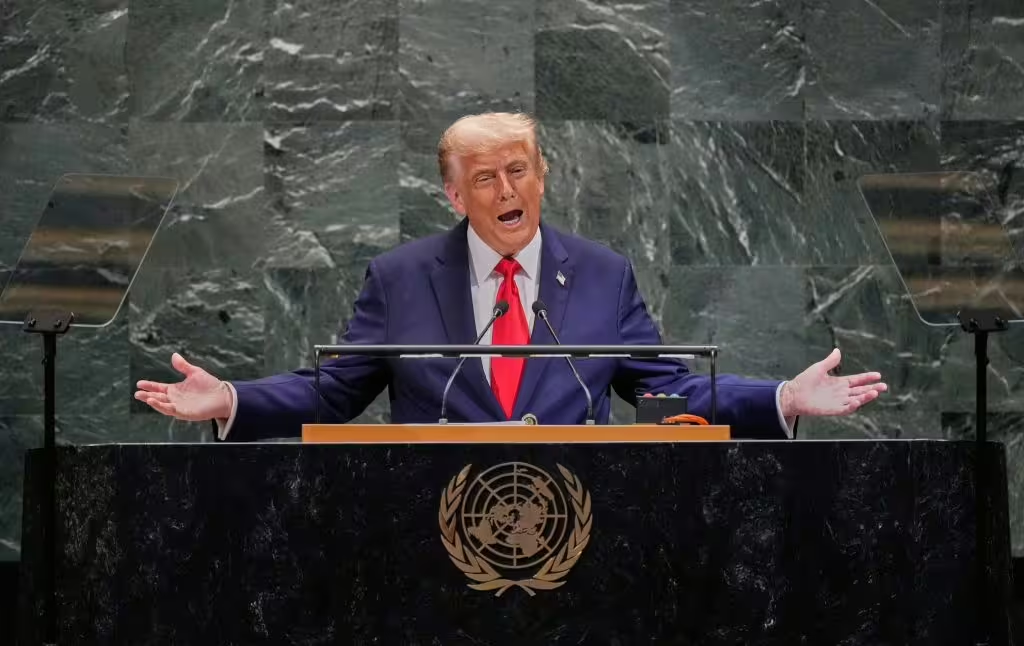
A choice between a deal with Iran and destroying it is now on his desk, President Donald Trump told the UN General Assembly, while predicting an agreement would come shortly after November’s congressional midterm elections. He urged every country to impose complete economic isolation on Tehran until it halts attacks on commercial shipping, abandons its nuclear ambitions and ends support for terrorism.
Details:
- The threat: Trump framed the decision as either allowing Iran to rebuild and rise among the great nations, or ending the Islamic Republic quickly without another chance. The only thing that matters to him is that Iran never possesses nuclear weapons, he said, rejecting the idea that electoral timing shapes the file.
- The election argument: Iran is waiting to see how he performs in the midterms, Trump said, adding that he is not a candidate, already won decisively and will remain in office for another two and a half years. The Republican Party is on the ballot and he will help it, he said.
- Justifying the war: Trump defended launching the war against Iran alongside Israel in February, claiming Tehran rejected every attempt he made to reach an agreement preventing it from obtaining nuclear weapons. He tied the campaign to October 7, saying Iran’s supreme leader had celebrated the massacre.
- The munitions denial: The president rejected reports of shortages in American munitions and interceptors, a gap said to be one reason for holding off on resuming the military campaign. Washington has more weapons than it can imagine using and is rebuilding stockpiles faster than ever, he said.
- Tehran’s position: Hours before the speech, a senior Iranian official told Reuters the delegation in New York, which includes Foreign Minister Abbas Araghchi, holds full authority to revive diplomacy with Washington. The official ruled out a Trump-Pezeshkian meeting and said Iran could reopen the Strait of Hormuz within seven days if military pressure eased.
- The meeting question: CNN reported, citing an American source, that Trump told advisers he wants such a meeting “if the right conditions emerge,” though no actual plan exists. Secretary of State Marco Rubio said Washington is open to the possibility if it secures the goal of keeping Iran without nuclear weapons.
- The walkout: Senior Iranian officials, including Araghchi, left the hall as Trump began speaking. Iranian President Masoud Pezeshkian received permission to enter New York for the General Assembly despite the ongoing war.
- Pushback from the podium: Brazilian President Lula da Silva, speaking immediately before Trump, said threatening the annihilation of civilizations will not bring stability to the Middle East. He said the Strait of Hormuz has become a battlefield and families worldwide are paying through higher fuel, fertilizer and food prices.
- The wider agenda: Trump thanked Qatar, Kuwait, Saudi Arabia and Turkey for funding Gaza’s Board of Peace, attacked the International Criminal Court as a rogue institution and urged members to withdraw, and announced the US government will rename artificial intelligence as superintelligence.
Background:
This was Trump’s second General Assembly address since returning to the White House, running about 36 minutes against 56 minutes last year. Washington transferred 725 million dollars to the UN this month, without which it would have lost its General Assembly vote.
Between the lines:
The ultimatum and the prediction of a deal sit in the same speech, and both point at the same November date. Tehran’s own signal — full negotiating authority, an offer on Hormuz in exchange for eased pressure — suggests the channel is live even as its delegation walked out. Neither side has named a venue or a date.
What’s next
Trump is expected to meet at least 11 world leaders, including a Gulf summit on Iran and the day after, plus talks with Zelensky. Netanyahu addresses the Assembly Thursday; the conference runs through Monday.