Key Points
- Scientists identified Leopardus tilcayo in Bolivia, the first living feline species discovered in more than a century.
- Genetic analysis separated tiger cats once treated as one group into five distinct species.
- The finding could reshape extinction-risk assessments as the Yungas forests face mounting habitat pressure.
The latest
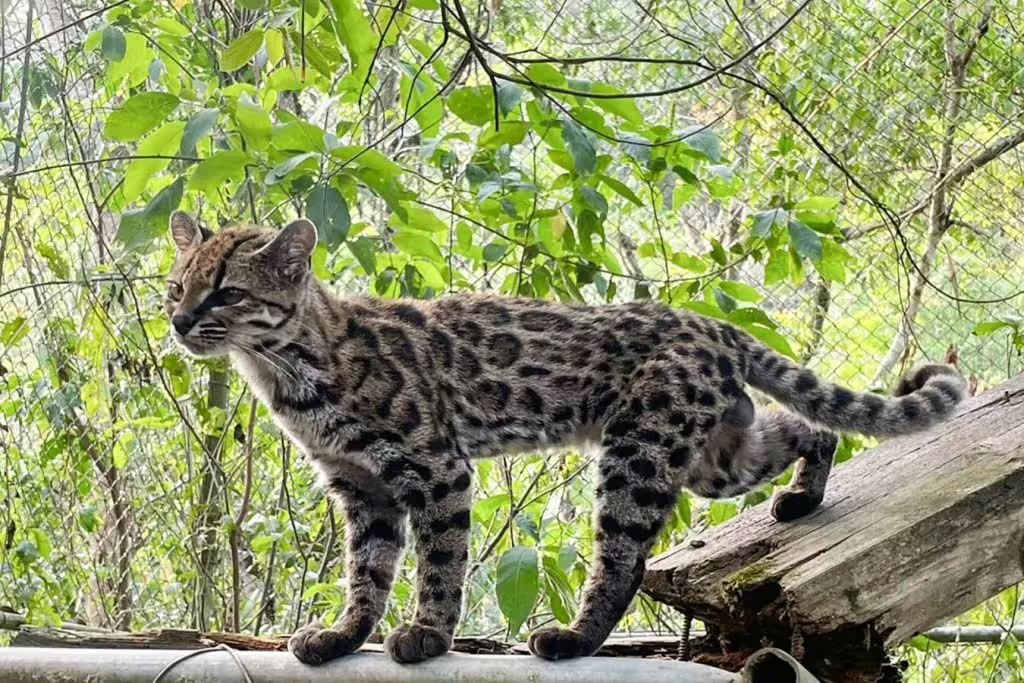
Scientists have identified Leopardus tilcayo, a small wild cat native to Bolivia’s Yungas cloud forests, as a species previously unknown to science. The finding, published in Current Biology, is described by researchers as the first discovery of a living feline species in more than a century. Known locally as the tilcayo cat, the animal weighs about three pounds, measures roughly 18 inches and is smaller than an average domestic cat.
Details
- Hidden in captivity: The investigation began after a local family kept a small spotted animal as a pet for about a year before taking it to the Senda Verde Wildlife Sanctuary. The 10-year-old male remains the only known tilcayo cat in captivity. National Geographic Explorer Paola Nogales-Ascarrunz pursued the case after its features failed to match descriptions and reference images of known tiger cats.
- Distinct appearance: Tiger cats are cryptic species whose close relatives can be difficult to distinguish by appearance alone. The tilcayo has light brown fur patterned with irregular rosettes, a small rounded face and small round ears. Researchers therefore used genetics to determine whether the Bolivian animal belonged to an established species.
- Genetic split: The team analyzed DNA from 38 cats across several South American countries, including eight museum specimens. Results divided animals previously treated as a single tiger cat group into five genetically distinct species. The lineage that produced Leopardus tilcayo separated from other tiger cats about 1.4 million years ago.
- Peruvian lineage: Researchers also identified a previously unknown tiger cat subspecies in Peru’s Yungas. They named it Leopardus tigrinus antisuyo after Antisuyu, the region of the former Inca Empire that encompassed its habitat. The result shows how genetic techniques can revise classifications applied to animals studied for decades.
- Sparse evidence: Knowledge of the tilcayo cat rests on two live animals examined by researchers and a small number of camera-trap records. Scat evidence indicates small rodents may form part of its diet, while camera traps suggest primarily nocturnal activity. Its population size, behavior, geographic range and distribution remain unknown.
- Conservation stakes: The IUCN currently treats tiger cats as two vulnerable species with declining populations. Researchers shared the genetic data ahead of a future assessment covering the five lineages, which may show that animals previously counted within a larger population are substantially rarer. The Yungas also faces deforestation, agricultural expansion, human-caused fires and mining.
Background
Researchers say restoring forests damaged by fires, protecting remaining native woodland and maintaining habitat connections will be critical in the Yungas. The identification of a distinct cat species adds conservation weight to an ecosystem where biodiversity remains incompletely cataloged and habitats are under increasing pressure.
What’s next
The next formal indicator will be the IUCN’s future assessment of the five genetically distinct tiger cat lineages, using submitted data to reconsider extinction risk beyond the current two-species classification.