The latest:
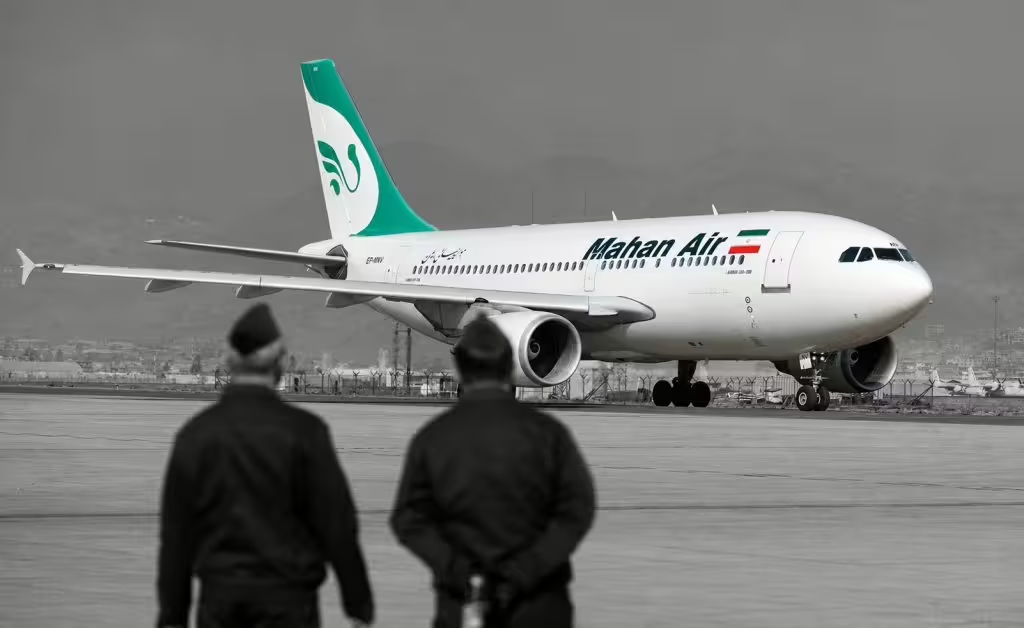
Iran’s largest private carrier has pulled out of two of its busiest international markets, suspending Muscat flights from Thursday and Istanbul and Ankara flights from Monday. The New York Times reported Mahan Air told travel agencies only that it was acting after decisions by Turkish and Omani aviation authorities, without mentioning sanctions. The Financial Times said roughly 50 of 143 scheduled Iran-bound flights did not operate Wednesday.
Details:
- The trigger: The Financial Times reported the US Treasury sanctioned 36 targets accused of supporting Iran’s aviation sector, which Washington alleges helps the government move weapons and personnel. Anadolu Agency said the September 8 package blacklisted 27 Iranian airlines and nine third-country intermediaries.
- The warning: Treasury Secretary Scott Bessent threatened further designations against any individual or company still working with Iranian carriers. The Financial Times quoted him saying anyone dealing with the remaining Iranian airlines risks being “cut off from the global financial system.” Anadolu reported the same warning.
- Licenses revoked: According to The New York Times, Treasury suspended authorizations covering overflight and emergency-landing payments to Tehran, US goods and services for Iran-bound aircraft, and safety-related exports for American-made planes. It said aviation-safety requests would be reviewed case by case.
- The wider net: Treasury also halted a broad license permitting transfers to Iran of civilian aircraft containing 10% or more American parts. Sanctions experts told The New York Times that because most of the world fleet falls into that category, foreign airlines must now seek US licenses to keep any Iran routes.
- The intermediaries: The New York Times reported Treasury sanctioned Emirati and Turkish companies it said helped Mahan Air buy three aircraft this summer. The Financial Times said the round also hit ground handlers and sales agents in Turkey and elsewhere accused of working with the carrier.
- Turkey’s role: A person familiar with the matter told the Associated Press that Turkish authorities ordered Mahan Air to suspend all flights to Turkey. Iran’s ISNA said the Tehran-Ankara suspension takes effect this week in both directions with no restart date, while other Iranian carriers continue serving the route.
- The fleet: Iran Air chief executive Taher Abdolhay told local media the national carrier has only nine operational aircraft, with the rest out of service or needing overhaul. He said 30 aircraft across various airlines were damaged and 10 returned to military use after US and Israeli strikes hit airports and radar infrastructure.
- Safety incidents: The Financial Times reported a Sepehran Airlines Boeing 737 made an emergency landing in Mashhad on Monday after a technical fault shortly after takeoff, three weeks after another Sepehran 737 veered off a runway. Neither incident caused injuries.
- Remaining routes: Mahan Air is still flying to Russia, China and Thailand, and several Iranian carriers have started regular service to the United Arab Emirates. Travel agents told the Financial Times that UAE travel is currently limited to dual nationals and Iranians holding Emirati residency permits.
- Economic backdrop: The New York Times said the US Navy has blockaded southern Iranian ports, limiting oil exports and essential imports, and that Tehran raised some fuel prices this month under fiscal pressure. Treasury has also targeted Iran’s gold and cryptocurrency trade, pushing the rial to record lows.
Background:
The New York Times said Mahan Air has been under US sanctions since 2011 over allegations it moved fighters and Revolutionary Guard personnel, a force Washington designates a terrorist organization. It nonetheless kept buying aircraft and flying abroad until the new restrictions took effect.
Between the lines:
ISNA’s point that rival Iranian carriers still fly the Turkey route suggests the immediate cost lands on Mahan Air rather than on Iran-Turkey air travel overall. But the wider license revocations reach every operator: with most of the global fleet containing 10% or more US parts, foreign airlines need Washington’s permission to serve Iran at all.
What’s next
Watch whether other Iranian carriers lose Istanbul and Muscat slots, how Tehran’s talks with Georgia’s aviation authority end, and whether Treasury grants any case-by-case aviation-safety licenses.