Key Points
- Satellite imagery dated September 13 shows heavy construction activity at Taleghan 2, southeast of Tehran.
- The facility was struck by Israel in October 2024 and again in March 2026.
- Its AMAD-era history makes the reconstruction significant for monitoring Iran’s nuclear-related infrastructure.
The latest
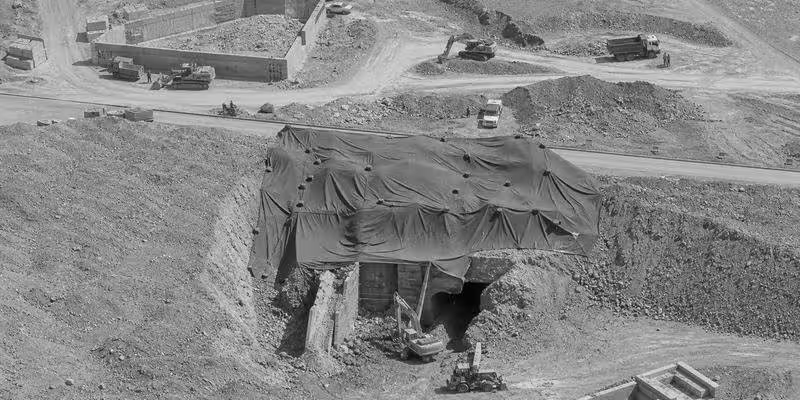
Iran appears to be accelerating reconstruction of the Taleghan 2 facility at the Parchin military complex, roughly 30 kilometers southeast of Tehran, with satellite imagery showing dump trucks, bulldozers, concrete pump trucks, cement mixers and cranes at the site. The Institute for Science and International Security said images from September 13 indicate active, substantial work on the underground and reinforced structure, which has twice been targeted by Israeli strikes.
Details
- Damage timeline: Taleghan 2 was heavily damaged in an Israeli strike in October 2024. Reconstruction reportedly began in May 2025, before Israel targeted the facility again in March 2026 during the broader conflict with Iran. Repairs and rehabilitation resumed in June, beginning with work to repair and fill penetration points created by heavy bunker-busting bombs with concrete.
- Concealed works: A large tarp appears to cover the underground structure. The institute said the covering may be intended to obscure reconstruction from satellite imagery and aerial surveillance. The latest images also appear to show a newly built concrete reinforcement slab on one side, potentially adding protection against future airstrikes.
- Sensitive history: The facility has drawn international scrutiny over alleged ties to Iran’s AMAD program, a covert nuclear weapons development effort associated by Western intelligence agencies with research into nuclear weapon design and potential development. Israel has said Taleghan 2 hosted sensitive experiments involving advanced explosives, while Western assessments place relevant experiments there more than two decades ago.
- Current use: The construction activity does not by itself establish that Iran is conducting nuclear weapons research at Taleghan 2. The imagery provides evidence of reconstruction, but not conclusive proof of the facility’s current use. Determining whether it is intended for conventional military purposes, nuclear-related research or another activity would require additional intelligence and site access.
- Monitoring challenge: The repeated rebuilding highlights the difficulty of tracking Iran’s nuclear-related infrastructure after military strikes. Damaged facilities can be repaired, reinforced or modified, while underground structures make it harder for outside observers to determine activities inside. The institute said Tehran’s continued investment in a site with such a sensitive past leaves major questions about its intentions.
Between the lines
The institute considers the rebuilding significant because of Taleghan 2’s history and has questioned why Tehran continues to commit resources to it. Repeated damage and repair also show how military strikes can alter nuclear-related infrastructure without resolving uncertainty over later use.
What to watch
Further satellite imagery will be the next concrete indicator, particularly whether heavy equipment remains in place, the tarp is removed or additional reinforcement appears. Intelligence access to Taleghan 2 would determine whether the rebuilt facility serves conventional military, nuclear-related or other activities.