Key Points
- Internal U.S. intelligence reports warn China could obtain F-35 technology through espionage or its partnership with Riyadh.
- The 48-jet package worth $24 billion went to two congressional committees in June for informal approval.
- Objections could stall the sale, or push the administration to bypass Congress entirely.
The latest:
Internal U.S. intelligence assessments warn that China could gain access to F-35 fighter jet technology if a pending $24 billion sale of the aircraft to Saudi Arabia proceeds, American officials told The New York Times. One detailed report from the Pentagon’s Defense Intelligence Agency questions whether Washington and Riyadh can keep the technology’s sites secure. The State Department, the Pentagon and the Saudi Embassy declined to comment.
Details:
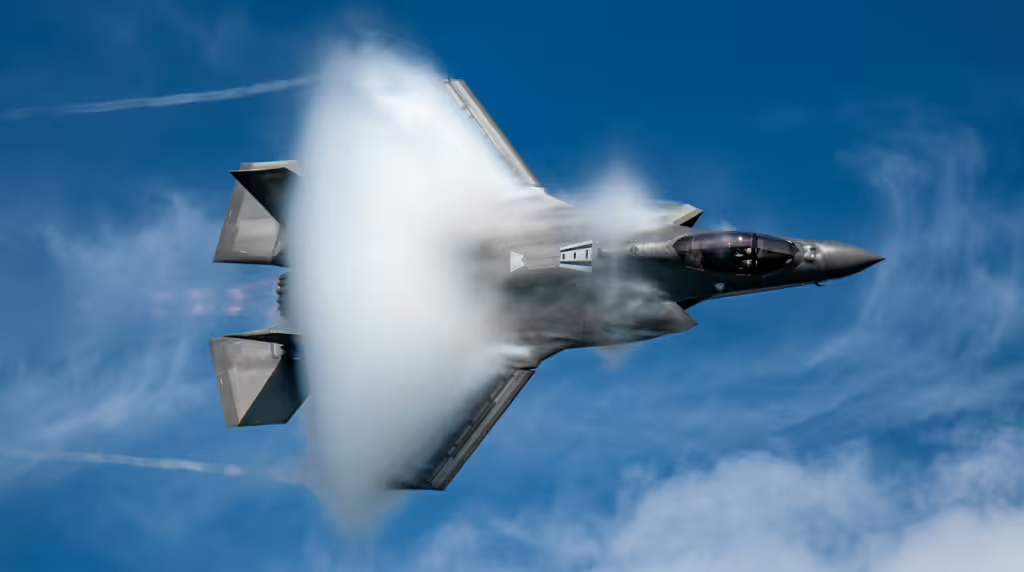
- The package: The proposed sale covers 48 F-35 jets and a spare engine, valued at $24 billion, according to U.S. officials. The State Department sent it to two congressional committees in June seeking informal approval. The aircraft are built by Lockheed Martin, a process that takes years from order to delivery.
- The intelligence concern: Analysts raised the possibility that Beijing could acquire F-35 technology either through espionage inside Saudi Arabia or through China’s military and security partnership with the kingdom, U.S. officials said. The officials spoke anonymously, citing sensitivities around espionage and military matters.
- What the report asks: The recent Defense Intelligence Agency report says only Saudi and American officers and contractors should have access to sites housing F-35 technology, a U.S. official said. It also asks whether Riyadh would agree more broadly to limit contact with Chinese military and intelligence personnel and associated entities.
- Huawei and ZTE: The report questions whether Saudi officials would remove Huawei and ZTE equipment from telecommunications and router infrastructure and from defense installations, a U.S. official said. It also discusses Chinese military access to Saudi bases and the kingdom’s use of Chinese technology in its telecom networks.
- The radar worry: Pentagon officials are especially concerned about protecting the F-35’s advanced radar and surveillance technology, a U.S. official said. The report is described as sharper and more technical than an earlier, more general assessment the agency issued in the fall of 2025, when the sale was still under discussion.
- Saudi-China ties: Saudi Arabia buys ballistic missiles from China, and the Chinese military is helping the kingdom learn to build them, set up production facilities and improve missile operations. Democratic lawmakers wrote to then-President Joseph Biden in June 2022 laying out concerns over that program.
- Israel’s position: Some Israeli officials have concerns about the deal, U.S. officials said. Israel is the only country in the Middle East operating F-35s and has used them in airstrikes on Iran in recent years. Since 1973, U.S. policy has sought to preserve Israel’s qualitative military edge, as mandated by Congress.
- The Emirati precedent: U.S. agencies raised similar objections after Trump agreed in 2020 to sell F-35s to the United Arab Emirates alongside normalization with Israel. The Biden administration reviewed the sale, citing Emirati military, intelligence and technology ties with China, and officials ultimately ended the sales process.
- The timeline: Trump announced the Saudi sale in November, a day before hosting Crown Prince Mohammed bin Salman at the White House. The Defense Intelligence Agency report has since circulated among several administration agencies and congressional offices, alongside assessments from other intelligence offices.
- The bypass option: Secretary of State Marco Rubio has repeatedly skipped the congressional approval process to speed weapons shipments to Israel, citing a regional emergency. If congressional leaders withhold approval for the Saudi F-35 sale, he could take the same route, according to the report.
Background:
Saudi Arabia is by far the largest buyer of American weapons, after decades of military cooperation with Washington. Prince Mohammed has long sought F-35s as part of an effort to build up a military that struggled in Yemen and against Iranian attacks.
Between the lines:
The unresolved questions in the Pentagon report — access controls at F-35 sites, contact with Chinese personnel, and Huawei and ZTE equipment in Saudi networks — read as conditions rather than objections, suggesting the sale’s fate may hinge on commitments Riyadh has not yet made. The Emirati case shows an unmet condition can end a deal entirely.
What’s next
Watch whether the two congressional committees grant informal approval, whether lawmakers force a formal review of Israel’s qualitative military edge, and whether Rubio invokes emergency authority to move the sale forward.