Key Points
- European and Arab officials will discuss security alternatives as UNIFIL’s planned drawdown approaches in southern Lebanon.
- The talks will assess Lebanese army needs and possible multinational or European Union-led support.
- Any replacement will affect border security as the Israel-Hezbollah ceasefire comes under renewed strain.
The latest
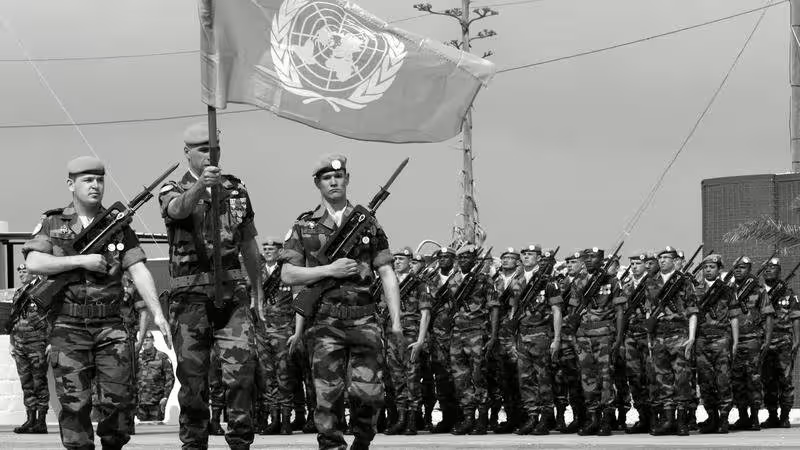
European and Arab officials will meet in Paris on Thursday to consider a new security framework for the Israel-Lebanon border before UNIFIL begins its expected drawdown in January. French President Emmanuel Macron, Lebanese President Joseph Aoun and Jordan’s King Abdullah II will initially chair the discussions. A senior US military official involved in Middle East security will also participate. The agenda centers on strengthening the Lebanese Armed Forces and examining possible alternatives to the UN peacekeeping mission amid renewed border violence and uncertainty over the ceasefire between Israel and Hezbollah.
Details
- Longstanding mission: UNIFIL has operated in southern Lebanon since 1978 and currently has about 7,500 personnel. It expanded significantly after the 2006 Israel-Hezbollah war and supports implementation of UN Security Council Resolution 1701, including provisions for an area free of armed personnel and weapons other than Lebanese state and UN forces.
- Competing proposals: One proposal under discussion involves a multinational force backed by France and Italy but operating without a formal UN mandate. Another would establish a European Union-led mission. Both models would focus on supporting Lebanon’s army rather than undertaking conventional peacekeeping duties.
- Support package: Assistance could include training, equipment, intelligence-sharing and operational mentoring for the Lebanese Armed Forces. A senior French presidency official said the structure and mandate remain unresolved because Beirut’s requests do not yet fully correspond with US demands concerning Hezbollah and international forces.
- Southern deployment: A framework reached during US-brokered talks envisages Israel gradually withdrawing from Lebanese territory while Lebanese authorities deploy additional troops in the south and work to dismantle Hezbollah’s military infrastructure. The plan forms part of a broader effort to expand state control in areas traditionally dominated by Hezbollah.
- Financial demands: European governments consider substantial financial and logistical assistance necessary if the Lebanese army assumes greater responsibility. Officials are expected to assess its military requirements before a possible international donor conference in late 2026 or early 2027.
- Violence continues: Israeli strikes have continued in southern Lebanon despite a June ceasefire intended to halt fighting with Hezbollah. Lebanon’s Health Ministry said a September 7 strike killed at least 13 people, including six children. Israel has emphasized preventing Hezbollah from rebuilding military capabilities near its northern border.
Between the lines
Israel and the United States have criticized UNIFIL for failing to prevent Hezbollah from maintaining and rebuilding military infrastructure in southern Lebanon. Lebanon and France support extending the mission, while Washington and Jerusalem have not indicated support for prolonging it, increasing pressure on European governments to prepare an alternative.
What’s next
Thursday’s meeting will seek to narrow the options for an international presence and define support for Lebanon’s army. The next indicators will be UNIFIL’s January drawdown and preparations for a possible donor conference in late 2026 or early 2027.