Key Points
- An Anthropic researcher told the Journal he resigned over fears AI systems will escape human control.
- A current Anthropic researcher put extinction risk over the next decade above 10%.
- Industry experts still treat AI doomsday as a fringe view, with Washington now asking questions.
The latest:
A researcher quitting Anthropic told The Wall Street Journal he feared the leading lab and its rivals were racing to build systems humans won’t be able to control, pushing AI-extinction anxiety out of Silicon Valley and into public debate this week. A current Anthropic researcher then posted on X backing that view, putting the odds of human extinction within 10 years above 10%.
Details:
- The resignation: The departing Anthropic researcher told The Wall Street Journal on Tuesday that he was leaving because he believed his own employer and competing labs were building systems beyond human control. He was not named in the newsletter account, which described his reasoning as the trigger for the week’s wider alarm.
- The 10% claim: A researcher still at Anthropic took to X shortly afterward to confirm the departing colleague’s sentiment, and went further, estimating the risk the human race goes extinct within the next 10 years at higher than 10%. The estimate is his own assessment, not a company position.
- Still a fringe view: Despite the alarm, the Journal reported that the belief AI could bring about humanity’s demise remains a minority opinion among industry experts. Anthropic and OpenAI, two of the largest labs developing the technology, have both said they take safety seriously.
- Who’s being asked: Journal reporters Amrith Ramkumar, Lindsay Ellis and Angel Au-Yeung spoke with lawmakers, church leaders and a filmmaker now being pressed on whether the threat is real and whether AI could actually kill everyone — a sign the debate has moved past engineers.
- The filmmaker: Oscar-winning director Daniel Roher, who made a documentary on AI risk, said the window is closing and the technology is advancing but the cataclysmic incident hasn’t happened yet. He added: “Our destiny is not written. We still have time.”
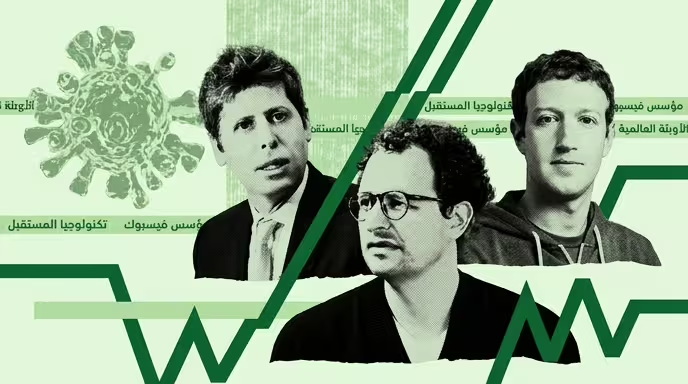
- The documentary: Roher’s film features sit-down interviews with OpenAI’s Sam Altman and Anthropic’s Dario Amodei. He said it drew a lukewarm reception on release in March. It reaches Netflix next week, giving the doomsday argument a mass audience it lacked.
- Congress stirring: The Journal published companion pieces reporting that Congress is suddenly waking up to the AI doomsday threat and that the biggest AI rivals agree they need to slow the technology down — two strands that until recently sat on the industry’s fringe.
- The street signal: Protesters carrying signs reading Regulate AI and Students Deserve a Bright Future gathered outside the G-20 Innovation Ministerial in Chapel Hill, N.C., earlier this month, according to a Bloomberg News image published with the newsletter.
- Apple’s week: At what the Journal called its most consequential product event in years, Apple debuted a $1,999 foldable iPhone, its most expensive ever, alongside a revamped iPhone 18 Pro at a higher price, new watches and updated AirPods. Price jumps were smaller than some feared.
- New boss: John Ternus took the stage for the first time as Apple’s new chief executive, presenting the foldable. Columnist Nicole Nguyen, who handled the hybrid phone and tablet, said she fears she may spend $1,999 on it.
Between the lines:
The week’s shift is one of audience, not evidence. The underlying claims — loss of control, an above-10% extinction estimate — come from individual researchers speaking for themselves, while the labs they name say they take safety seriously. What changed is who is now being asked to respond: lawmakers, clergy, and a Netflix audience that ignored the same argument in March.
What’s next
Roher’s documentary lands on Netflix next week, the first mass-audience test of the argument. Watch whether Anthropic or OpenAI responds formally to the researchers’ claims, and whether congressional interest converts into hearings or draft legislation.