The latest:
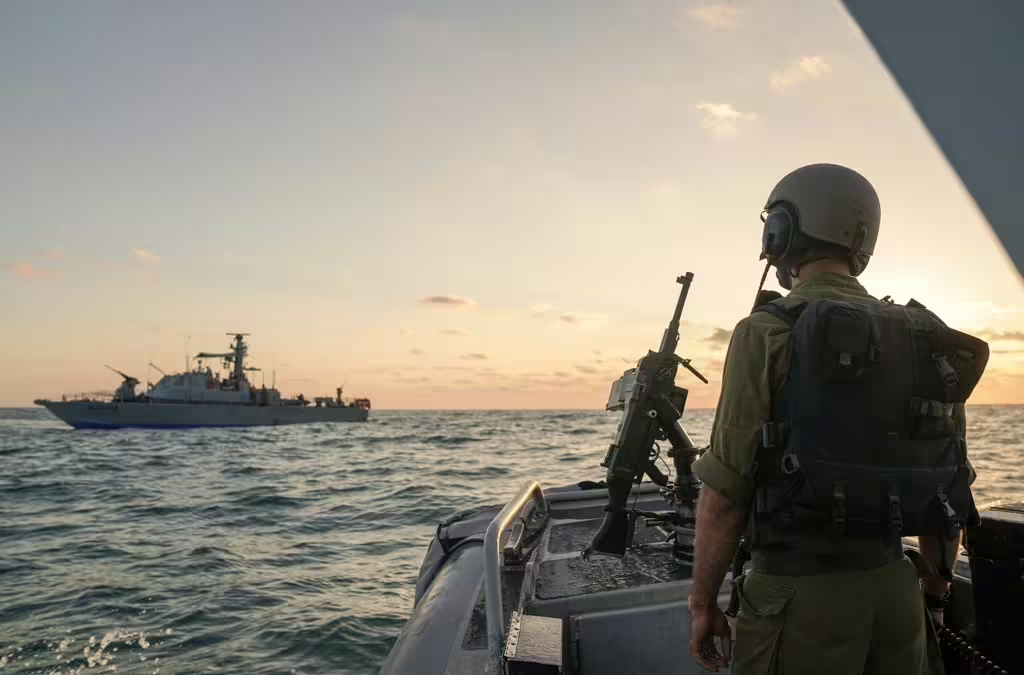
Israel’s military is on high alert for any new Turkish movement by sea, land or air, including near Greece, Cyprus, Syria and Gaza, The Jerusalem Post reported. The navy’s message, according to the paper, is that if Ankara assumes redeployments carry no consequences, Israel will show they come at a price. Israeli commanders acknowledge Turkey’s fleet is large and cannot be ignored.
Details:
- The Syria trigger: The Jerusalem Post reported that Israel views the sharpest Turkish threat as coming from Syria, where the military recently struck a Syrian airbase to stop Ankara installing a new radar and other assets that could constrain Israeli freedom of operation.
- The strike’s design: Israel’s Channel 12 reported the operations were deliberately limited, avoided casualties and hit only runways, framed as a warning against Turkish deployment of advanced drones, air defense systems and precision missiles at the airbase.
- The decision chain: According to Channel 12, the attack was ordered only after diplomacy was exhausted, including American-mediated talks and direct messages to Ankara. The army recommended striking runways rather than the weapons shipments themselves, to send a signal without immediate escalation.
- The American intervention: US envoy Tom Barrack said the intelligence Israel relied on for the Abu al-Duhur strikes was not accurate, accused Israel of trying to drag Turkey into confrontation and hinted at a link to Israeli elections, before contacting Ankara and Tel Aviv to set new deconfliction mechanisms.
- The military’s worry: Israeli military sources said blunt remarks by Prime Minister Benjamin Netanyahu and Defense Minister Israel Katz could prove costly, narrowing Israeli operating room in Syria and allowing Turkish crews to resume strengthening the Syrian army.
- The rhetoric: Katz said President Recep Tayyip Erdogan is dragging Turkey into a dangerous Syrian adventure and dismissed his speeches as delusional; Netanyahu called him a reckless antisemite. Sources said the language moved the dispute from disagreement into hostility.
- The Haaretz challenge: An editorial in Haaretz questioned Israeli claims about Turkish activity, arguing Ankara is shrinking its footprint in northern Syria with many bases now empty, and asked whether bombing can push out a NATO member that keeps an embassy in Tel Aviv.
- The analysts: Michael Milshtein of Tel Aviv University’s Dayan Center wrote in Yedioth Ahronoth that Erdogan’s government is hostile, but force should be the last tool, weighed against energy, trade and aviation links running through Turkey while other fronts stay active.
- The political reading: Haaretz military editor Amos Harel argued the government is feeding fires on multiple fronts to sustain a permanent security agenda. Former deputy foreign minister Danny Ayalon said opening an eighth front with Turkey is unwise and urged political solutions with Damascus.
- The Egypt question: Israeli defense sources see room to coordinate with Cairo against Ankara’s maritime ambitions, while pessimists note Egypt’s defense minister Ashraf Salem Zaher visited Ankara on July 13, and joint Turkish-Egyptian air and special forces drills showed deep operational alignment.
- The Greek track: Greek navy chief Vice Admiral Dimitrios Eleftherios Kataras visited Israel in late June and met navy commander Vice Admiral Eyal Harel and the Shayetet 13 special forces unit, deepening joint mechanisms between the two navies.
- Also: Turkish encroachment in the Mediterranean is pushing Israel toward Greece, Cyprus and possibly Egypt.
Background:
Israel has opposed, successfully so far, any Turkish role in the international stabilization force for Gaza. Israeli assessments hold that Ankara’s commitment in Syria runs deeper and carries religious meaning, while its Gaza posture is tied more broadly to regional influence.
Between the lines:
Two readings compete. Israeli naval sources argue Cairo’s own unease over Ankara’s maritime reach, including in Libya, naturally overlaps with Israeli interests alongside Greece and Cyprus. Pessimists read the Zaher visit and the joint drills as a structural shift, with Egypt drifting toward Turkey. The navy is preparing for both, studying defenses against naval drone swarms.
What’s next
Watch whether the American-brokered deconfliction mechanisms hold, whether Turkish crews resume equipping Syrian air defenses, and whether Egyptian-Turkish exercises expand or Cairo joins further naval coordination with Israel, Greece and Cyprus.