Key Points
- Leaders of China, Russia, India and Iran gathered in Bishkek for the two-day Shanghai Cooperation Organization summit.
- Chinese trade has sustained Moscow and Tehran while blunting U.S.-led efforts to isolate both wartime economies.
- The meeting highlights Washington’s pressure limits before Xi Jinping seeks to extend an economic truce with President Trump.
The latest
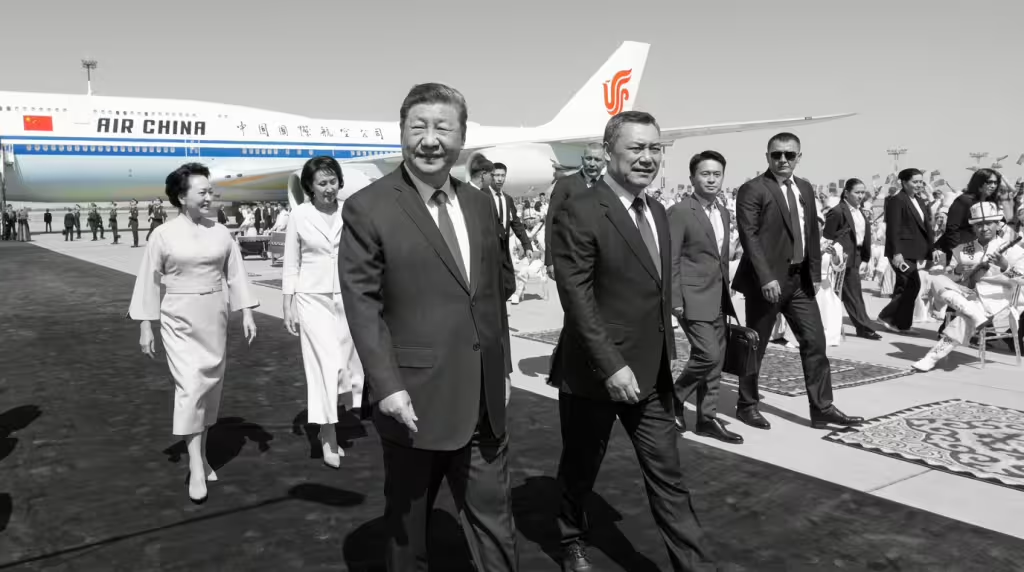
The 10-nation Shanghai Cooperation Organization opened its two-day summit in Kyrgyzstan on Monday, bringing Xi Jinping together with leaders including Russia’s Vladimir Putin and Iran’s Masoud Pezeshkian. The gathering displayed China’s ability to support countries targeted by Washington while Xi promotes himself as a leader of non-Western nations and challenges what he calls U.S. hegemony, without committing Chinese forces to their wars.
Details
- Economic lifelines: China has helped sustain the Russian and Iranian economies and war efforts, using its position as the world’s largest crude importer and consumer-goods exporter. Its trade has weakened attempts by the United States and its allies to pressure Moscow and Tehran through sanctions and economic isolation.
- Washington’s threats: Trump threatened an “economic D-Day” against countries providing Tehran with a lifeline, after previously warning buyers of Russian oil, but took no action against Beijing. Julian Gewirtz, a former National Security Council official, said Trump now faced a “fundamental credibility problem” with Xi.
- Russian ties: Xi met Putin for bilateral talks and praised the prospects for their relationship. Putin proposed making visa-free travel permanent and highlighted the first scheduled Chinese container voyage through the Northern Sea Route in mid-August as a precursor to broader Arctic cooperation.
- Support boundaries: Beijing has increased trade and supplied technologies that can be used on battlefields, but has not deployed troops to defend Russia or Iran, which joined the organization in 2023. China has instead formally called for dialogue and an end to the conflicts.
- Sanctions routes: Central Asian countries have become important import and payment channels for Russia, while Iran has used the region as an alternative route during the U.S. blockade. India, Kazakhstan and Belarus recently shipped gasoline to Russia after Ukrainian long-range attacks severely damaged Russian refineries.
- Oil advantage: India became a major buyer of Russian crude after the 2022 invasion of Ukraine. Although purchases later fell under U.S. pressure, disruption from the Iran war pushed suppliers back toward Russian imports. China remains the largest buyer of Russian and Iranian crude and has accumulated discounted Russian oil.
Background
The organization began with China, Russia and four Central Asian states before adding India and Pakistan in 2017, followed by Iran and Belarus. Its expansion has made it a growing counterweight to Western-led political and security groupings. China’s influence has also increased in Kyrgyzstan, once firmly within Moscow’s sphere.
What’s next
Attention will focus on whether Xi holds separate talks with Pezeshkian during the Bishkek summit. Xi is then scheduled to make state visits to Egypt and India before traveling to Washington in less than a month, where he will seek to extend the fragile U.S.-China economic truce and Trump is expected to pursue cooperation on Iran and North Korea.