The latest:
Ten defendants tied to January’s protests in Isfahan were sentenced to death, with six others jailed for up to 25 years, according to the Iranian Human Rights Association. The Abdorrahman Boroumand Center puts Iran’s executions since the start of 2026 at no fewer than 916, and says the true figure is likely far higher because authorities withhold case information.
Details:
- The rulings: Judges Morteza Barati and Mohammad Reza Tavakoli of Branch 1 of Isfahan’s Revolutionary Court issued the sentences, according to the Iranian Human Rights Association. HRANA reported that in the Isfahan Martyrs’ Square case, 10 activists received death sentences while 16 detainees drew prison terms adding up to 256 years.
- The charges: Defendants were tried on counts including waging war against God, carrying bladed weapons, destroying public property, assembly and collusion, and propaganda against the state, according to Hengaw. HRANA reported the indictment contained no direct murder charges, and that the core accusation was limited to assembly and conspiracy against the system.
- The defense: Lawyers said they were denied access to much of the case file and were given insufficient time to review documents and evidence, according to HRANA. They maintained the verdicts rested on confessions extracted under coercion and torture. Hengaw said no documented evidence links the 16 to either of the two deaths.
- Torture allegations: Defendant Saeedi testified in court that interrogators tortured him over his alleged role in the deaths, saying he was subjected to electric shocks to his neck and genitals, according to Hengaw and Iranian diaspora channels. One female defendant alleged sexual assault; the court issued its ruling without investigating the claim.
- The women: Taraneh Rahimi, 20, was sentenced to death alongside nine men, and her sister Romina received a prison term, according to Hengaw and HRANA. In a separate Isfahan case, Leila Abolhasani, 43, was convicted of corruption on earth and enmity against God over a shop fire; relatives deny the charge, saying she was only filming.
- The toll: Iran Human Rights, based in Norway, reported 511 executions since the start of 2026, at least 29 of them tied to the January protests, and warned hundreds more face execution, including over 70 in Isfahan. The Boroumand Center’s separate count reaches 916, including 15 in August.
- The UN figure: High Commissioner Volker Turk said at least 56 people have been executed on national security charges since 19 March, including 27 in protest-related cases, and that more than 100 others face similar capital charges. He called on Tehran to halt all executions and move toward abolition.
- Executions carried out: Arvin Kheirkhah, 20, was executed at Shahroud prison on 1 August over the January protests, according to Iran International; his family gathered outside the prison beforehand. Amir Hossein Saffari and Abolfazl Sepahi were hanged in Isfahan’s Alikhani Square in late July, after Golmohammad Mohammadi and Erfan Esfandiari were executed on 19 July.
- UN experts: A group of UN human rights experts urged Tehran in July to halt executions in the Isfahan case, citing closed proceedings, alleged mistreatment and confessions broadcast on state television. They said sentencing 12 people to death in a single closed session, without clarity on individual responsibility, breaches fair trial standards.
- Widening net: Hana Human Rights Organization reported at least 77 Kurdish citizens detained across Iran’s Kurdish regions, most without summonses or judicial warrants, including 11 women and a 16-year-old. Actress Katayoun Riahi said a fresh case was referred against her to Tehran’s culture and media prosecutor’s office.
Background:
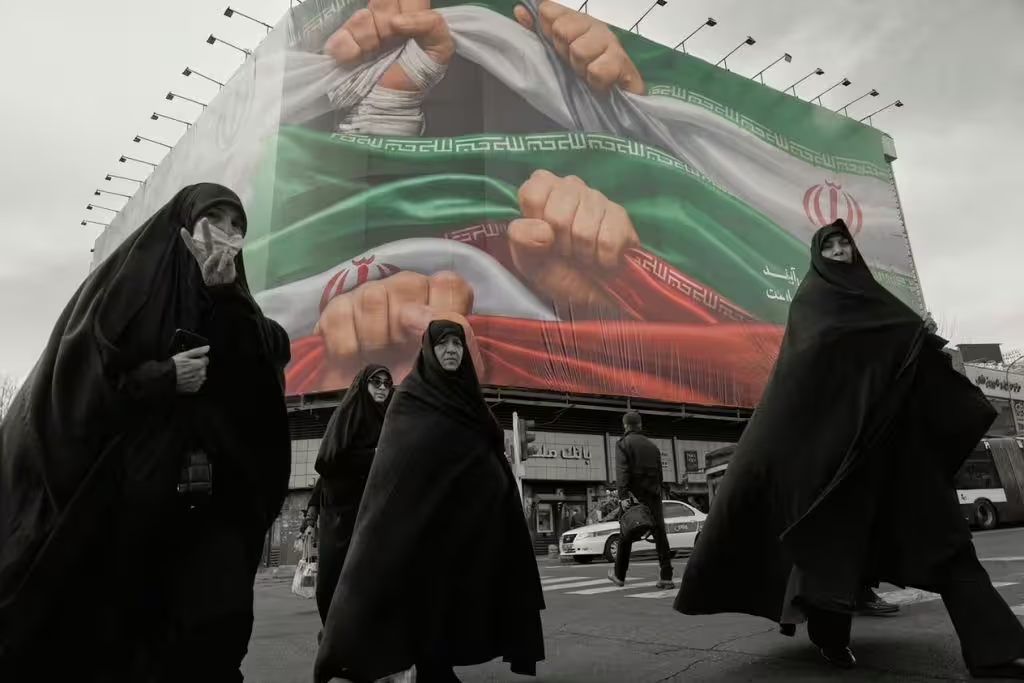
Protests began in December over deteriorating economic conditions and escalated in January into a broader movement calling for regime change, peaking on the nights of 8 and 9 January. Isfahan became the focal point of the nationwide unrest.
Between the lines:
The Boroumand Center assesses that Tehran is using death sentences and executions to intimidate the public and deter further protest. The pattern the monitors describe points the same way: closed sessions, coerced confessions, indictments without murder charges, and a 26-defendant case built around assembly and conspiracy. Reopening files against previously known dissidents, and criminalizing contact with foreign media, suggests deterrence rather than prosecution is the objective.
What’s next
Leila Abolhasani’s case is before the Supreme Court for review. Lawyers for Ali Asghar Peyghambari, whose death sentence was upheld, are preparing a retrial request and a stay of execution after his transfer to Ghezel Hesar prison.