The latest:
A €3.1 billion program to build Greece’s integrated, multi-layered air and missile defense system is due to be signed Monday in Tel Aviv, launching an execution phase expected to run about 35 months. Known as Achilles Shield, the project ranks among the largest security ventures developed jointly by the two countries, and was approved by Greece’s Government Council for National Security, KYSEA.
Details:
- The signatories: According to Protothema, the agreements will be signed between the General Directorate for Defense Investments and Armaments of Greece’s defense ministry and the Israeli defense ministry’s international defense cooperation directorate, SIBT, alongside Israeli defense bodies and the private defense firms taking part in the program.
- The architecture: Greece’s stated goal is a multi-layered network combining systems it already fields with advanced Israeli platforms: Spyder, Barak MX and David’s Sling, together with Patriot batteries and additional capabilities. Sensors, command-and-control and interceptors are to communicate with one another so the most suitable defensive means is selected each time.
- The AI core: The heart of the new system is a command-and-control layer that includes artificial intelligence capabilities. It is designed to pull data from radars, sensors and detection means, classify incoming threats and support the decision on how each one is engaged, rather than leaving that judgment entirely to operators under time pressure.
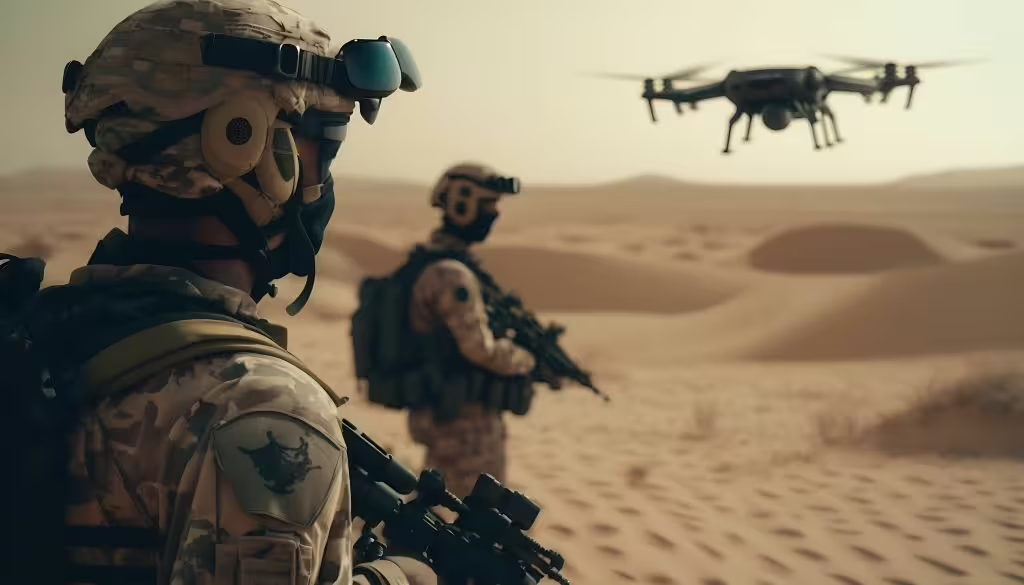
- The drone problem: The central challenge is not ballistic missiles alone but skies crowded with drones and unmanned aerial vehicles. Where an adversary can launch large numbers of them at low cost, firing an expensive interceptor at every drone is not an economically viable option, and the system is built to match threat type to response.
- The source code: One of the most contested issues in the negotiations was access to the source code of the software running the air-defense system. Such access would give Greece greater autonomy over maintenance, modifications and future upgrades, an element that has become standard in advanced security agreements in recent years.
- The industrial share: Around 12 Greek companies are expected to take part, with activity exceeding €700 million and Greek industry participation at roughly 25% of the program. For Athens, the aim is that the outlay produces knowledge transfer and local capability, not only the acquisition of weapons systems.
- The timeline: Defense Minister Nikos Dendias said on the sidelines of a briefing on ministry armament programs that Achilles Shield would be operationally ready within 35 months, adding that the timeframe refers to completion of the program, which will be implemented in stages.
- The price tag: Dendias put the total for the air-defense systems at just over €3 billion. The figure cited for the program elsewhere is about €3.1 billion, covering the integration of the Israeli and existing Greek layers into a single defensive network.
- The approval: Achilles Shield was cleared by KYSEA, Greece’s Government Council for National Security, on Thursday, 23 July 2026, ahead of Monday’s signature in Tel Aviv. The execution phase begins after the agreement is signed.
Background:
Israel and Greece have deepened defense ties over the past decade, and Athens now counts among Israel’s closest regional security partners. Achilles Shield is presented as the next stage in that cooperation rather than a first step.
Between the lines:
The economics matter more than the hardware list. A network that matches a cheap threat to a cheap response, chosen by an AI-assisted command layer, is an answer to cost-exchange, not just to range and altitude. Athens’ insistence on source-code access points the same way: the value being bought is the software and the autonomy to modify it, not only the interceptors it fires.
What’s next
Monday’s signing in Tel Aviv, the identity of the Israeli defense firms named in the contracts, and whether the source-code question is settled in the final text. The 35-month clock starts once execution begins.