Key Points
- Iranian forces have assessed possible strikes on US assets in south-eastern Europe, two regime insiders told the Financial Times.
- Potential options include sites in Bulgaria and Cyprus, plus subsea communications cables in the Strait of Hormuz.
- Any expansion into Europe would widen the conflict despite questions over Iran’s long-range accuracy and capacity.
The latest
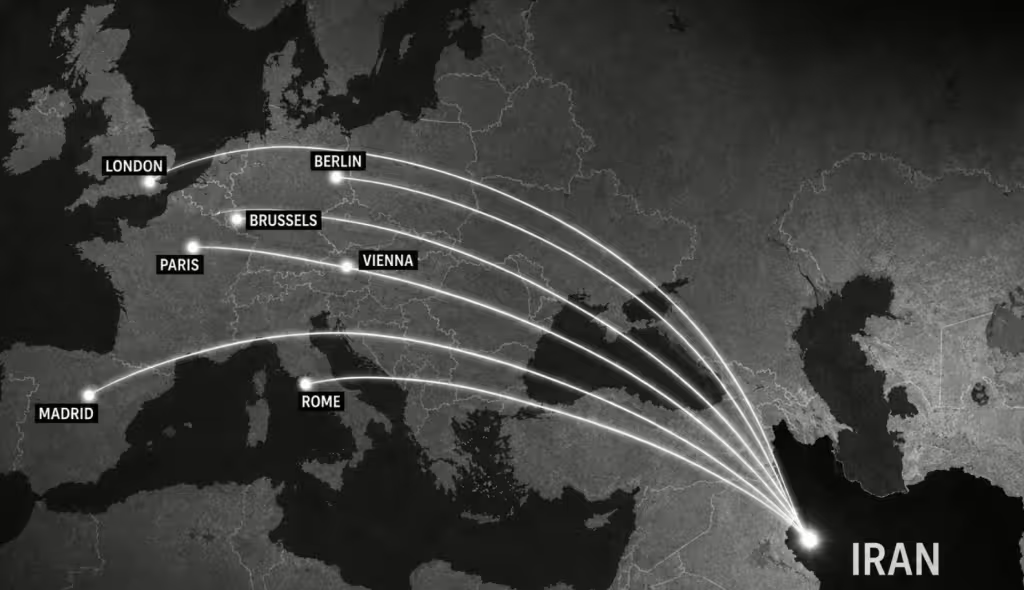
Iran has assessed striking US military assets in south-eastern Europe if President Donald Trump escalates the war, two people close to the regime told the Financial Times. The reported planning covered Bulgaria and Cyprus, as well as possible attacks on subsea fibre-optic cables in the Strait of Hormuz. Both insiders said retaliation would depend on Washington’s actions, and the newspaper presented no evidence that Tehran had authorised an operation.
Details
- Potential targets: Bulgaria approved the use of Bezmer air base for US refuelling aircraft last month, according to the report. One insider also named Cyprus, where Britain’s Akrotiri base was struck by a drone in March. Western officials suspected an Iranian drone launched by regional proxies rather than directly by Tehran.
- Missile constraints: Sidharth Kaushal of the Royal United Services Institute described the missile threat as “real, but limited”. He said Shahab medium-range missiles could reach US assets in southern and south-eastern Europe, but their payload and ability to cause damage would decline at longer ranges. Douglas Barrie of the International Institute for Strategic Studies said the Diego Garcia attempts indicated ranges beyond 2,000km, while questioning Iran’s stockpile and willingness to risk interception or failure.
- Escalation threshold: The insiders tied any broader response to renewed US attacks, particularly against Iranian infrastructure. One said Tehran was preparing to expand the conflict if Trump acted on threats to strike bridges or power plants. The other said Iran would place “no limits” on its response to US aggression.
- Previous attempts: Washington accused Tehran of firing missiles at Diego Garcia after the US and Israel launched the war in February, although none reached the joint US-UK base. Turkey said Nato defences intercepted Iranian ballistic missiles in March. The insiders also cited a strike in Jordan that killed three US service members as evidence of improved long-range precision.
- Diplomatic breakdown: A June US-Iran memorandum collapsed last month after attacks on vessels in the strait and mutual accusations of violations, the report said. Trump said Tuesday that no talks were taking place or scheduled. Supreme Leader Ayatollah Mojtaba Khamenei has meanwhile elevated hardliners, including former Guards commander Mohsen Rezaei, to senior security positions.
Between the lines
The assessments show potential targets, not a final attack decision. Experts also distinguish between possessing missiles capable of reaching Europe and having enough accurate weapons to inflict significant damage. Kaushal said operating through regional proxy groups could be more effective for Tehran.
What’s next
The next concrete indicators are whether Washington carries out Trump’s threatened strikes on Iranian infrastructure and whether diplomatic efforts secure the reopening of the Strait of Hormuz and resumed negotiations on a broader settlement.