The latest:
Israel has publicly claimed the overnight air raid on Abu al-Duhur base in eastern Idlib countryside, saying Damascus was close to breaching a security status quo by permitting a Turkish deployment near Aleppo. Prime Minister Benjamin Netanyahu’s office said Syria ignored repeated warnings. Ankara rejected the account outright, and Washington’s envoy warned the strike risks pushing Turkey deeper into Syria.
Details:
- The Israeli statement: Netanyahu’s office, in an English-language statement, said Israel and Syria had agreed to preserve the status quo on security matters and that Syria chose to ignore repeated warnings that a Turkish deployment would threaten Israeli security. It added Israel would welcome a return to that status quo.
- Ankara’s denial: The Turkish presidency dismissed what it called baseless claims by Netanyahu’s office, saying they were meant to legitimize illegal Israeli air raids violating Syria’s sovereignty and territorial integrity, according to the state-run Anadolu agency. A Turkish official told Axios there was no Turkish presence at the base.
- The US warning: Tom Barrack, Washington’s envoy to Syria and ambassador to Turkey, told Reuters that Ankara was not notified in advance, tracked the aircraft heading north toward its territory, and could reasonably have prepared its own response. He said cooler heads prevented further deterioration.
- The mechanism: Barrack said the United States is already facilitating an information-sharing and dialogue channel among Israel, Syria and Turkey, and is working on a deconfliction mechanism. He argued investment in such structures costs far less than reliance on military means, which he priced at hundreds of millions of dollars.
- The damage: Syria’s official Ikhbariya channel, citing a military source, reported eight Israeli strikes on a runway and warehouses. Sabreen news agency said four aircraft targeted runways and depots. A Syrian military source and a nearby resident told Reuters there were no casualties.
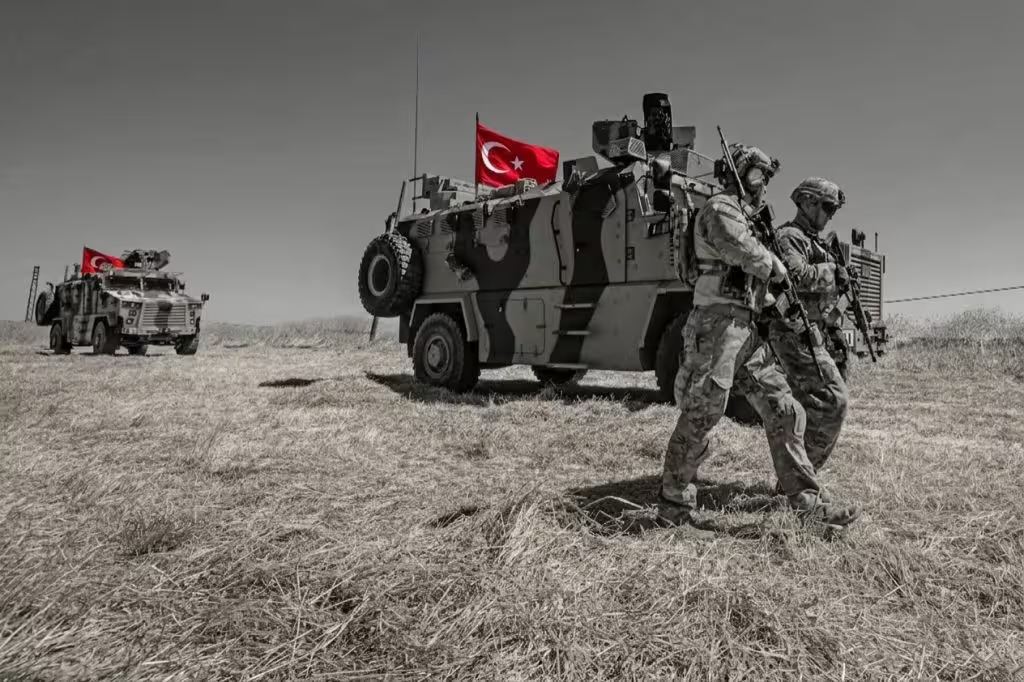
- The Turkish visit: Sources told Qatar’s Al-Araby Al-Jadeed that the strikes followed a visit by a Turkish military delegation to rehabilitate the runway. Hezbollah’s news network said all four runways were damaged and described this as the third such strike on sites Turkey sought to refurbish.
- The site: Abu al-Duhur sits roughly 70 kilometers east of the Turkish border and about 27 kilometers east of Saraqib, between Idlib, Hama and Aleppo provinces. Estimates of its area diverge, from about 16 square kilometers to roughly 23. It has been out of service as a dedicated military airport since 2013.
- The intelligence trail: Israel’s Kan public broadcaster cited an Israeli security source saying intelligence on Turkey’s deployment plans was shared with Washington, and that strikes followed only after dialogue with Damascus failed. Fox News reported Israel passed the Americans intelligence on Syrian reconstruction, air defenses and modern drones.
- Turkey’s position: Ankara is training the Syrian army and helping rebuild state institutions and infrastructure, becoming a principal ally of President Ahmad al-Sharaa. Turkey fields NATO’s second-largest military and signed a joint defense agreement this month with Pakistan and Saudi Arabia.
Background:
Israel has bombed targets in Syria for years to curb what it calls Iranian influence and block weapons transfers to Hezbollah. Since Bashar al-Assad’s fall in 2024, it has viewed Syria’s new rulers with suspicion, most recently striking government sites in the south and center in March.
Between the lines:
Barrack framed the raid as driven by a perception, accurate or not, that Turkey would expand its footprint at the base. Read against the reported Turkish delegation visit and the shared intelligence on air defenses and drones, the target set points to a contest over Syrian airspace rather than a border dispute. Israeli commentator Ron Ben-Yishai assessed the strike echoed Israel’s April 2025 hit on the same site.
What’s next
Watch whether Washington’s deconfliction mechanism produces a formal channel among the three governments, whether Israeli-Syrian de-escalation talks resume after several inconclusive rounds, and whether Turkey resumes rehabilitation work at Abu al-Duhur.