Key Points
- Taiwan is building aerial and maritime drone fleets to complicate a potential Chinese amphibious assault.
- The “hellscape” concept combines unmanned systems, mobile missiles and artillery, drawing heavily on lessons from Ukraine.
- Its credibility depends on training, doctrine, resilient communications and domestic production, not procurement alone.
The latest
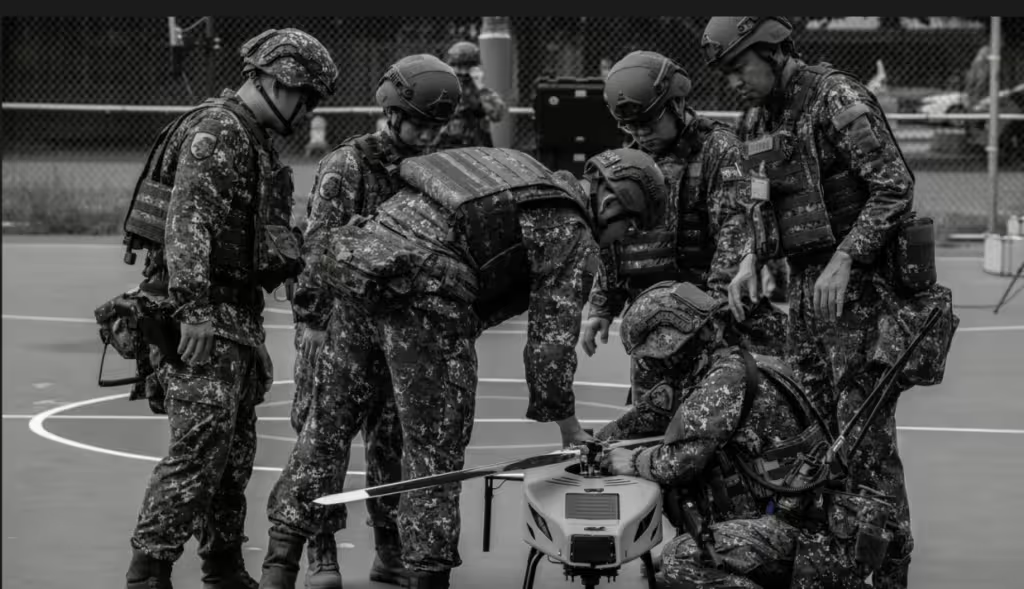
Taiwan is accelerating plans to deploy flying drones and uncrewed attack boats against Chinese forces approaching the island, while training troops to relocate before retaliatory strikes. During the annual 10-day Han Kuang exercises, the military demonstrated drone reconnaissance and said units would also practice counter-drone operations. The approach, called a “hellscape” by U.S. commanders who developed it, seeks to overwhelm an amphibious force with drones, missiles and artillery, making an attack too costly and uncertain for Beijing to attempt.
Details
- Late acceleration: Lieutenant General Huang Wen-chi, the Defense Ministry’s strategic planning chief, told lawmakers that Taiwan started late on drones and counter-drone systems but accelerated over the past two years. The military has also formed a Littoral Combat Command to combine drones, mobile missiles and artillery in coastal defense.
- Industrial targets: The government wants domestic factories to produce 100,000 drones monthly by 2030, with about half exported, and plans for the military to acquire more than 210,000 aerial and maritime systems. Experts say blockade resilience also requires stockpiles of cheap, short-range one-way attack drones.
- Battlefield demands: Experts say Taiwan must operate swarms, process reconnaissance rapidly and distribute targeting data while protecting systems from detection and jamming. Units would need to move quickly and operate independently. Stacie Pettyjohn of the Center for a New American Security warned against prioritizing technology over organizational and doctrinal change.
- Competing systems: Retired Australian Major General Mick Ryan said Ukraine’s longer-range strikes suggest Taiwan might target ships leaving Chinese ports during an assault. He cautioned that China is also expanding uncrewed fleets and investing in detection and jamming technology.
- Spending dispute: The government proposed $6.5 billion over five years for drone purchases, but two opposition parties controlling the legislature rejected it, citing waste and corruption risks. The opposition Nationalist Party proposed $7.4 billion over six years, tied to progressively higher domestic-production requirements.
- Export surge: Taiwan exported $115 million in drones during the first three months of 2026, surpassing its total for 2025, according to the Ministry of Economic Affairs. The Czech Republic was the leading destination, although research cited by The New York Times said many drones later reached Ukraine.
Between the lines
Taiwan faces a different constraint from Ukraine: it must overhaul its forces without the pressure of an active invasion. Shu Hsiao-Huang, at the Defense Ministry-supported Institute for National Defense and Security Research, said troops that fire without immediately moving may not get a second chance. Taiwan’s polarized parties agree on expanding drones but differ over spending controls and local-content rules.
What’s next
The remaining Han Kuang drills will test counter-drone skills and integration with coastal firepower before the 10-day exercise ends. Lawmakers must separately decide between the government’s five-year procurement proposal and the Nationalist Party’s six-year alternative.