Key Points
- Louvre Abu Dhabi's holdings grew from about 600 works at opening to more than 6,000 today.
- Owned pieces overtook loans in 2021 and reached 56.8% of gallery displays in 2025.
- The museum is shifting from borrower to lender as it builds toward curatorial autonomy.
The latest:
Louvre Abu Dhabi’s permanent collection has expanded from roughly 600 works when it opened in 2017 to more than 6,000, according to a new book documenting a decade of acquisitions. Guilhem Andre, the museum’s director of scientific, curatorial and collections management, told The National the institution began as a borrower and is now increasingly a lender, with outgoing loans more than tripling since 2021.
Details:
- The book: Birth of a Collection, edited by Andre, gathers contributions from 42 scholars, curators and historians examining 240 objects, from ancient artefacts to contemporary art. It is available online and in select bookstores in English, Arabic and French, and follows Birth of a Museum, published in 2013 to introduce the founding collection.
- The gallery shift: Andre said about 30% of works in the permanent galleries came from the museum’s own collection when it opened in 2017. Owned works outnumbered borrowed ones for the first time in 2021, and their share reached 56.8% in 2025. The remainder is still drawn from international institutions and collectors.
- Lending record: Since opening, the museum has lent 42 works to exhibitions in the UAE, the Gulf and abroad, including the Metropolitan Museum of Art in New York, the Musee d’Orsay in Paris and the Galleria Borghese in Rome. Andre said lending began even before the building opened in 2017.
- The Mamluk carpet: A wool carpet with three medallions, made in Cairo between 1450 and 1500, returned to Europe last year for a major Louvre exhibition in Paris on the Mamluk dynasty. Such carpets were commissioned by popes and exchanged as diplomatic gifts across the Mediterranean.
- The Kotte casket: Among acquisitions documented in the book is an ivory casket made around 1543 in the Kingdom of Kotte, in present-day Sri Lanka. Decorated with gold, rubies and sapphires, it belongs to a small group of objects sent by Kotte’s rulers to the Portuguese royal court. The museum acquired it in 2024.
- Filling the gaps: Andre said acquisitions of Asian, African and Oceanian art have addressed areas underrepresented in earlier holdings. He described collecting as an unending process in which each step forward exposes further gaps, adding that the museum concentrates on masterpieces rather than volume.
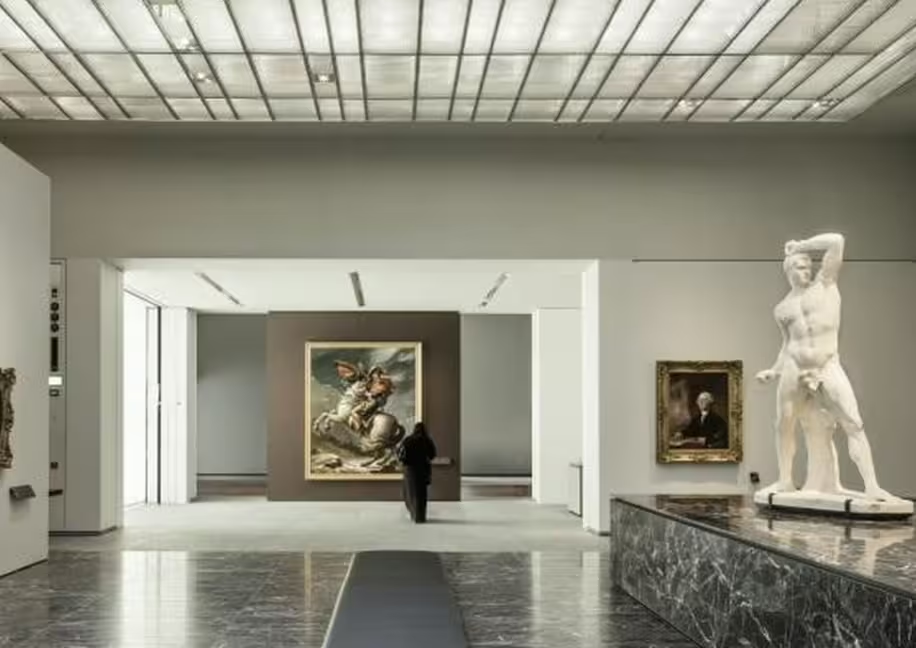
- The curatorial mandate: Andre said the brief is not to display endless lists of artworks but to feature cross-cultural relationships spanning more than 10,000 years. Pieces from different civilisations are placed in dialogue so the connections between them, rather than the objects alone, carry the narrative.
- The ambition: Andre said the museum must dream of one day presenting its permanent galleries entirely through its own collection, achieving full autonomy, while lending more of its masterpieces internationally. He gave no timeline for reaching that point.
- Andre’s background: He joined the project in 2012, helped build the collection and its Asian art programme, and now oversees scientific, curatorial and collections management. The more than 6,000 works include pieces held in storage or conservation rather than on display.
Background:
Louvre Abu Dhabi opened in November 2017 under an agreement with France, presenting itself as the first universal museum in the Arab world. Many works in its early galleries were loans from French institutions and private collectors, making the balance between owned and borrowed pieces a measure of the project’s maturity.
Between the lines:
The two numbers Andre cited point the same way: owned works rose to 56.8% of gallery displays in 2025 while outgoing loans tripled since 2021. An institution that lends 42 works to the Met, the Musee d’Orsay and the Galleria Borghese is being treated as a peer rather than a recipient. Andre framed full gallery autonomy as a goal still ahead, not an achievement.
What’s next
Watch whether the owned-works share passes 60% in the museum’s next annual gallery count, further acquisitions in Asian, African and Oceanian art, and new international loan requests following the Paris Mamluk exhibition.