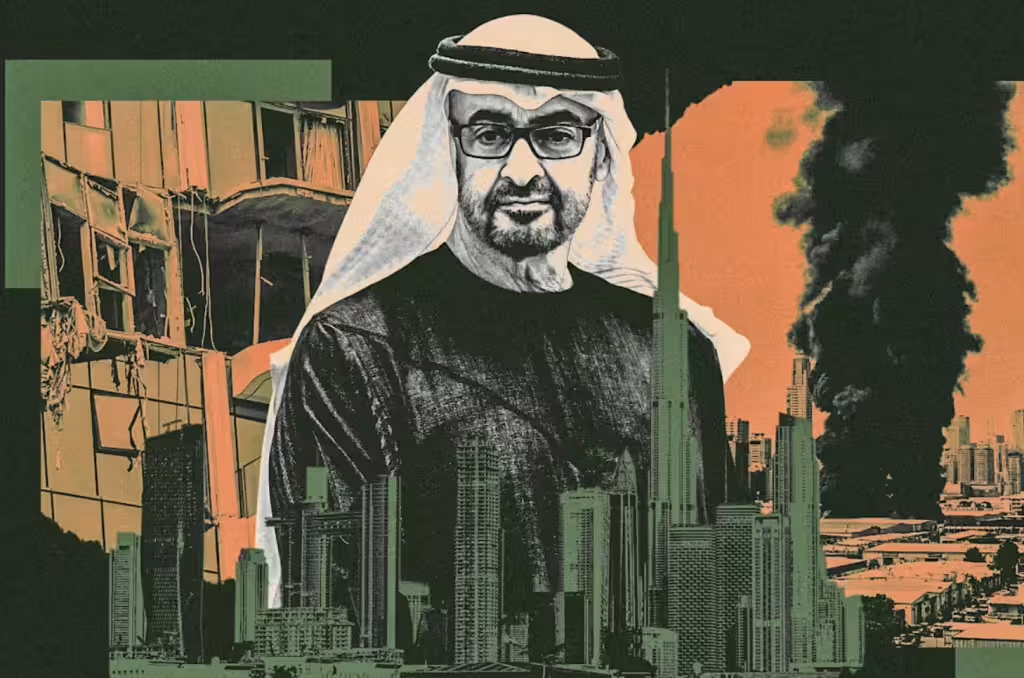
The UAE has chosen to manage the Iranian threat through two parallel tracks: a cautious détente intended to restore trade and political communication, and a quieter expansion of its defensive capabilities with the US and Israel. The objective is less about reconciliation with Tehran than preventing another confrontation from threatening the country’s position as a regional center for finance, trade and tourism.
Five months after the threat of Iranian drones emptied Dubai’s financial district, offices have filled again, traditional vessels have resumed carrying goods to Iran and the first Iranian flights have returned. Authorities have also begun allowing some of the roughly 20,000 UAE-resident Iranians who were abroad when the war began to re-enter the country.
The reopening is taking place as the UAE deepens defense cooperation with Washington and Israel, considers moving oil pipelines and data centers into protected underground facilities, and accelerates export routes designed to reduce its dependence on Hormuz.
From confrontation to détente
- Wartime shock: The UAE faced almost 3,000 Iranian missile and drone attacks during the opening months of the war, according to the Financial Times, and responded with dozens of strikes, adopting the most hawkish position toward Tehran among Gulf states.
- Calculated shift: After the fragile US-Iran truce in April, Abu Dhabi gradually moved from direct confrontation toward de-escalation, reflecting a recognition that the war would neither remove Iran’s government nor eliminate the Revolutionary Guards.
- Geographic reality: The crisis demonstrated that the UAE, despite its financial and military influence, cannot change its proximity to Iran or fully insulate its economy from disruption in Hormuz.
- Trade resumes: A memorandum signed by Donald Trump and Tehran to extend the ceasefire and reopen the strait accelerated the partial restoration of trade and Iranian flights.
- Fragile truce: Iran targeted two UAE tankers after announcing that it was closing the strait again, but did not strike Emirati territory during the latest escalation, even as it attacked other countries in the region.
Managing the Iran channel
- Senior leadership: UAE President Sheikh Mohamed bin Zayed delegated the de-escalation effort to Sheikh Mansour bin Zayed, Sheikh Abdullah bin Zayed and Sheikh Tahnoon bin Zayed, according to people familiar with the situation.
- Initial contact: The first sign of rapprochement was a call between Sheikh Mansour and Mohammad Bagher Ghalibaf, a senior Iranian wartime official and Tehran’s lead negotiator with Washington.
- Diplomatic channel: Sheikh Abdullah later held his first call since the war began with Iranian Foreign Minister Abbas Araghchi.
- Iranian initiative: Emirati academic Abdulkhaleq Abdulla said Tehran initiated the dialogue and that rejecting an adversary’s request for talks would not have served the UAE’s interests.
- Cold peace: The policy is not based on trust. It combines deterrence, diplomacy and economic leverage to give Iran a material stake in stability.
Economic pragmatism
- Dubai’s Iran connection: Dubai is home to several hundred thousand Iranians and has long served as a major trading and re-export hub for the country.
- Mutual dependence: Emirati leaders hope Iran’s reliance on UAE ports and markets will give Tehran an economic incentive to maintain a functional relationship.
- Cost of separation: Some Iranian imports can be replaced, but not easily or cheaply, particularly everyday food products whose substitution could raise prices.
- Conditional opportunity: Emirati figures cited by the newspaper expressed interest in future investments in Iranian energy, ports and logistics if the war ends permanently and US and international sanctions are lifted.
- Transfer denial: The UAE has denied making financial transfers to Iran, while the economic reopening remains limited by political developments and sanctions.
Deeper defense partnerships
- Israel: The conflict demonstrated the strategic value of the UAE’s ties with Israel under the Abraham Accords after Israel sent Iron Dome and its advanced Iron Beam laser system to assist the country.
- Expanding presence: Israel’s embassy in Abu Dhabi has doubled in size, while cooperation is expected to expand across defense, technology, AI, dry ports and storage facilities.
- Defense companies: An Israeli official said the operations of Israeli defense companies permanently based in the UAE had become larger and more comprehensive since the war.
- Persistent tensions: Security cooperation has not eliminated strains with Benjamin Netanyahu’s government. Some Emiratis privately blame the Israeli prime minister for drawing the region into the conflict and creating political difficulties for Abu Dhabi.
- Layered protection: UAE defenses intercepted most Iranian missiles and drones with support from US, Israeli, South Korean and Ukrainian systems, as well as British and French fighter jets.
- Washington’s role: Abu Dhabi concluded from the conflict that the US had become more essential to regional security, not less.
- Strategic gains: The Trump administration eased the UAE’s access to US military equipment and advanced chips, citing its role in advancing American interests during the war.
Redesigning critical infrastructure
- Resilience first: Resilience has become central to Emirati planning, including stronger physical protection and reduced dependence on any single supplier or route.
- Underground assets: Officials are discussing placing oil pipelines and data centers underground to protect both the country’s current source of wealth and the infrastructure supporting its AI ambitions.
- Beyond Hormuz: The UAE is searching for new transportation and export routes while expanding food-security and storage capacity.
- Fujairah terminals: DP World plans to build two terminals on the UAE’s east coast to reduce reliance on its flagship Jebel Ali port.
- Jebel Ali disruption: The port operated at about 10% of capacity because of Iran’s closure of Hormuz, exposing the vulnerability of the UAE’s main trade gateway.
- New oil pipeline: Adnoc is accelerating a pipeline project expected to double the UAE’s oil export capacity through Fujairah next year.
- Limits of protection: The threat cannot be eliminated entirely. Offshore energy facilities remain exposed, while assets in Fujairah are still within range of Iranian weapons.
Financial strength, economic damage
- Large buffers: Abu Dhabi’s sovereign investment funds hold almost $2 trillion in assets, giving the UAE exceptional capacity to finance recovery, defense and infrastructure.
- Deal flow: Bankers said transactions continued throughout the war, suggesting a deliberate effort to maintain confidence in the economy.
- Record output: Adnoc’s crude production reached a record 4.1 million barrels a day last month, according to the International Energy Agency, after the UAE left Opec in April.
- Securing supplies: With Hormuz effectively cutting Jebel Ali off from major trade flows, goods were flown in or transported overland to keep supermarket shelves stocked.
- Aviation and tourism: Most Western airlines have yet to resume Dubai flights, while hotel occupancy has fallen despite steep discounts.
- Hotel closures: More than six luxury hotels, including the Burj Al Arab and Armani Hotel, closed for refurbishment as several restaurants also suspended operations.
- Restaurant losses: Business at Tashas Group’s flagship restaurant in Dubai’s financial district fell by as much as 80%, forcing the company to request salary reductions of up to 30%.
- Shortages and costs: The group reduced its menus because of shortages of products including Scottish salmon and lamb cutlets, while operating costs increased.
- Early recovery: Business began rebounding in June. The group expects 2026 trade to finish broadly unchanged from the previous year, followed by a recovery next year.
Between the lines
The UAE is not choosing between Iran on one side and the US and Israel on the other. Its strategy assigns a different purpose to each relationship: trade and diplomacy to reduce the likelihood of an attack, military partnerships to raise its cost, and infrastructure investment to limit the damage if one occurs.
The war also exposed a vulnerability deeper than air defense. Abu Dhabi’s wealth gives the economy substantial capacity to absorb losses, but Dubai’s appeal depends on investors, tourists and residents believing it is safe and connected to the world. Interceptor systems alone cannot preserve that confidence.
What to Watch:
September will provide an important test. The reopening of schools will indicate how many expatriates have returned after the summer, while cooler temperatures will test Dubai’s ability to attract tourists again. Shipping through Hormuz, the return of Western airlines and the durability of the détente with Iran will determine whether the recovery can last.
Over the longer term, the UAE’s strategy will be judged by whether it can turn Fujairah into an effective trade and energy alternative, protect its data centers and oil infrastructure, and preserve its security partnerships with Washington and Israel without closing its channel to Tehran.