
The latest
A coalition that grew from more than 20 to about 50 technology companies has called on the US government to avoid imposing premature restrictions on open-weight artificial intelligence models.
Open-weight models allow users to download, modify and run them locally. That gives businesses and developers greater control than closed proprietary systems, although access to the model weights does not necessarily make the entire technology fully open source.
The signatories argue that low-cost open models could make AI practical for billions of everyday tasks across factories, hospitals, farms, classrooms and small businesses. They also acknowledge that downloaded models can be modified in ways their original developers cannot control.
Details
- Leading signatories: Nvidia and Microsoft were among the most prominent companies backing the letter.
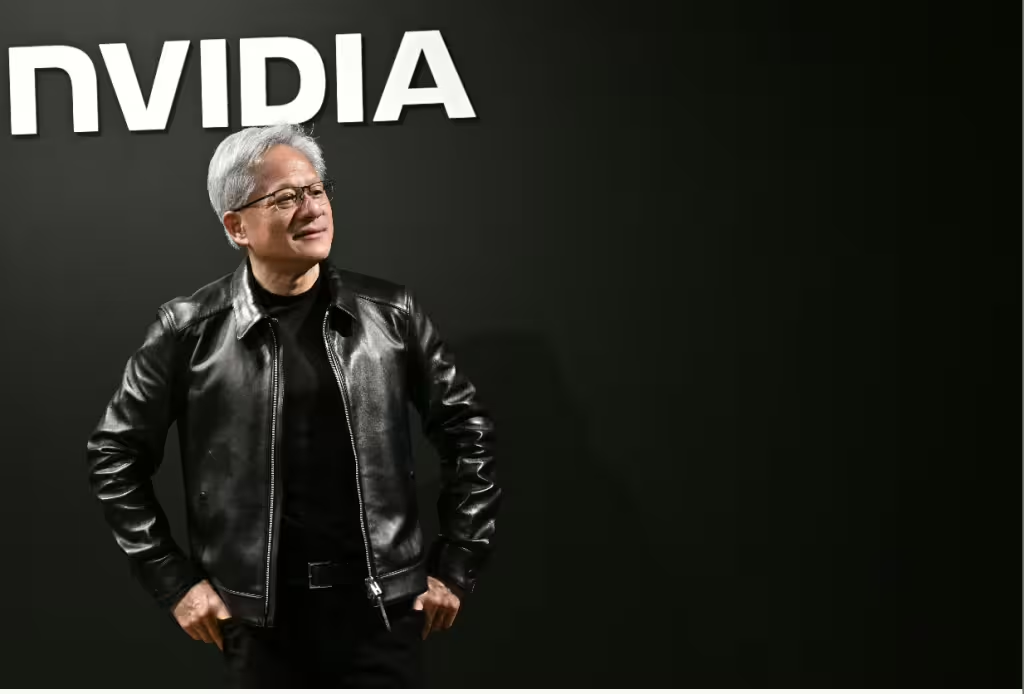
- Growing support: The number of signatories rose to about 50 after Nvidia Chief Executive Jensen Huang shared the letter publicly.
- OpenAI’s position: OpenAI joined after the initiative gained momentum.
- Notable absences: Anthropic, Amazon and xAI were not among the signatories cited.
- Developer control: Open weights allow organizations to adapt models to local data, run them on their own systems and reduce dependence on remote proprietary services.
- Economic argument: The companies say cheaper models can extend access to AI beyond large corporations and well-funded laboratories.
- Security concern: Once released, model weights may be altered for purposes the original developer cannot monitor or prevent.
- Policy request: The letter asks Washington to avoid rules that suppress competition or encourage AI development to move outside the United States.
- Global competition: Several widely used Chinese systems, including models from DeepSeek and Moonshot AI, already follow an open-weight approach.
Between the lines
The letter does not directly frame China as the central threat, but its argument reflects growing concern that restrictive US policy could leave Chinese developers with an advantage in the open-model ecosystem. The signatories are seeking safeguards that address misuse without closing access to the technology itself.
What to watch
Attention will turn to whether US policymakers distinguish between fully open-source systems and models that release only their weights. The broader policy test will be whether Washington can manage security risks without concentrating the AI market further among a small group of proprietary model providers.