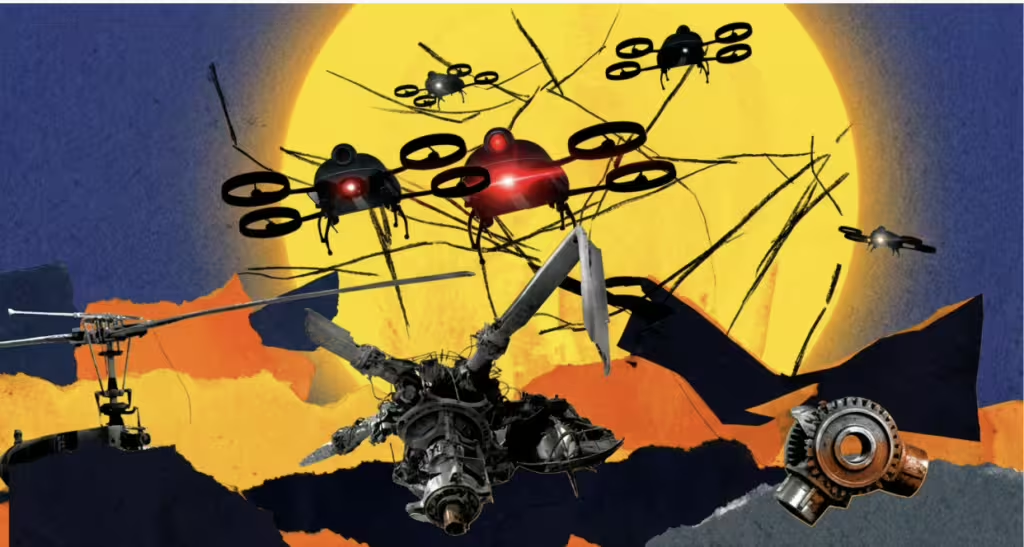
Drones have changed the balance of power in modern warfare. Disrupting an energy sector no longer requires expensive aircraft or advanced missiles. Small, low-cost swarms can reach refineries, tankers and power stations, forcing markets to price in risks far greater than the immediate physical damage.
Ukraine has used long-range drones against Russian refineries and oil infrastructure around the Black Sea, while Iran has deployed drones against shipping in the Strait of Hormuz and regional energy facilities. Despite overwhelming U.S. military superiority, these attacks have deterred oil and liquefied natural gas traffic and helped push crude prices to $100 a barrel.
This capability challenges the last century’s reliance on large, centralized facilities to achieve economies of scale. The larger the critical asset, the greater the potential damage from a strike, pushing governments and companies toward smaller units, distributed networks and mobile power sources that can be repaired or replaced quickly.
Details
- Cost imbalance: A cheap drone may be intercepted by a missile costing many times more, making sustained defense financially draining.
- Exposed targets: Refineries, pipelines, gas terminals and ports have fixed, known locations that are difficult to move or conceal.
- Global shock: Limited local attacks can interrupt oil and gas production and generate inflation far beyond the battlefield.
- Distributed networks: Microgrids and mobile energy sources can keep services running after an attack.
- Layered defense: Protection can include electronic jamming, netting, lasers, missiles and blast-resistant walls.
- Infrastructure hardening: Assets that cannot be decentralized can be protected by burying some systems and reinforcing transformers and sensitive equipment.
Between the lines
Drones have not only made warfare cheaper. They have shifted the measure of power from destroying an opponent’s army to repeatedly disrupting its economy. An actor without air superiority can now impose strategic costs on a militarily dominant state.
What to watch
Energy and defense planning will increasingly emphasize decentralization, hardening and direct cooperation between militaries and infrastructure operators. The central challenge will be developing low-cost interception systems capable of protecting large numbers of facilities without exhausting missile inventories and defense budgets.