The latest
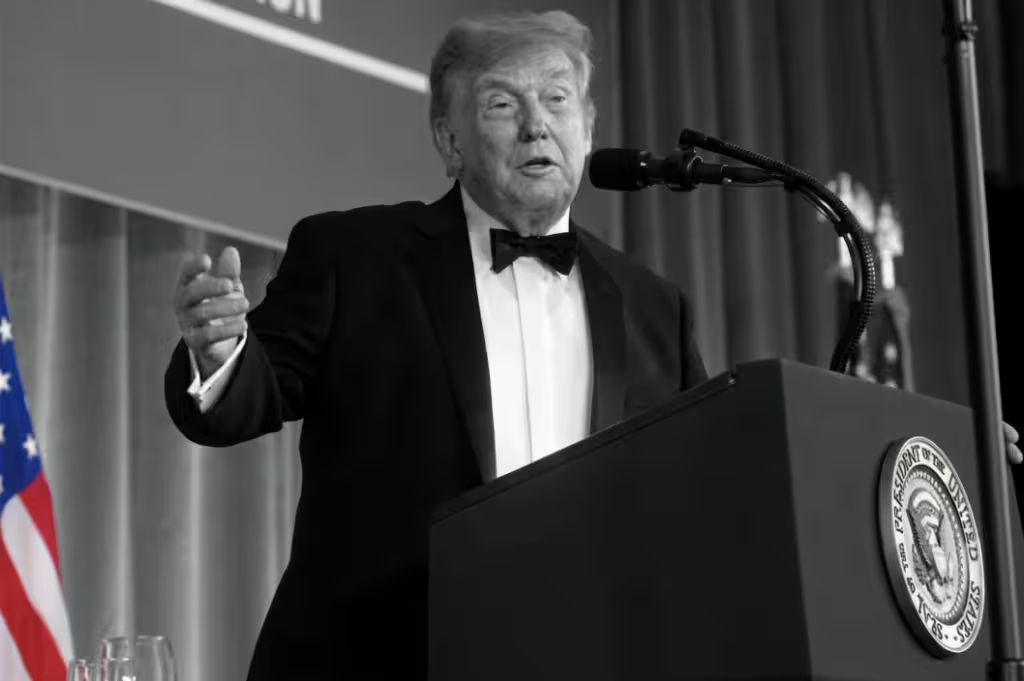
President Donald Trump has returned to emphasizing diplomacy, mentioning six times during a White House appearance that his envoys were talking to Tehran. He kept the military option open, however, saying U.S. forces were ready and that the campaign could be taken to a higher level if negotiations failed.
The shift reflects a pattern repeated throughout the five-month war: expansive threats followed by efforts to convert military pressure into negotiating leverage. The conflict has nevertheless reached a stalemate. U.S. strikes have weakened Iran without ending its attacks, while Tehran needs only a limited number of drones and mines to threaten Hormuz and global energy markets.
The calculation is further complicated by U.S. intelligence assessments that Iran’s new supreme leader, Mojtaba Khamenei, is more open than his father to developing a nuclear weapon, although he has not publicly advocated doing so. The assessment could provide additional justification for escalation, but it does not establish that Iran has decided to build a bomb.
Details
- Talks underway: Trump said negotiations were continuing but did not identify the participants or disclose the substance of the contacts.
- Two difficult options: Retreat would carry a political cost for Trump, while a wider war would create major regional and economic risks.
- New front: The Houthis have expanded the conflict to Bab el-Mandeb, threatening the route Saudi Arabia uses to bypass Hormuz.
- U.S. casualties: Iranian attacks killed four American service members in two weeks, raising the U.S. military death toll to 18.
- Economic pressure: Oil rose above $100 before easing to about $96 a barrel, compared with roughly $60 at the start of the year.
- Depleted stockpiles: The war has pushed the Pentagon to increase missile orders as U.S. weapons manufacturers report record backlogs and higher profit forecasts.
Between the lines
Trump’s renewed emphasis on diplomacy does not mean he has chosen de-escalation. The talks may instead be part of an effort to force Iran into an agreement under continued bombardment. Tehran, meanwhile, is betting it can absorb military pain longer than Washington and its allies can tolerate rising energy costs, casualties and electoral pressure.
What to watch
The immediate test is whether the contacts produce a new proposal on Hormuz and Iran’s nuclear program or become a final deadline before wider strikes. Any Iranian move toward weaponization—or another attack on U.S. forces—could accelerate Trump’s shift from negotiations to escalation.