The Latest
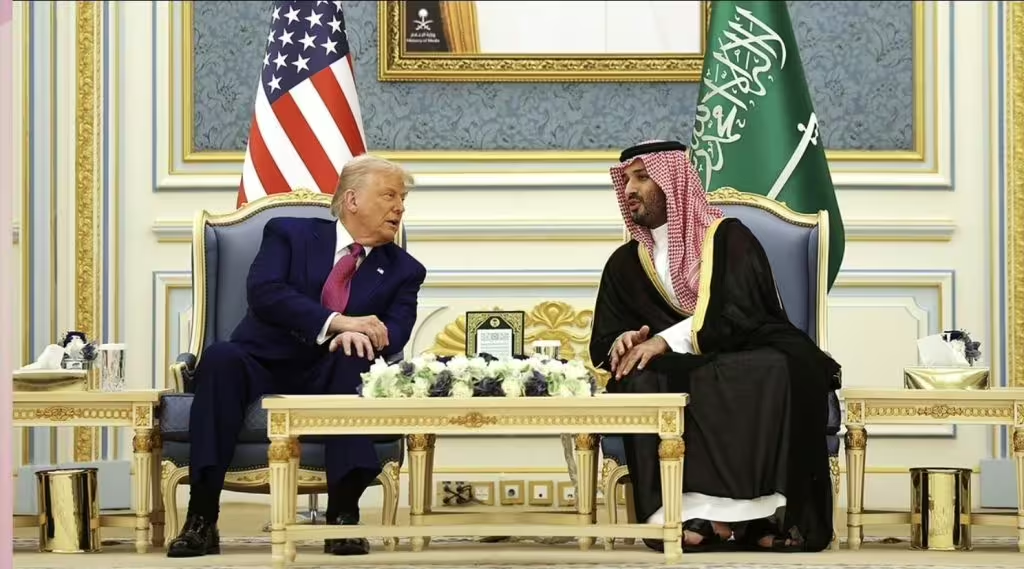
President Donald Trump has transformed the proposed U.S.-Saudi civilian nuclear agreement into a broader geopolitical package, declaring that Washington’s approval will depend on Saudi Arabia joining the Abraham Accords and permanently giving up uranium enrichment. The announcement came less than 24 hours after U.S. and Saudi energy officials signed a civilian nuclear cooperation agreement, shifting the issue from a technical energy deal to a strategic diplomatic initiative linked directly to Israeli-Saudi normalization.
Details
- Trump’s conditions: Trump said on Truth Social that the civilian nuclear agreement would involve “no uranium enrichment” and would be approved only if Saudi Arabia joins the Abraham Accords.
- Ending enrichment: The proposal abandons earlier negotiating frameworks that, according to U.S. reports, explored allowing Saudi Arabia to develop uranium enrichment capabilities after a joint feasibility study. Instead, it returns to the 2009 U.S.-UAE model, under which Abu Dhabi permanently renounced uranium enrichment and spent fuel reprocessing.
- Saudi position: Riyadh has repeatedly maintained that it will not normalize relations with Israel before the establishment of a Palestinian state, a position it reaffirmed throughout the Gaza war, making Trump’s conditions a direct political test for Crown Prince Mohammed bin Salman.
- Israeli response: Israeli Prime Minister Benjamin Netanyahu’s office welcomed Trump’s announcement, calling Saudi accession to the Abraham Accords “a historic leap forward for peace” and linking the opportunity to what it described as Iran’s weakened regional influence following the recent conflict.
- Congressional stance: U.S. reports indicate bipartisan opposition in Congress to allowing Saudi Arabia to develop uranium enrichment capabilities, making the main obstacle political and diplomatic rather than legislative.
Background
Uranium enrichment has long been the central issue in U.S.-Saudi nuclear negotiations. While Saudi Arabia says its civilian nuclear program is intended to support electricity generation and desalination as part of Vision 2030, Washington and Israel argue that preventing new enrichment programs in the Middle East remains a key safeguard against nuclear proliferation. Analyses published by Yedioth Ahronoth and Maariv suggest that linking the nuclear agreement to normalization gives Washington and Jerusalem additional leverage, while analysts at OSINTdefender say the proposal reflects a broader effort to reshape regional alliances after the confrontation with Iran.
Between the Lines
For the first time, Trump has explicitly linked three previously separate issues: civilian nuclear cooperation, a permanent ban on uranium enrichment, and normalization with Israel. If Washington maintains this position, progress on Saudi Arabia’s nuclear ambitions could become directly dependent on diplomatic normalization rather than technical nuclear standards alone.
What to Watch
Attention now turns to Riyadh’s response. Saudi Arabia must decide whether to accept Washington’s new conditions, seek changes that preserve its position on Palestinian statehood, or delay the civilian nuclear agreement while negotiations continue.