The latest
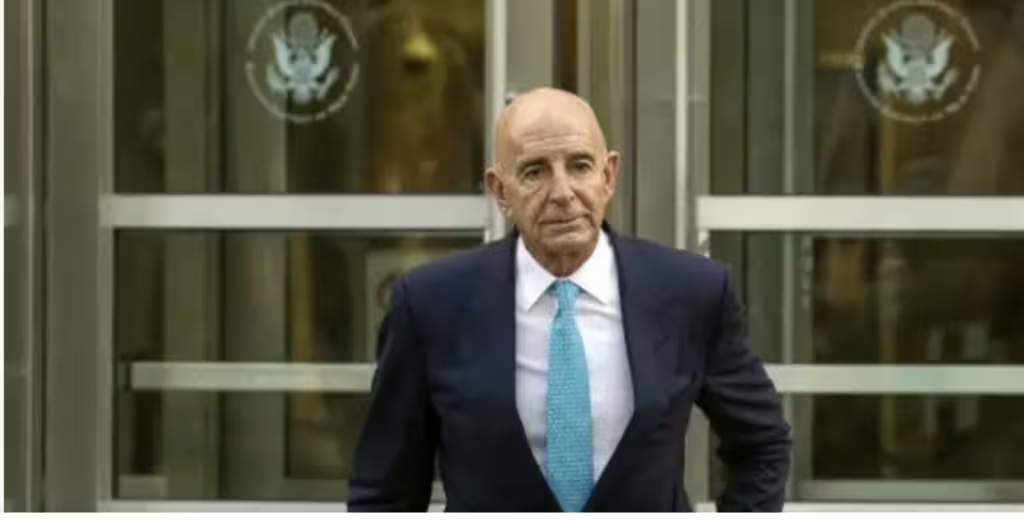
Tom Barrack, the U.S. special envoy for Iraq and Syria, is advancing talks on an oil corridor linking Iraq to Syria’s Mediterranean coast. Discussions centre on rebuilding the Kirkuk–Baniyas pipeline, dormant for more than two decades, while alternative routes from southern Iraq through Haditha and onward to Syria, Türkiye or Jordan are also under consideration.
The proposed “Barrack Pipeline” is an editorial label, not the project’s official name. It reflects the envoy’s role in bringing Iraqi and Syrian officials together with energy companies. Bloomberg reported that Chevron had joined the discussions, while a State Department official confirmed U.S. support for rehabilitating the cross-border link and said American companies were expected to participate.
The initiative gained momentum around Iraqi Prime Minister Ali al-Zaidi’s White House visit. Informed sources said Barrack was among the principal architects of the trip inside the administration. After the meeting, he called it a “turning point” and argued that the next phase of U.S.-Iraqi relations should be built on investment, trade and economic opportunity, with Iraq serving as a bridge between the Gulf, Türkiye, Syria, Jordan, Central Asia, the Balkans and the Caucasus.
Details
- Primary route: The leading proposal would restore an approximately 800-kilometre pipeline running from Kirkuk to the Syrian port of Baniyas.
- Historic link: The Kirkuk–Baniyas pipeline was built in the 1950s and originally carried about 300,000 barrels a day before falling out of service.
- Hormuz alternative: The route would provide direct access to the Mediterranean without passing through the Strait of Hormuz, reducing Iraq’s vulnerability to Gulf disruptions.
- Second option: Baghdad is also examining a pipeline from Basra to Haditha that could later branch towards Syria, Türkiye or Jordan.
- Baniyas gateway: The Syrian port is emerging as a potential outlet for Iraqi crude and already hosts the country’s largest refinery.
- Corporate interest: Chevron, TotalEnergies, TI Capital and UCC Holding have taken part in discussions, although no final construction agreement has been announced.
- Iraqi interest: The pipeline would diversify Baghdad’s export options beyond its southern terminals and the existing northern route to Türkiye’s Ceyhan port.
- Syrian gains: Damascus could secure transit revenue and investment in ports, refineries and pumping stations while rebuilding its place in regional energy trade.
- Security risks: Potential routes cross Iraq’s Anbar province and eastern Syria, where Islamic State cells remain active.
- Reconstruction cost: Large stretches of the old system, along with pumping stations and associated infrastructure, would need to be rebuilt at a cost likely to run into billions of dollars.
- Political resistance: Iran-aligned Iraqi factions may view the corridor as an attempt to weaken Tehran’s influence over regional energy routes.
- Early stage: The parties have yet to announce a final route, financing structure, operating capacity or construction timetable.
Between the lines
The proposed “Barrack Pipeline” takes its name from the political project surrounding it, rather than from a new piece of engineering. The physical route is historic. What is new is the attempt to recast the Fertile Crescent as an integrated economic space connected by ports, pipelines and capital instead of fractured by closed borders and competing spheres of influence.
In Barrack’s model, energy infrastructure is not the reward for stability but a means of producing it. His strategy is to anchor Iraq and Syria in a web of interests involving Türkiye, Gulf capital and American companies, offering governments an economic alternative to the armed networks associated with Iran. For Iraq, that would turn geography from a liability during a Hormuz crisis into leverage as a bridge between the Gulf and the Mediterranean.
Yet a pipeline cannot by itself create a stable regional order. The project will require credible security guarantees, a durable Iraqi-Syrian agreement and sufficient domestic legitimacy to prevent it from being cast as a U.S.-designed corridor aimed solely at containing Iran.
What to watch
The next test is whether the talks produce a formal agreement setting out the route, financing, operating capacity, revenue-sharing arrangements and the roles of U.S. and regional companies. The response of Iran-aligned groups in Iraq, and the ability of Baghdad and Damascus to secure the corridor, will determine whether the “Barrack Pipeline” advances from political vision to an operational link between the Gulf and the Mediterranean.
:::