The latest:
US Treasury Secretary Scott Bessent said Washington will impose fresh secondary sanctions on Iran on a weekly basis, with banks and financial institutions handling Tehran-linked money first in line. He told Reuters ahead of the G20 finance ministers’ meeting that Treasury will keep widening the net, and that he will press participants to cut economic ties with Tehran.
Details:
- The mechanism: Bessent said the recent action against Bank Misr branches in the United Arab Emirates is part of a broader strategy to narrow access to the dollar-based financial system. He added that tougher restrictions may follow against institutions still providing banking services linked to Iran.
- The campaign: Treasury launched a drive named Operation Economic Outcast to tighten financial pressure by targeting banking channels, funding networks and trade tied to Iran. Its Financial Crimes Enforcement Network proposed measures limiting certain banks’ access to the US financial system, calling them important facilitators of Iran-linked transfers.
- The oil claim: Answering critics who say sanctions are ineffective without targeting buyers of Iranian crude, Bessent said US pressure has restricted a large share of Iranian oil flows to international markets, and that volumes stored aboard tankers have fallen recently.
- The Emirati response: The UAE central bank announced an urgent investigation into some transactions involving the bank branches covered by the US measures.
- The economy: Iran’s central bank said inflation reached 84%, with food prices rising weekly and eggs now beyond the reach of many middle- and working-class Iranians. The rial fell to a record low of roughly 2 million to the dollar in recent days, pushing up import prices.
- The fuel squeeze: Officials and experts said Iran’s refining capacity has long fallen short of gasoline needs, with the gap slightly above one-tenth of daily consumption normally covered by imports. Those imports are now nearly cut off by the US naval blockade on southern ports, while strikes damaged refineries.
- The queues: Iranians in Tehran, Isfahan, Mashhad and Bandar Abbas told the New York Times that long lines at filling stations, even after midnight, have become routine. The government is wary of cutting costly subsidies, a step that triggered mass protests in 2019.
- The rationing debate: Officials have repeatedly urged citizens to conserve gasoline and electricity and are studying new quotas. Parliament Speaker Mohammad Baqer Qalibaf said Tuesday that fuel savings are needed.
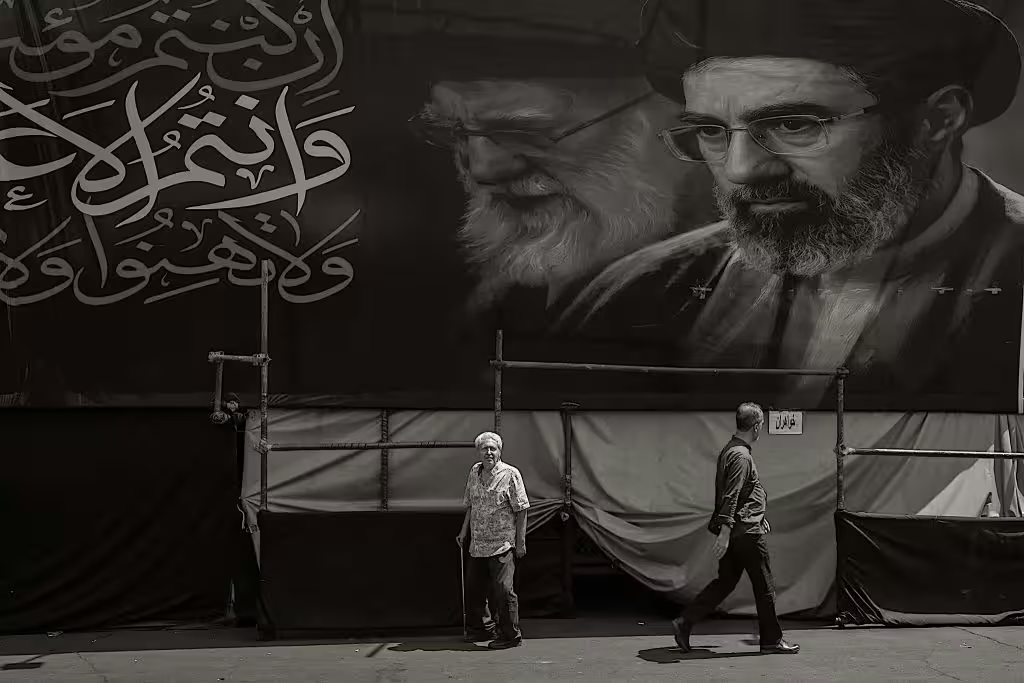
- The leadership split: President Masoud Pezeshkian said last week it is better to end the war now from a position of strength and dignity, according to the Times. Supreme Leader Mojtaba Khamenei acknowledged economic and livelihood challenges but warned officials against publicizing government weaknesses.
- The analyst view: Ali Vaez, Iran project director at the International Crisis Group, said: “The situation is bad, but this is not the kind of pressure that leads to economic collapse.” He noted Iran is a large country with long experience evading sanctions.
Background:
The war began in February when the United States and Israel struck Iran, expecting the government to fall within weeks. Supreme Leader Ali Khamenei was assassinated early in the conflict and succeeded by his son Mojtaba. A ceasefire memorandum signed in June ended the first phase.
Between the lines:
Analysts cited by the Times assess that the renewed squeeze is more likely to strengthen the pragmatists around Pezeshkian, who want the June understanding revived, than to topple the system. The public split between his call to end the war and Khamenei’s warning against airing economic weakness is the clearest sign of that internal contest. Vaez’s point about Iran’s size and evasion experience sets the ceiling on what sanctions alone can deliver.
What’s next
Watch whether the G20 finance meeting produces commitments to curb dealings with Tehran, whether Treasury names new bank targets in its weekly tranches, the UAE central bank’s investigation findings, and any decision on gasoline quotas.