Summary
President Donald Trump’s visit to Ankara could mark a turning point in U.S.-Turkey defense ties, with fresh signals that Ankara may be allowed back into the F-35 program. The prospect comes as tensions between Turkey and Israel continue to rise and Washington seeks to preserve NATO unity amid growing regional challenges.
What’s New?
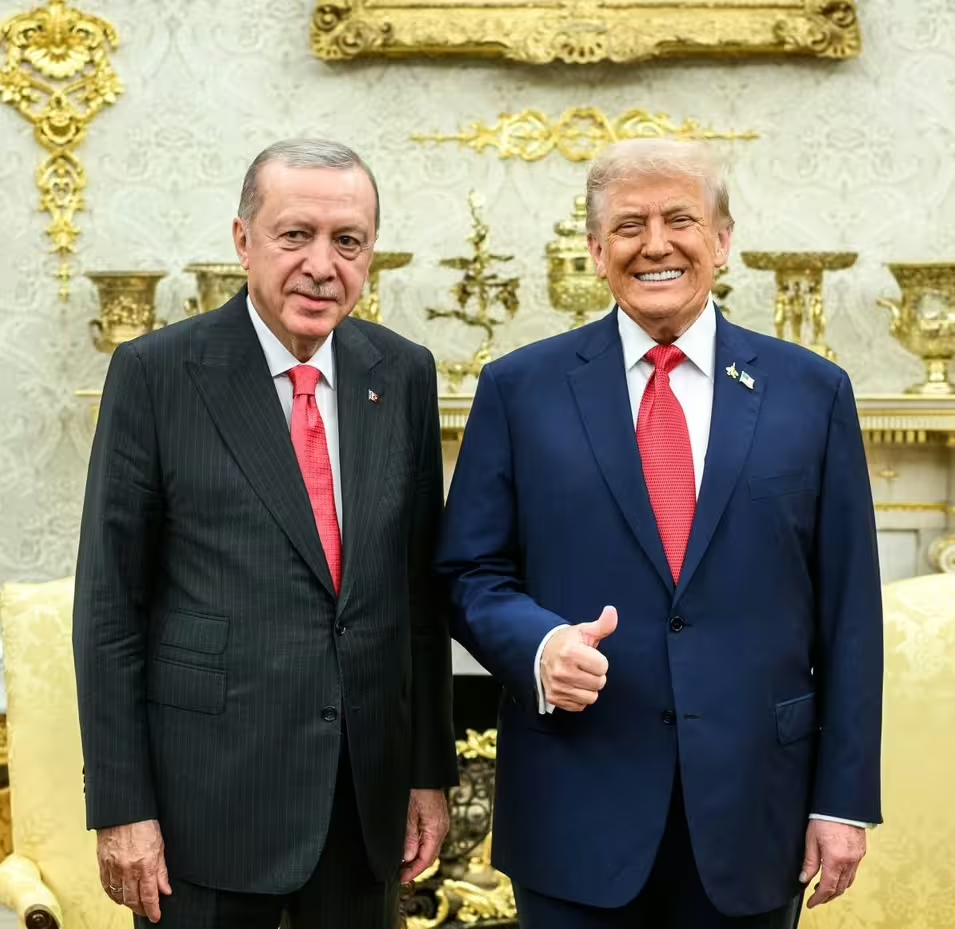
Trump is expected to meet Turkish President Recep Tayyip Erdoğan on the sidelines of the NATO summit in Ankara, marking the first visit by a U.S. president to Turkey since 2015. During a recent appearance with NATO Secretary General Mark Rutte, Trump hinted at a move that would “make Erdoğan very happy” after being asked about F110 jet engines and a possible return to the F-35 program.
Why It Matters
Turkey’s return to the F-35 program would represent a major shift in U.S.-Turkey relations after years of strained ties. It could also reshape the strategic balance within NATO and the Eastern Mediterranean at a time when Israel is closely watching Ankara’s expanding regional role.
Background
Washington removed Turkey from the F-35 program in 2019 after Ankara purchased the Russian-made S-400 air defense system. U.S. officials argued that operating both systems could expose sensitive information about the stealth fighter, while sanctions under the CAATSA law further froze defense cooperation.
What Has Changed?
The Trump administration appears to be rebuilding defense ties with Ankara step by step. The State Department has reportedly moved forward with a deal worth more than $700 million to supply F110 engines for Turkey’s indigenous KAAN fighter jet, a move widely seen as a possible precursor to broader discussions on F-35 cooperation.
Obstacles Remain
Despite Trump’s positive rhetoric, Turkey’s return to the F-35 program still faces significant legal and political hurdles. Lawmakers from both parties continue to oppose any deal as long as Ankara retains the S-400 system, meaning congressional approval remains a key obstacle.
Israel Is Watching
The renewed U.S.-Turkey defense dialogue comes as relations between Ankara and Israel grow increasingly strained. Turkish officials have sharply criticized Israel in recent weeks, while Prime Minister Benjamin Netanyahu has sought stronger U.S. backing to curb Turkish influence in Syria. Trump’s warm relationship with Erdoğan, however, suggests Ankara could gain greater influence in Washington’s regional calculations.
What to Watch
Attention will focus on the expected Trump-Erdoğan meeting at the NATO summit to see whether the president’s remarks translate into concrete action, either through final approval of the F110 engine sale or the launch of a political process that could eventually bring Turkey back into the F-35 program.