
The story
Oman now finds itself in one of its most delicate positions since the Strait of Hormuz crisis began: one foot planted in international law, the other caught in waters that no longer operate by the old rules.
Publicly, Muscat says freedom of navigation must remain governed by international law, and that any future arrangements in the Strait of Hormuz should not amount to transit fees imposed on ships.
Behind the scenes, however, the picture is more complicated. Bloomberg reported that Oman told European officials the strait will not return to its pre-war status, and that vessels crossing the waterway may have to pay fees.
That apparent contradiction is not necessarily a sign of Omani confusion. It reflects a geopolitical trap. Muscat is trying to keep the strait open while avoiding a direct confrontation with Iran.
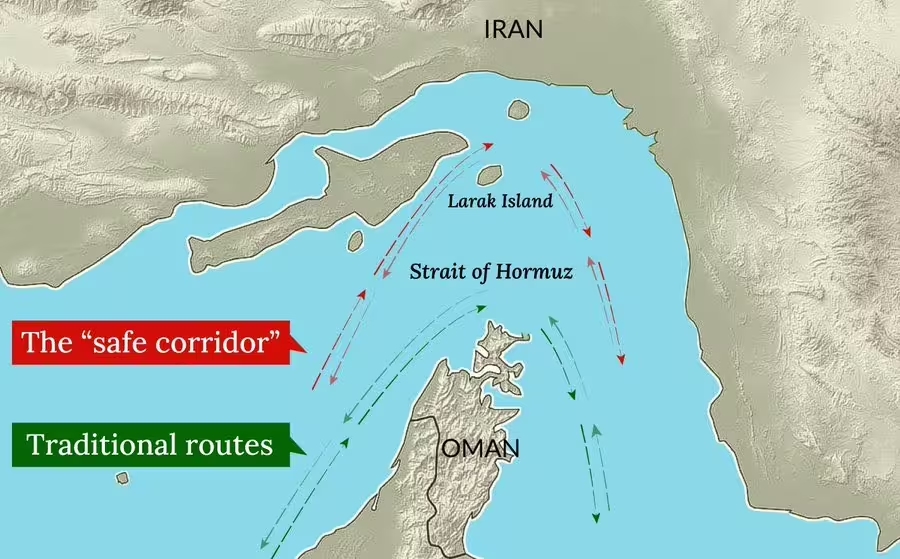
The most dangerous development came when a cargo ship was struck near Oman’s coast. The attack, attributed to Iran by U.S. and Iranian officials, came hours after the Revolutionary Guards warned ships against using routes that had not been coordinated with Tehran — an apparent reference to the southern route close to Omani waters.
- U.S. President Donald Trump described the incident on Truth Social as “a foolish violation” of the ceasefire agreement.
- Western maritime reports said a cargo vessel was hit by a projectile near Dahit, Oman, damaging its bridge.
- The attack forced the International Maritime Organization to suspend a plan to evacuate seafarers and stranded vessels from the Gulf.
- It also pushed oil prices higher, as fears grew that the reopening of the strait may be temporary, fragile, and conditional.
At the heart of the crisis, this is not only about transit fees.
Iran wants practical recognition that it holds the upper hand in the Strait of Hormuz.
The United States wants to reaffirm the principle that international waterways do not belong to any single state.
Between them stands Oman — a country that owns part of the geography, but cannot guarantee security alone.
Iran’s message from the attack was clear:
- Any alternative route near the Omani coast will not be safe unless it passes through an understanding with Tehran.
- That leaves Muscat facing a difficult equation: how can it preserve its image as a quiet mediator committed to international law while Iran uses shared geography to impose new rules?
- The crisis also exposes the limits of recent U.S.-Iran understandings. Even if Washington says the strait is open, the real test is not in political statements or Trump’s posts. It is at sea. What happened near Oman shows that Iran can still disrupt passage when it wants, or at least impose a new cost on crossing.
- So the question over the Strait of Hormuz is no longer simply whether it is open or closed.
- The real question is: who gets to write the new rules of passage?
- Oman wants internationally acceptable rules.
Iran wants a security and political order on its own terms.
The United States wants freedom of navigation without fees and without Iranian guardianship.
And the ships are left moving between all three maps.