The latest
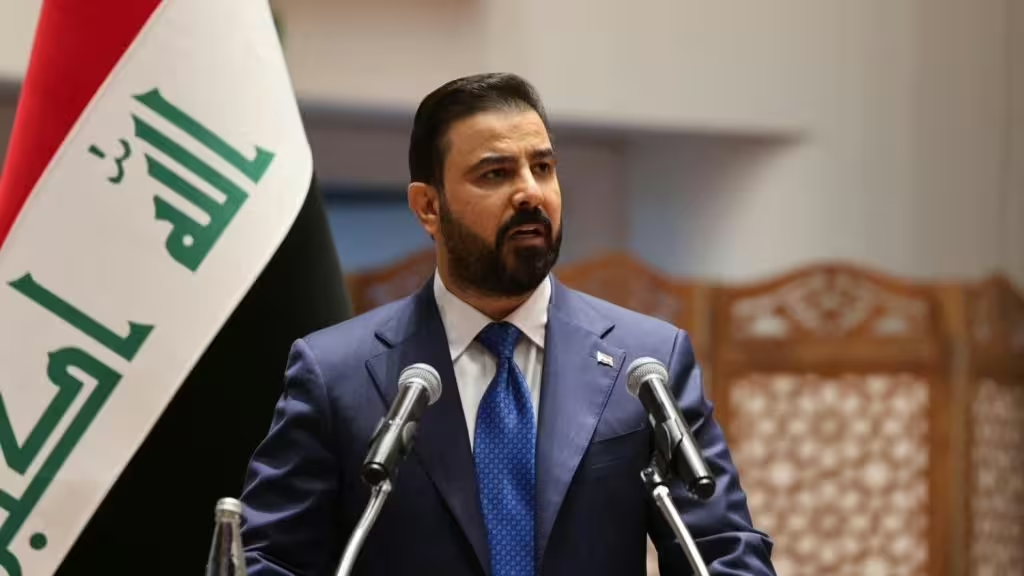
Prime Minister Ali al-Zaidi has entered an early confrontation with Iran-backed armed groups after ordering all militias to submit to state authority, in what is widely seen as the defining test of his government since taking office in late April.
According to The New York Times, the move follows mounting pressure from the Trump administration, which has urged Baghdad to reduce Iranian influence and dismantle armed groups operating outside government control in exchange for continued U.S. financial and security support.
Details
- Al-Zaidi ordered all armed factions to come under the government’s chain of command. Several influential groups, including Kataib Hezbollah, rejected the directive, arguing that ending what they describe as U.S. interference in Iraq should take priority.
- In contrast, Shiite cleric Muqtada al-Sadr said his Peace Brigades (Saraya al-Salam) would fully integrate into Iraq’s official security forces, giving the prime minister an important political boost. The pledge, however, does not include the strongest Iran-aligned factions.
- The Trump administration argues that armed groups operating outside state authority threaten Iraq’s sovereignty and regional stability. That position was reflected in a joint statement issued after al-Zaidi met U.S. envoy Tom Barrack, reaffirming plans to disarm and dissolve all armed formations outside government control.
- Analysts remain skeptical that Baghdad can fully implement those commitments, noting that several militias maintain deep political influence and institutional ties that make integration or dismantlement far more complicated than issuing government orders.
Background
The Popular Mobilization Forces (PMF) were established in 2014 after Iraq’s highest Shiite religious authority called for volunteers to fight ISIS. Parliament later recognized the PMF as a state institution, but several factions—particularly those closely aligned with Iran’s Islamic Revolutionary Guard Corps—retained independent command structures and military capabilities.
Successive Iraqi governments have repeatedly pledged to place all weapons under state control, but those efforts have largely failed because of the political and military influence of powerful armed groups.
U.S. pressure has intensified following renewed regional tensions with Iran. Washington accuses several Iraqi militias of attacking American personnel and facilities, while those groups say they are resisting the U.S. military presence in Iraq.
Many observers believe al-Zaidi faces a more difficult environment than his predecessors, as Washington increasingly ties its partnership with Baghdad to reforms aimed at strengthening Iraqi sovereignty and ending the existence of armed groups operating outside state authority.
What to watch
The coming weeks will show whether al-Zaidi can translate his promises into concrete action or whether resistance from powerful militias will trigger another political and security confrontation, with significant consequences for Iraq’s ties with both Washington and Tehran.