
The latest
Before the latest flare-up in regional tensions, Washington and Tehran were discussing the details of a new nuclear agreement that U.S. officials describe as the closest the two sides have come to a breakthrough in years.
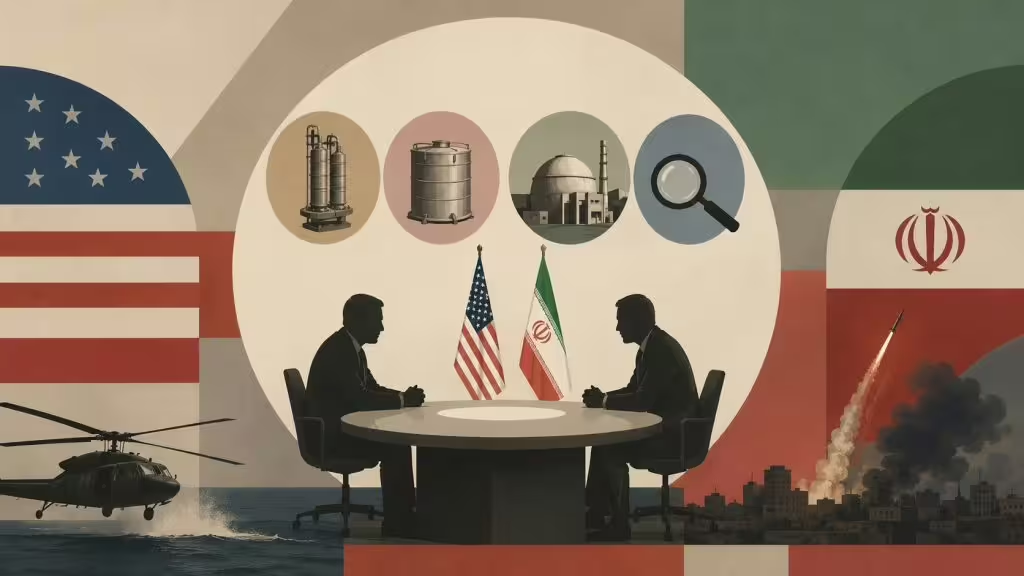
According to U.S. officials and diplomats familiar with the talks, negotiations are focused on four major issues that would extend restrictions on Iran’s nuclear program and create a stricter monitoring regime than the 2015 nuclear deal.
Details
1. A Long-Term Halt to Enrichment
The United States wants Iran to suspend uranium enrichment for between 15 and 20 years.
Iran initially proposed a 10-year pause, but U.S. officials believe Tehran could ultimately accept a period closer to 15 years as part of a broader agreement.
2. Iran’s Enriched Uranium Stockpile
Washington wants Iran’s estimated 11-ton stockpile of enriched uranium to be diluted or neutralized under the supervision of the International Atomic Energy Agency (IAEA).
A key dispute remains over the U.S. role in the process. Washington favors direct involvement, while Tehran argues that any American role should be limited to oversight.
3. The Future of Nuclear Sites
The United States is pushing for the dismantling of Iran’s main nuclear facilities at Natanz, Fordow, and Isfahan.
Iran has reportedly shown some willingness to discuss closing two sites but continues to insist on keeping one facility operational as a symbol of what it considers its right to enrich uranium.
Fordow, the heavily fortified underground site, remains one of the most sensitive issues in the negotiations.
4. Expanded Inspection Powers
Washington wants international inspectors to have broad authority to conduct surprise inspections across Iran.
Tehran has yet to clearly accept unrestricted access, particularly to sites located within military facilities controlled by the Islamic Revolutionary Guard Corps.
The Frozen Assets Dispute
Despite signs of progress, Iran’s frozen assets remain one of the biggest obstacles to a final agreement.
Tehran is seeking the early release of a substantial portion of roughly $25 billion in frozen funds, while the Trump administration insists that any asset release should be tied to phased implementation of the deal.
U.S. officials say Iran views the funds as a test of Washington’s seriousness. The United States, however, argues that releasing the money upfront would weaken its leverage to ensure compliance.
What to watch
The future of the negotiations now depends largely on whether both sides can contain the latest round of military tensions between Iran and Israel.
White House officials remain hopeful that detailed technical talks could begin in Switzerland in the coming weeks if calm holds. But another escalation could derail months of slow progress and push the negotiations back into uncertainty.