The latest
Trump started with deterrence language. Then he lowered the temperature.
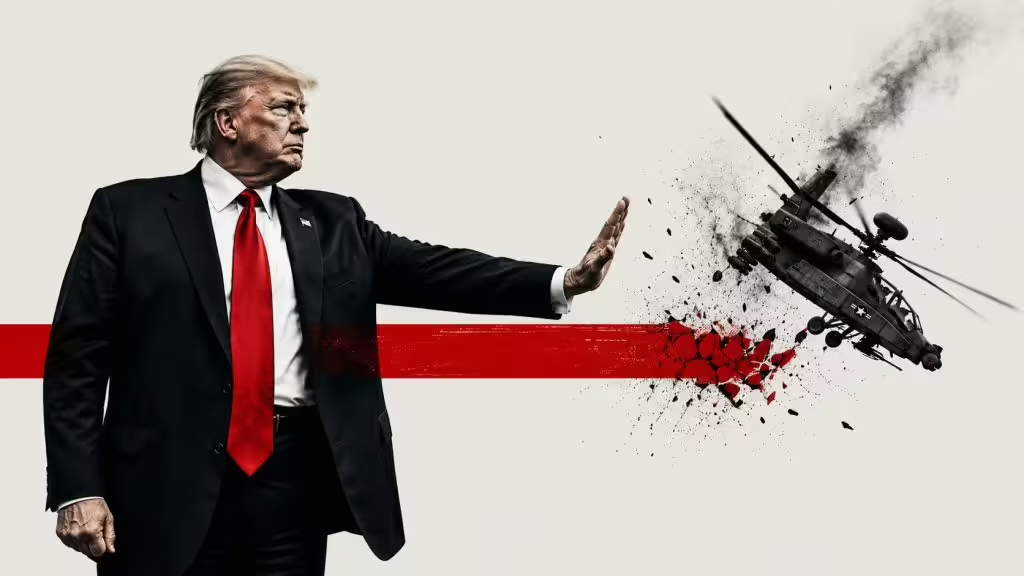
After a U.S. Apache helicopter was shot down near the Strait of Hormuz, Trump wrote that the United States “must, of necessity, respond to this attack.”
The line sounded like a signal that a new U.S. strike on Iran could follow.
But in later comments to The Wall Street Journal, Trump said the helicopter incident was “not a big deal,” adding that the pilot was fine.
The change does not erase the seriousness of the incident. But it changes the political reading. Trump did not fully withdraw the threat. He moved the crisis away from an almost certain military response and back into a zone of maneuver.
The Washington Post reported that the crew was rescued about two hours after the helicopter went down, in an operation involving a U.S. Navy Corsair surface drone. U.S. Central Command said the crew was in stable condition and that the incident remains under investigation.
Iran also tried to lower the threshold of responsibility. Assistant Foreign Minister Esmail Baghaei said Tehran did not deliberately shoot down the American helicopter.
Other Iranian officials kept the harder message alive.
Foreign Minister Abbas Araghchi said foreign forces operating near Iranian territory remain exposed to risks from human error, accidents or crossfire. He added that Iran prefers diplomacy but “speaks other languages too.”
Parliament Speaker Mohammad Bagher Ghalibaf said Iran prefers diplomacy, but can speak “other languages far more fluently.”
Details
• The incident took place near Oman’s coast and the Strait of Hormuz, one of the world’s most important energy chokepoints.
• Trump first described the incident as an attack requiring a U.S. response, then played it down in later comments to The Wall Street Journal.
• The Washington Post reported that the crew was rescued by a Navy sea drone, in what officials described as the first operation of its kind for the U.S. military.
• U.S. Central Command said the crew was stable and that the incident is under investigation.
• Baghaei’s denial gives Tehran room to avoid claiming a deliberate shootdown.
• Araghchi and Ghalibaf’s comments keep Iran’s deterrence message intact: foreign forces near Iran carry the risk.
• Trump’s softer tone may be an attempt to keep the diplomatic track with Tehran alive, not a sign that the incident is over.
What to watch
The question now is whether Trump’s softer tone becomes policy.
If Washington limits itself to investigation language, the U.S. may be choosing containment. If the Pentagon or U.S. Central Command identifies a target, weapon or retaliatory plan, the crisis could move back toward escalation.
A limited response could preserve the ceasefire on paper. A broader strike could push the Gulf into another direct confrontation.