The latest
A senior Gulf official told +ontime that his country “will not submit to blackmail and will not pay money in exchange for its sovereignty,” amid growing pressure on Gulf states after recent Iranian attacks on Kuwait and Bahrain.
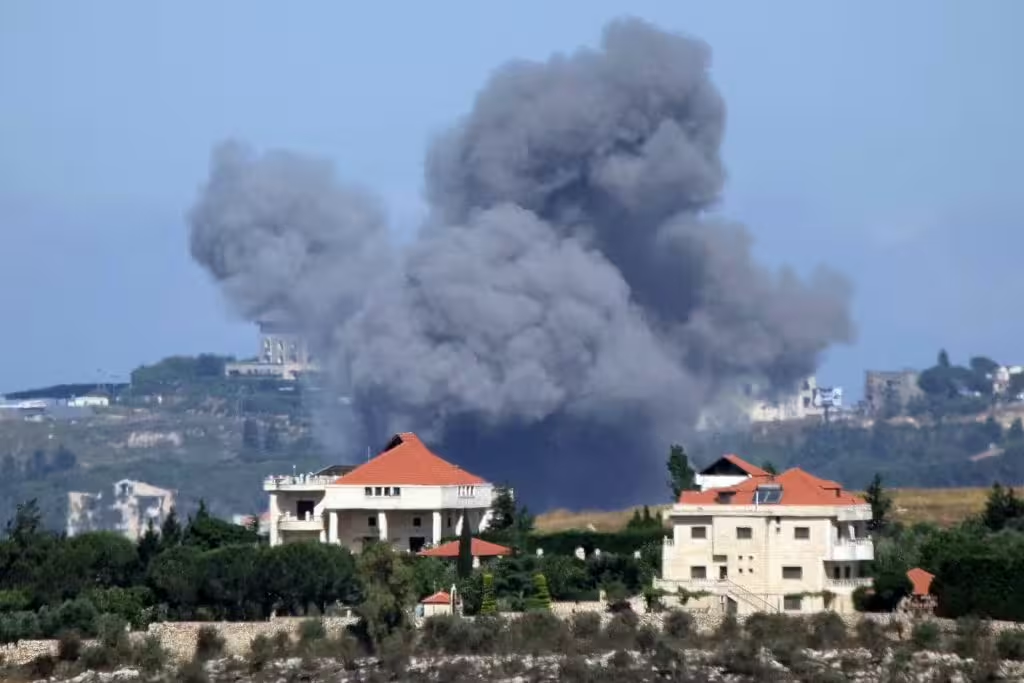
The comments came at a highly sensitive moment in the region, after Iran launched missiles toward Kuwait and Bahrain and air defenses responded.
According to the official, some Gulf states have “bowed to the storm” and moved toward bilateral understandings or arrangements outside a unified Gulf position. He said those states could face “double blackmail” — from Tehran on one side, and from the power providing protection or calm on the other.
Details
• Iran launched seven ballistic missiles toward Kuwait and Bahrain. Six were intercepted, while the seventh did not reach its target. Washington also denied Iranian claims that the U.S. Fifth Fleet headquarters in Bahrain had been damaged.
• CENTCOM described the drone attack on Kuwait International Airport as “deliberate, calculated and unjustified.” Washington also rejected Tehran’s claim that the damage was caused by a U.S. interceptor missile.
• Kuwait’s Al Rai newspaper cited an Emirati position saying no Gulf state should be left alone in the face of attacks.
• In a late Sunday statement, the U.S. Treasury Secretary said Washington would use frozen Iranian assets to rebuild and repair damaged facilities in the Gulf. He said a U.S. team had been assigned to assess damage among Gulf allies and estimate repair costs. Washington will also examine mechanisms to use Iranian assets to support previous repair operations.
• No money for calm: The Gulf official told +ontime that his country rejects “buying security with money,” despite damage to infrastructure. “Rationality does not mean submission to the aggressor,” he said. “Nor does invoking development and economic gains justify losing the will to defend oneself.”
• Criticism of Gulf division: The official said one Gulf state “paid money and presented itself as a mediator,” while “everyone knows that neither side of the crisis respects its mediation.” He added that another Gulf state “detached itself early from the Gulf space and aligned itself one way or another,” without naming either country.
• The ‘unknown aircraft’ factor: The official said deterrence and a forceful response to Iranian attacks are “the language Tehran understands,” referring to what some regional circles describe as “unknown aircraft.” He did not provide operational details or official confirmation of who is behind those strikes.
Why it matters
Iranian attacks on Gulf states are becoming a political test inside the Gulf Cooperation Council, not just a military issue.
Some capitals want to contain escalation through understandings, mediation or financial arrangements. Others see that approach as the start of a long cycle of blackmail, where Tehran treats calm as something that can be bought, not as respect for sovereignty.
That is why the official told +ontime that “the billions spent on advanced weapons will become delayed scrap” if they are not used to build real deterrence. He said political rationality means “distinguishing between friend and enemy, and treating each accordingly.”
What to watch
The first signal is whether Iranian attacks on Kuwait and Bahrain remain tied to exchanges between the IRGC and U.S. forces near Hormuz, or become a recurring pressure tool against Gulf states.
The second is the position of Gulf capitals themselves: will they move toward a unified security posture, or continue separate arrangements that leave each state negotiating its own security alone?
The third is compensation. If Washington moves ahead with using frozen Iranian assets to repair Gulf damage, compensation could become a political deterrent, not just a post-attack repair mechanism.