The latest
Iran’s fragile ceasefire has given people some relief from sudden death. But it has left them facing a harsher reality: a collapsing economy, surging prices, disappearing medicine and negotiations that stop and start without a clear result.
According to The New York Times, disillusionment is spreading across Iran. It is felt by regime opponents who once hoped the war might trigger political change, and by government supporters who now see war, sanctions and inflation eating into daily life.
Details
• When the United States and Israel began striking Iran in late February, some opponents of the Islamic Republic believed the war might bring an end to decades of theocratic rule. Months later, after bombing and destruction, that hope has faded.
• The newspaper said the war has reportedly killed about 1,700 civilians and caused wide damage to airports, roads, factories, seaports, universities and densely populated neighborhoods.
• The effective closure of the Strait of Hormuz, along with strikes on key sectors such as petrochemicals, has pushed an already weakened economy into a faster collapse.
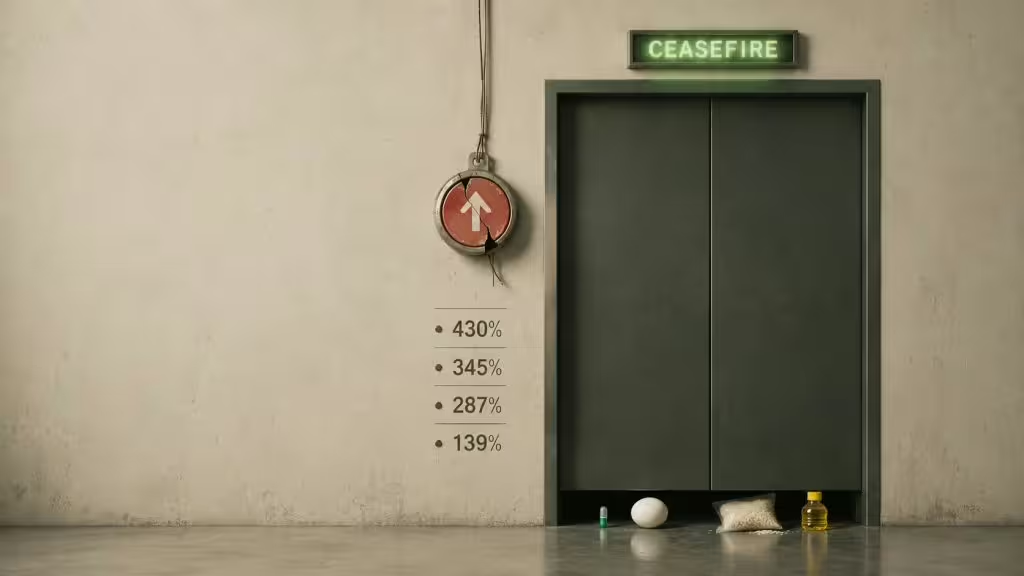
• Prices have become the heaviest burden. Iran’s official statistics center said inflation jumped from the same period last year, with cooking oil up 430%, eggs 345%, rice 287% and milk 139%.
• In one everyday sign of the crisis, a pro-government public employee said his salary runs out by the middle of the month and he can no longer afford beef or chicken for his family.
• The pain cuts across politics. One conservative government supporter said rising prices “do not distinguish between supporters and opponents,” because they hit everyone.
• Shortages of raw materials have shut down factories. The manager of a plastic bottle factory near Mashhad said production had stopped and workers were furloughed because petrochemical supplies were disrupted.
• The health sector is also under strain. A doctor in Isfahan said pharmacies are rationing medicine, and the Health Ministry has told doctors to prescribe only essential drugs because of shortages.
• The head of Iran’s hemophilia association warned that the country has no reserve of medicines needed by people with bleeding disorders, and that imports have become extremely difficult.
• The war has also left brutal personal stories. One widely shared case is Hamed Mirzaei, who said he lost 12 relatives in an Israeli strike on Tehran’s Resalat Square, including his wife, parents and other family members.
• For regime opponents, there was another humiliation: The New York Times reported that Washington and Tel Aviv had initially considered installing former president Mahmoud Ahmadinejad after regime change. Many Iranians saw that as proof they were being treated as pieces in a game larger than themselves.
• Trump’s shifting remarks have added to the confusion. He has spoken of helping Iranian protesters, threatened to destroy Iran’s ancient civilization, and later said he would be “honored” to meet the new supreme leader, Mojtaba Khamenei, if a deal were reached.
• After a long public internet shutdown from the start of the war until late May, Iranians returned to social media with messages that painted a bleak picture: fear, anger, sarcasm and exhaustion from a war they did not choose.
What to watch
The Times says many Iranians, including some who oppose the regime, now see negotiations as the only path to stabilize the country and stop the economic free fall.
The deeper question is no longer only whether the regime weakens or survives. It is how much Iranian society can endure if it remains trapped between a war that does not change power, a peace that does not arrive and an economy collapsing on everyone.