The latest
Muqtada al-Sadr has reopened one of Iraq’s most sensitive files: the future of armed factions outside direct state control.
Sadr announced that Saraya al-Salam would break fully from the National Shiite Movement and come under the state and its official military authorities.
He said the decision was made in the national interest and to avoid risks facing the country. He also urged other Popular Mobilization factions to break away from partisan and sectarian command structures.
Sadr said civilian bodies linked to Saraya al-Salam would be reorganized under Al-Bunyan al-Marsous, without offices, weapons, uniforms or other organizational labels.
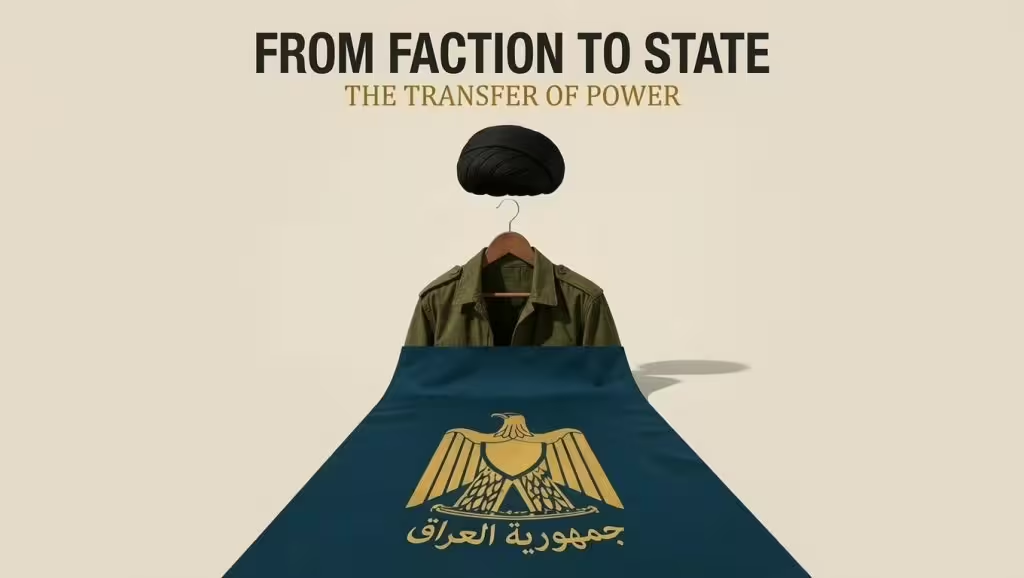
The decision puts the Iraqi state before a direct test: Can it absorb a major armed formation under one security command, or will the move remain more political than operational?
Details
• Saraya al-Salam was founded in June 2014 at Sadr’s call, after ISIS swept across large parts of Iraq. It initially presented itself as a force to protect holy sites and fight the group.
• The formation grew out of the Mahdi Army, which Sadr created after the 2003 U.S. invasion of Iraq before later dissolving it.
• Saraya al-Salam fought ISIS in several battles, including Jurf al-Nasr, Tikrit, Samarra and Ishaqi Island.
• After ISIS was defeated, the group’s status returned to the center of Iraq’s debate over weapons outside state control.
• Sadr has repeatedly called for arms to be restricted to the state and has tied his position on Saraya al-Salam to a wider path that includes other factions.
• Iraqi Prime Minister Ali al-Zaidi welcomed the decision, calling it support for state authority and a step toward unified security command.
• Figures close to the Sadrist movement say placing Saraya al-Salam under the commander-in-chief is meant to unify military decision-making and prevent competing chains of command.
• The real challenge is not the announcement. It is the mechanism: Who controls the weapons? Who gives the orders? And how far can political loyalty be separated from military structure?
What to watch
The real test will be Saraya al-Salam’s conduct after the announcement, not the wording of Sadr’s statement.
If orders, funding and field movement shift genuinely to the state, Sadr’s move could become a precedent that pressures other factions. If political influence remains intact behind an official cover, the step will look more like repositioning than the end of party-linked arms.