
The latest
Washington is approaching south Lebanon through a limited test, not a grand settlement.
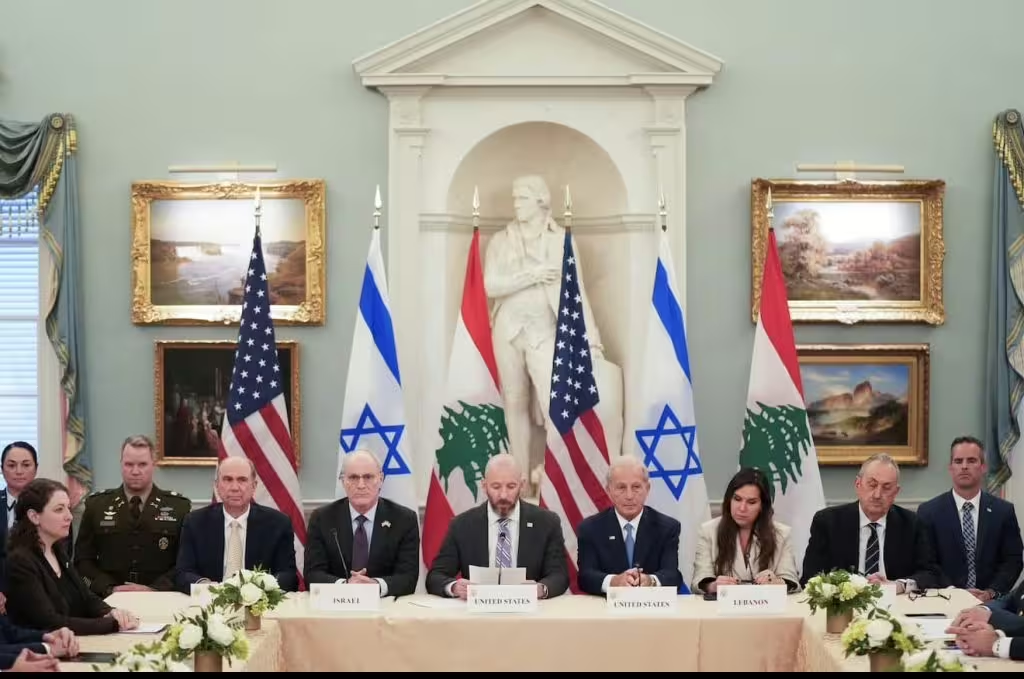
After Lebanese-Israeli talks in Washington, the idea of pilot zones has emerged as a possible first step. The Lebanese army would take control of specific areas, Israel would withdraw from agreed points, and residents would be allowed to return to their villages.
The plan would give the Lebanese state a measurable gain on the ground without forcing an immediate confrontation with Hezbollah over its weapons.
But the political layer is just as important. Reports in Beirut point to indirect U.S. contact with Hezbollah official Ammar al-Moussawi. If accurate, that suggests Washington knows parallel channels are already in play.
The U.S. move appears designed to put the Lebanese state back at the center of the talks, rather than leaving the file between Hezbollah and Iran on one side, and Israel and the United States on the other.
Details
• The pilot zones give the army a defined mission: protect areas of control without launching a disarmament campaign.
• That reduces the risk of a direct clash with Hezbollah and limits the party’s ability to portray the state as attacking its own community.
• The plan’s credibility depends on the return of residents. Without villages coming back to life, the state will not gain real trust.
• The model takes account of the Lebanese army’s limits. Holding defined areas is easier than an open-ended deployment across the south.
• Israel remains the main uncertainty. Any hesitation over withdrawal would weaken the state and give Hezbollah a counterargument.
• Iran will try to link Lebanon to its negotiations with Washington and present itself as the guarantor of the south.
• Washington is moving in the opposite direction: it wants the Lebanese state, not Tehran, to be the address for de-escalation.
What to watch
The test is not in the statement. It is on the ground.
Will Israel withdraw? Will the Lebanese army deploy? Will residents return?
If that happens quickly, Hezbollah and Iran will have a harder time blocking the process in public.
Sources: