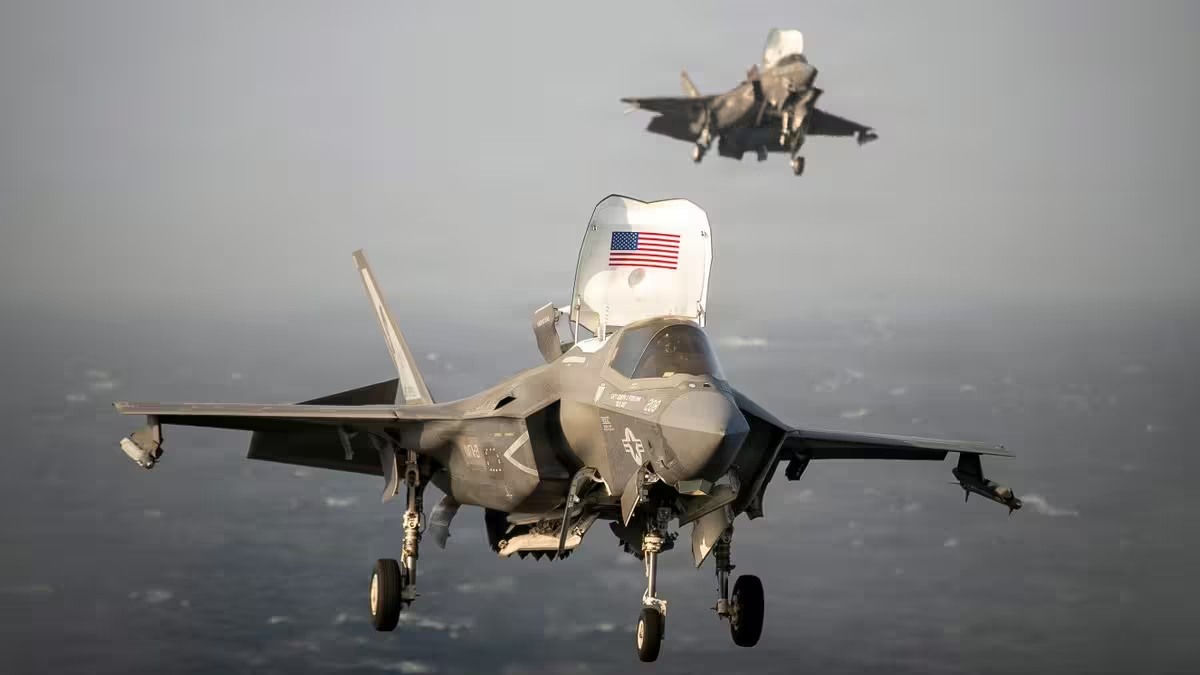
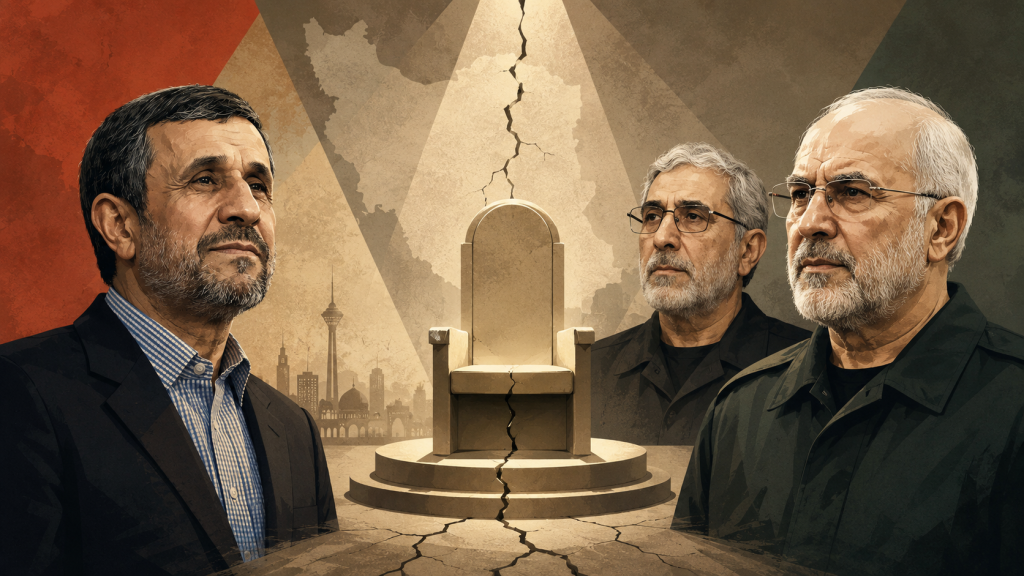
The New York Times has opened a new front in the post-Khamenei battle after publishing a report saying Israel and the United States entered the war on Iran with a surprising name in mind to lead a transitional phase: former Iranian President Mahmoud Ahmadinejad.
According to the report, an Israeli strike on the first day of the war was designed to target the area around Ahmadinejad’s home in Tehran, not to kill him, but to free him from alleged house arrest, as part of a wider plan to topple the regime and produce an alternative leadership.
But the account, despite its seriousness, raises a bigger question than its direct content: Was Ahmadinejad really part of a foreign plan, or is the leak itself part of an internal Iranian struggle to eliminate him politically?
Details
• The New York Times account is striking because it attributes to U.S. officials the claim that Ahmadinejad was a possible choice to lead Iran after the initial strikes, even though he has historically been associated with fierce hostility toward Israel and the United States.
• This contradiction allows for another reading: a leak from inside the Iranian regime, or from circles close to it, to portray Ahmadinejad as a possible agent of Washington and Tel Aviv, especially after years of public opposition to Khamenei’s line and criticism of the structure of rule and corruption.
• Ahmadinejad is no longer just a former president. He remains a figure with a support base inside parts of the hard-line and populist current, making him a nuisance to any internal arrangements involving Mojtaba Khamenei, Mohammad Bagher Qalibaf, or the current linked to Hassan Rouhani and Mohammad Javad Zarif.
• If the goal of the leak is to hit Ahmadinejad, the message to the Iranian public is clear: the man who once raised a hard-line anti-Western discourse may, in the eyes of his rivals, be part of an American-Israeli game. Inside Iran’s political environment, that is a lethal accusation.
• At the same time, the possibility cannot be ruled out that Israel and the United States truly overestimated Ahmadinejad’s ability to play a transitional role, relying on his conflict with the regime and his status as a recognizable figure inside Iran.
• What is notable is that the suspicions do not stop with Ahmadinejad. The killing of Khamenei and several senior commanders, while other influential figures remained outside the circle of targeting, raises a sensitive question: who inside the system knew more than they should have?
• The name of Quds Force commander Esmail Qaani is being raised in this context in media circles because of his public appearances and because he remains in a highly sensitive position, the same post once held by Qassem Soleimani before his killing.
• Mohammad Bagher Qalibaf also appears to be a name that cannot be ignored. His history in the IRGC, his presidential ambitions, past corruption allegations, and his hard-line rhetoric after the war all make him a potential player in the succession battle, not merely a parliament speaker commenting from the outside.
• More importantly, inflating the Ahmadinejad story may serve a third party: someone who wants to redirect the discussion toward a controversial former president and push suspicion away from figures still embedded in the real architecture of power.
What next?
The decisive indicator is not only whether Ahmadinejad appears or remains absent, but whether Iranian media begin an organized campaign against him in the coming days.
If accusations of collaboration or foreign links escalate, it would mean the report has turned into an internal tool to eliminate him politically.
But if the story quickly fades, it may be just one part of a wider psychological war between Washington, Tel Aviv and Tehran.
So far, all the names being floated remain within the circle of political suspicion. But what is certain is that the battle over Khamenei’s succession is no longer taking place only behind closed doors. It has moved into Western media, security leaks and the internal calculations of eliminating rivals within the regime.
Source: