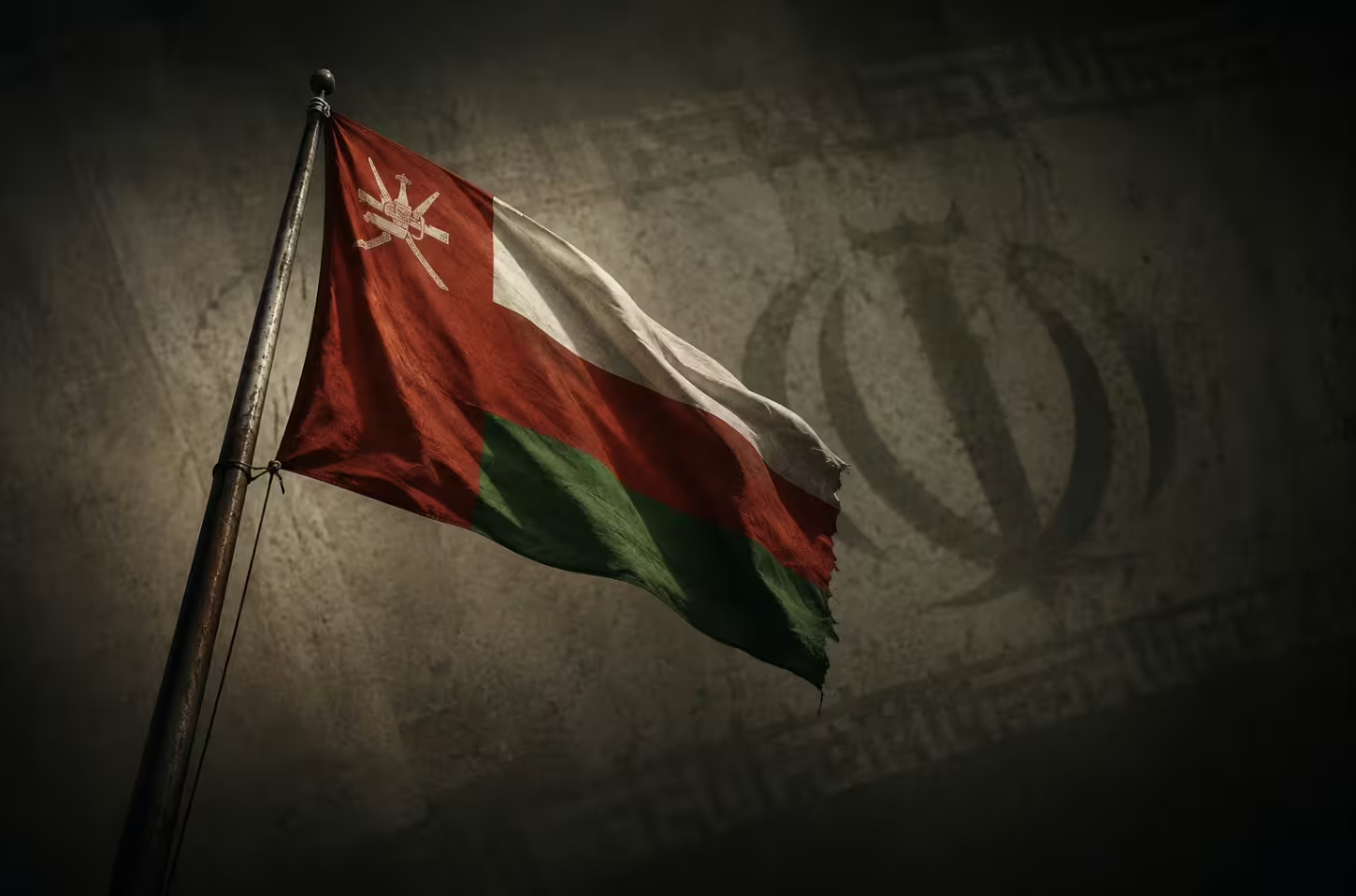
The battle over the Strait of Hormuz now looks like a clash between two models: Gulf states that built their strength on stability, ports, energy, aviation and finance, and an Iranian regime that knows how to invest in chaos when it cannot compete with success.
In The Atlantic, Karim Sadjadpour wrote that Iran lags behind the UAE on most indicators of success: from GDP and services to education, healthcare and happiness. But it excels in one dangerous area: the regime’s ability to ignore the suffering of its own people and use conflict as a political tool.
Sadjadpour called this the “vulture advantage”: finding opportunity not through success, but in conflicts and on the carcasses of failed states.
Details
• This idea explains the core of the current Gulf crisis. Building a global airport, a financial hub, a port or an energy city takes years and billions. Threatening it with a drone, a missile or the closure of a maritime passage can happen within hours.
• A Gulf official tells +ontime that Gulf states viewed Trump’s second return to the White House as a new page with Washington, after a chill that began under Obama and deepened with Democrats over the Khashoggi, Yemen and human rights files.
• According to the official, the Gulf view was that Washington had left a vacuum that allowed Iran to expand after the nuclear deal, benefiting from released billions and from America’s declining appetite to remain deeply engaged in the Middle East, while developing ballistic missiles, drones and supporting its arms in Iraq, Syria, Lebanon and Yemen.
• That is why Trump’s return looked like an opportunity to restore balance: advanced arms deals, security agreements, massive commercial understandings and special guarantees, especially with Qatar. But what followed showed that the relationship is still governed by Washington’s shifting calculations, not by Gulf needs alone.
• Qatar offers the clearest example. The war did not only strike the idea of passage through Hormuz; it reached the energy infrastructure itself. Iran targeted sensitive equipment at Ras Laffan, especially the cryogenic heat exchangers used to liquefy natural gas, threatening Doha’s ability to resume exports quickly even if the strait is reopened.
• The danger of Ras Laffan is that it is not an ordinary facility. It is the heart of Qatar’s liquefied natural gas industry, and any prolonged disruption there would shake both Doha and the global energy market. In that case, Iran does not need to occupy the trade route; it only needs to make confidence in it expensive.
• The UAE also stands at the heart of the same equation. It is the prosperity model Iran contradicts: ports, airlines, a strong economy, real estate, technology and energy. That is why threatening navigation, maritime sovereignty or investor confidence becomes a strike against the idea of the UAE itself.
• In this context, the Gulf bet on Trump becomes more complicated. Yes, warmth returned to relations through arms, investments and agreements. But the war showed that Tehran can force everyone to pay the cost of tension, even when they were not the ones who started it.
• In the background, Jared Kushner appears as a symbol of the gray zone in Trump’s diplomacy. Bloomberg reported on his dual role: a peace envoy on the Iran file, and the manager of an investment fund linked to billions in Gulf money with a direct interest in ending the war and protecting energy and navigation.
• This personal detail reveals the nature of the moment: the Gulf is investing in Washington in search of influence and protection, while Washington negotiates with Iran between the option of a deal and the option of a strike, as regional states pay the direct cost of any miscalculation.
• The bottom line is that Iran does not need to outperform the UAE, Qatar or Saudi Arabia economically. It only needs to target the weak points in the prosperity model: energy, ports, insurance, aviation, capital and investor confidence.
What next?
The real question now is not only whether the Strait of Hormuz will reopen, but whether confidence in the Gulf equation will return to where it was before the war.
If energy facilities remain under threat, shipping and insurance companies stay hesitant, and Washington keeps moving between escalation and signaling a ready deal, political de-escalation alone will not be enough to restore the regional economy to its previous state.
The Gulf was not wrong to try to repair the relationship with Trump. But it is now discovering that deals alone do not create lasting deterrence, and that guarantees are not enough if Iran remains able to turn ruin into a card of power.