News
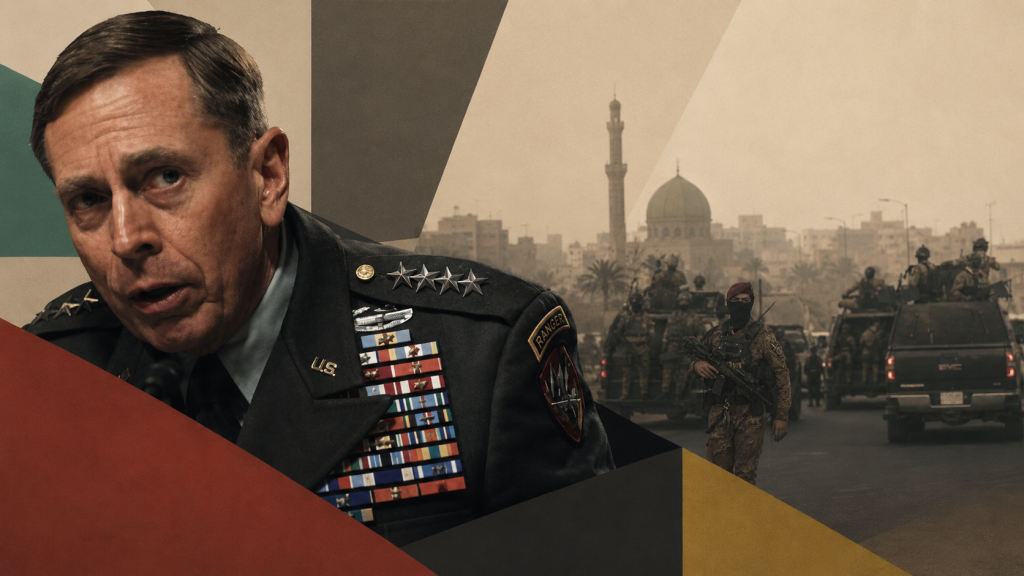
David Petraeus returned to Baghdad at a sensitive moment, neither under a declared official capacity nor merely as a visitor revisiting old memories.
The retired U.S. general, who once led American forces in Iraq and later served as director of the Central Intelligence Agency, met in Baghdad with senior Iraqi officials, including the U.S. embassy chargé d’affaires, the new prime minister, the speaker of parliament, the head of the Supreme Judicial Council, the commander of the Counter-Terrorism Service, and the outgoing interior minister.
But what turned the visit into a complicated political file was its connection, within Iraqi circles, to a proposal to establish a new ministry called “Internal Security” and transfer security formations to it, including parts of the Popular Mobilization Forces.
Details:
• Petraeus wrote after his visit that what he heard in Baghdad was encouraging, with particular focus on the need for Iraqi security services to have a monopoly on the use of force, to develop constructive relations with neighboring countries, and to prevent any external party from violating Iraq’s sovereignty.
• The Iraqi government has not, so far, announced a clear capacity for Petraeus’s visit, nor has the prime minister’s office issued a detailed statement on the substance of the meeting, unlike statements that appeared regarding his meetings with the head of the Supreme Judicial Council and the speaker of parliament.
• The political bureau of the Badr Organization attacked the proposal to establish an “Internal Security” ministry, considering that attaching the PMF, or parts of it, to a new ministry would represent an entry point for reshaping the security system in a way that targets the PMF.
• A member of parliament representing the “Khadamat” bloc told +ontime that Petraeus’s visit was “not entirely official and not spontaneous either,” explaining that the nature of the figures he requested to meet suggests that he came on a “reconnaissance” mission to present a vision regarding the future of the PMF.
• The lawmaker, who requested anonymity, added that establishing the “Internal Security” ministry could become a “machine for dissolving the PMF,” by directly linking its members to a new government structure that makes them closer to official security employees rather than elements within ideological formations tied to factions.
• According to the same source, the idea could open the door to disentangling the PMF as an official cover from the factions as armed and political forces, then referring some leaders to retirement, dismissing members who lack the required legal or educational qualifications, and gradually stripping the institution of its ideological character — all of which is categorically rejected, he said.
• In contrast, a senior officer at the Interior Ministry, in a passing comment to +ontime, said he doubts this proposal would be accepted politically, but added that forming such a ministry would expose the scale of “ghost members” inside the PMF, referring to fake or inactive names on payroll lists.
• There are no recent, publicly announced official figures on the number of “ghost members” inside the PMF. But the file of fake names has a heavy Iraqi precedent, as former Prime Minister Haider al-Abadi announced in 2014 the discovery of 50,000 fake names in the Defense Ministry’s records — not specifically in the PMF, whose numbers are surrounded by many questions.
• Therefore, the “Internal Security” battle appears to go beyond an administrative adjustment. Its real core is the question of authority within the state: will the PMF remain an independent institution with political and ideological weight, or will it gradually be turned into a disciplined security force inside a new government bureaucracy?
• For the Badr Organization and factions close to Iran, the idea appears to be an American attempt to re-engineer the balance of power from within, without direct confrontation. For opponents of parallel arms, however, it is a rare opportunity to redefine the relationship between the state and the factions.
What’s next?
The most important indicator now is not Petraeus’s visit alone, but the emergence of any official or semi-official draft for the “Internal Security” ministry project.
If the draft includes powers affecting the Popular Mobilization Forces, the Counter-Terrorism Service, or the Interior Ministry, the story will move from political debate to an open battle over the shape of the Iraqi state — and over who holds the decision of arms inside it.