News
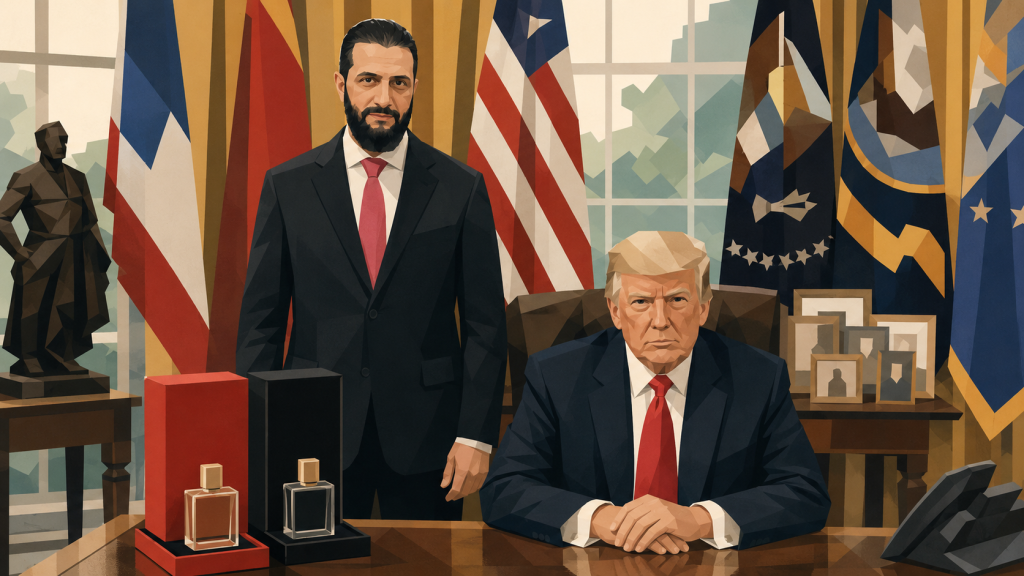
Syrian President Ahmad al-Sharaa posted a photo of perfume bottles gifted to him by U.S. President Trump, in a scene that appeared to go beyond a personal courtesy or a meaningless protocol gesture.
In politics, symbols sometimes say what foreign ministries do not. Just a few years ago, al-Sharaa’s name was associated with factions, weapons, and sanctions. Today, he speaks of an American president in a friendly tone, and of a stronger relationship between Syria and the United States.
This is where the real story begins: a story of political transformation imposed by the interests of the state over the memory of ideology.
Details
• The Assad family’s rule left Syria so exhausted that no new leader can afford the luxury of grand speeches. Al-Sharaa faces destroyed cities, a broken economy, and millions of Syrians living in refugee and displacement camps, while the state itself needs to be rebuilt from the ground up.
• This destruction made al-Sharaa’s first question clear: will he govern in the name of the organization’s memory, or in the name of the state’s needs?
• The answer that has emerged so far is neither ideal nor complete, but it is pragmatic. Al-Sharaa has begun moving as a head of state seeking sanctions relief, renewed financing, institutional repair, and restored external recognition.
• In January 2025, al-Sharaa was declared transitional president after Assad’s fall, alongside the dissolution of the former regime’s institutions and the prioritization of filling the vacuum, preserving civil peace, and building state institutions.
• This is where the moment of national realization appeared: the Syria al-Sharaa inherited cannot be governed with red headbands, combat clothing, or life under Russian airstrikes. States are run through banks, power stations, international recognition, open trade routes, controlled borders, and the return of refugees.
• In his public image, the symbolism of the hardened fighter gradually disappeared in favor of the statesman’s suit: ceremonies, reciprocal visits, conference appearances, and economic language. These details are not entirely cosmetic; they form the frame of a transition from rejected legitimacy to a legitimacy seeking acceptance at home and abroad.
• The real transformation is that al-Sharaa has begun acting as though the survival of his rule is tied to the success of the state, not to the continuation of the “revolution” or ideological rhetoric.
• In practice, the priority has shifted toward lifting sanctions, restoring financing, bringing back services, and building an Arab, Western, and Turkish network of relations that gives the new system the conditions for survival.
• Geopolitically, Assad’s fall and al-Sharaa’s rise represent a deep blow to Iran’s project in the Levant. For decades, Damascus was a central node in Iran’s line of influence stretching toward Lebanon and the Mediterranean. After the fall of the former regime, Syria is no longer the same comfortable base for Iran.
• Al-Sharaa does not have the luxury of breaking with Turkey. Geography imposes that reality: borders, refugees, security, factions, trade, and northern Syria.
• Nor does he have the luxury of moving away from the Gulf, because reconstruction requires money, trust, political cover, and regional networks capable of opening the doors of international institutions.
• This is the new realism: al-Sharaa cannot rebuild Syria without moving in every direction. He needs Turkey for security and borders, the Gulf for money and Arab cover, Washington for sanctions and international legitimacy, and Europe for development and institutions.
• One major mistake with any of these parties could quickly push Syria back into isolation.
But the Transformation Is Not a Certificate of Innocence
• The new Syria faces a difficult transition amid the legacy of war, sanctions, and divisions. The path is not guaranteed, and the situation is closer to a dangerous transition that requires tough decisions to prevent a slide backward.
• Recognizing the national interest does not erase the past, nor is it enough on its own to build a state. The real test will be controlling security, protecting minorities, building institutions that are not based on factional loyalty, and delivering an economy Syrians can feel in their daily lives, not just numbers announced at conferences.
What Next?
Put more clearly: al-Sharaa has crossed half the road by realizing that the national interest is stronger than ideology. But he has not fully won the bet yet.
Al-Sharaa, it seems, knows well that Syria can no longer tolerate a leader living in the past. The destruction he inherited from Assad is stronger than any ideology he carried in his youth.
The question now is this: can al-Sharaa turn this personal and political transformation into a viable Syrian state, or will the weight of war, division, and sanctions swallow this moment of pragmatism before it becomes a stable governing project?