News
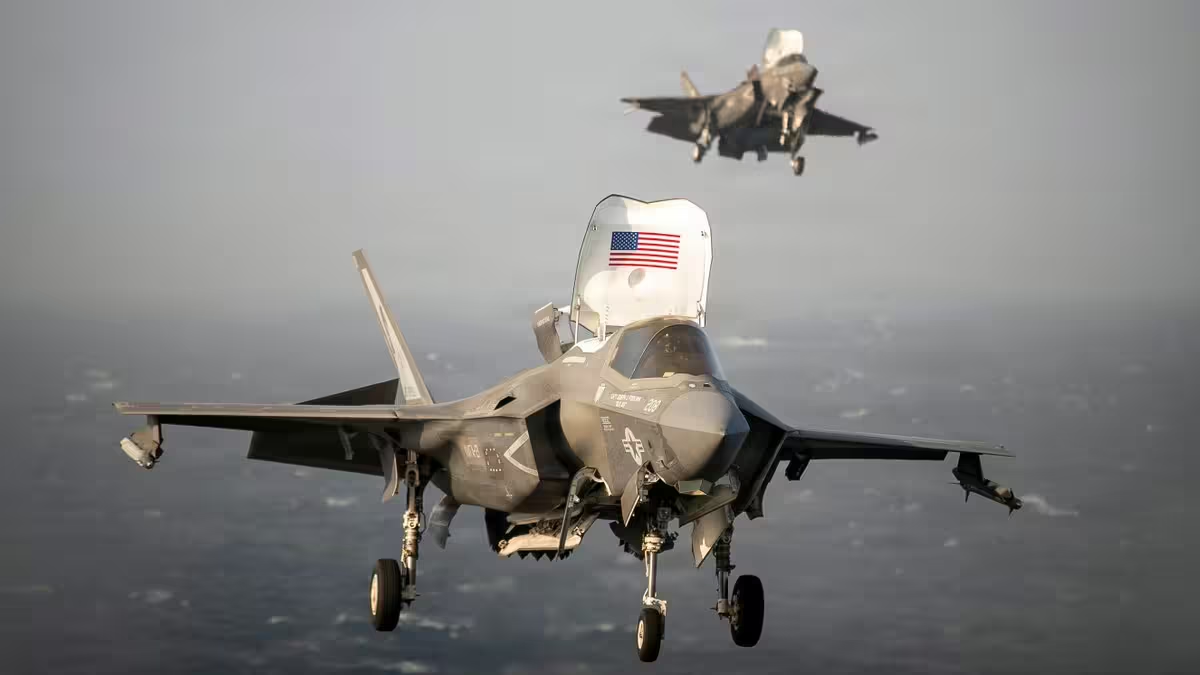
Trump pushed the crisis with Iran back to the edge of a military decision, after saying he stopped a major U.S. strike planned for Tuesday in response to a request from the leaders of Qatar, Saudi Arabia, and the UAE to allow room for what he described as serious negotiations.
But the delay does not look like a withdrawal from the strike option. It looks more like a short and limited deadline. Asked how many days Iran has to come to the negotiating table, Trump said the window could be two or three days, perhaps Friday, Saturday, or Sunday, or early next week, stressing that it is a limited period of time.
Details:
• According to Axios, Trump ordered the attack to be suspended for now and asked Defense Secretary Pete Hegseth and Joint Chiefs Chairman Gen. Dan Caine to keep forces ready to carry out a broad attack if no acceptable agreement is reached with Tehran.
• Calls from the leaders of Qatar, Saudi Arabia, and the UAE came in the hours before the decision, after the White House concluded that Iran’s latest proposal was not enough to reach a deal.
In separate remarks on Tuesday evening, Trump said:
• Iran cannot be allowed to have a nuclear weapon.
• I do not trust Tehran’s leadership.
• We may have to strike Iran again, but I am not sure yet.
• Qatar asked me to stop attacking Iran one hour before the attack was carried out.
• Saudi Arabia, the UAE, and Qatar asked for the attack on Iran to be stopped one hour before it was carried out.
• We are waiting to see whether Iran will accept an agreement with us.
• Trump did not back away from the strike. He moved the crisis onto a short countdown: Friday, Saturday, Sunday, or early next week.
• Israeli reports: Tel Aviv was surprised by Trump’s announcement that he had delayed a planned attack on Iran.
• Israeli reports: Tel Aviv and Washington conducted a military review to ensure that any potential strike on Iran would achieve guaranteed results.
• Israeli reports: The air force is preparing for a scenario in which Trump may order an airstrike on Iran.
• This means Israel is not treating the delay as the closing of the file, but as a temporary pause inside an escalation track that could quickly return if negotiations fail.
• In parallel, Washington intensified economic pressure, as the U.S. Treasury Department announced new sanctions targeting a financial network and vessels linked to the transport of Iranian oil.
• The sanctions included Amin Exchange Company, front companies in the UAE, Turkey, China, and Hong Kong, as well as 19 vessels accused of operating within Iran’s oil and petrochemicals shipping network.
• The message is clear: even with the strike suspended, Washington is not stopping its pressure tools. The military track takes one step back, while sanctions and the blockade take one step forward.
• Iran, meanwhile, is trying to reinforce the narrative that it does not negotiate under coercion. But Washington sees Tehran’s offer as insufficient, especially on the nuclear file, freedom of navigation, and the blockade.
• The “Gulf deadline” is an attempt to prevent war, protect energy markets, and avoid the tension moving from Gulf waters to gas stations and global markets.
What’s Next?
The coming hours will determine the direction of the crisis: either Iran offers enough of a concession to give Trump a reason to extend negotiations, or the White House returns to the strike option that was not canceled, only temporarily put on hold.