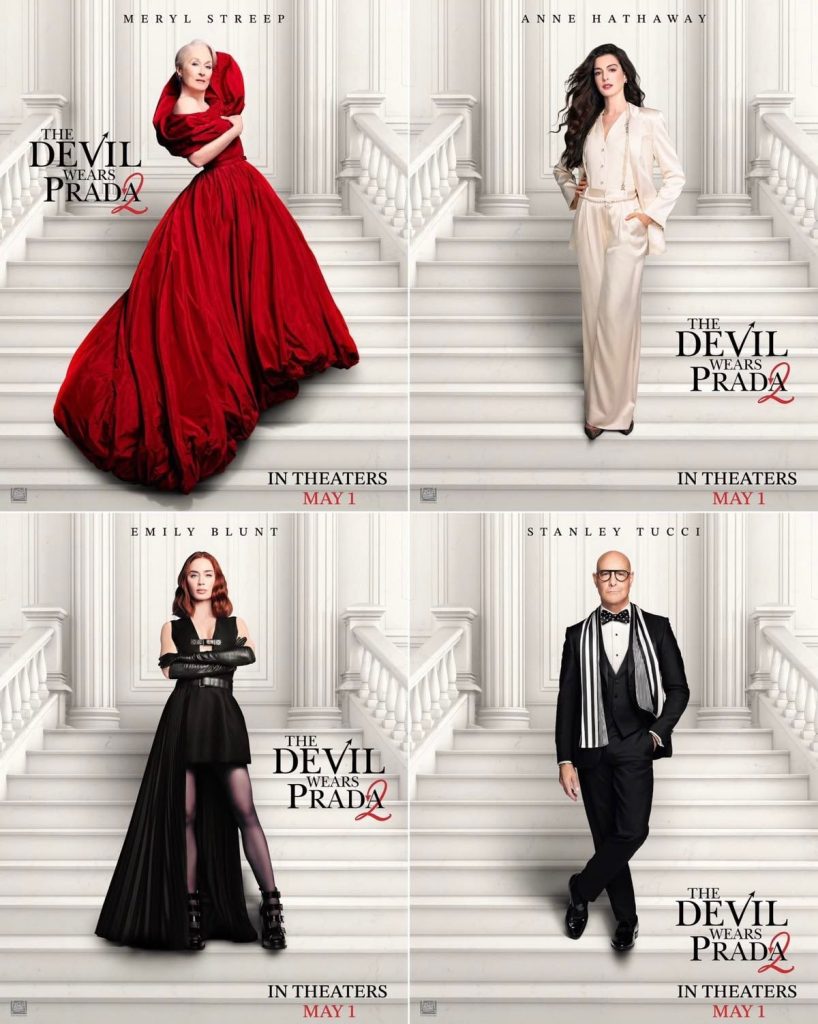
Miranda Priestly and Andy Sachs return in The Devil Wears Prada 2, but the world they return to is no longer the glittering one they left in 2006.
In the first film, the battle took place inside a luxury fashion magazine, between a young assistant trying to prove herself and a ruthless editor in chief ruling her world with imperial coldness. In the sequel, the confrontation turns into a wider question: what remains of old power, journalism, and magazines when the internet becomes the biggest editor, financier, and executioner?
According to Manohla Dargis’s review in The New York Times, the film does not simply revive nostalgia for Miranda, Andy, Emily, and Nigel. It places them in a chain of crises that begins with Andy losing her job after her publication shuts down, passes through a labor scandal hitting Runway, and moves toward an existential threat to the magazine and Miranda’s own position.
Details
• The film’s strength does not come only from the return of familiar characters, but from the way time has changed around them. Andy is no longer the confused young woman entering the fashion world. She is now an award-winning journalist colliding with the collapse of the industry she chose.
• Miranda, too, is no longer just a terrifying editor in a glass office. The power she once exercised through taste, authority, and the ability to make stars now faces a different kind of power: tech money, algorithms, and the collapse of the magazine model.
• Dargis sees the film as still offering glossy pleasure: plenty of fashion, sharp laughs, and light drama. But it is more aware than the first movie of the cost of that world: exhausted journalism, compromised fashion, and wealth that the film criticizes before returning to enjoy its shine.
• Here lies the smart contradiction. The film critiques luxury, but it cannot resist displaying it. That was also the game of the first film, but in the sequel it feels more tense because the world itself is less innocent.
• Meryl Streep’s return gives the film its real weight. Critically, Miranda Priestly was never just a villain on the page. A.O. Scott wrote about the first film in The New York Times that Streep made Miranda both terrifying and fascinating, turning her from a simple embodiment of evil into a figure of aristocratic grace and unexpected humanity.
• Roger Ebert also saw Streep as poised and commanding in the role of Miranda, while praising Anne Hathaway and Stanley Tucci. That helps explain why the first film did not become a disposable comedy, but a pop-cultural reference point for power, ambition, and work.
• This legacy is the sequel’s dilemma. Audiences do not only want a new story. They want to know whether Miranda can still dominate in a world that no longer fears magazines the way it did twenty years ago.
• Emily Blunt returns as Emily, now working at Dior, which makes the film even more embedded in the world of major brands. Stanley Tucci returns as Nigel, the elegant ally who was, in the first film, Runway’s soft conscience inside a brutal machine.
• The arrival of tech billionaire Benji Barnes, as noted in the review, moves villainy from Miranda’s office to a broader world. Miranda may be cruel, but she belongs to an older system built on taste and hierarchy. The tech billionaire represents power without cultural memory, swallowing journalism and fashion at once.
• That is why the film does not look like mere nostalgic sequel-making. Rolling Stone Philippines reads the second film as more than a nostalgia play, arguing that it has something to say about the future of publishing, not only its past.
• By contrast, harsher criticism from IndieWire sees the sequel as closer to a cinematic version of fast fashion: glossy and easy to consume, but at risk of recycling an icon more than developing her.
• This critical divide is the real strength of the story. The film is neither simply a beloved return nor a guaranteed failure. It is a test of a larger idea: can an icon from the age of print magazines remain powerful in the age of technology that devours everything?
What Next?
The most important question in The Devil Wears Prada 2 is not: has the magic returned? It is: can old magic save a world that has radically changed?
If the film succeeds, it will be because it understands that Miranda cannot return exactly as she was. She has to face an era harsher than herself. If it stumbles, it will be because it only sells nostalgia to an audience that remembers the line, the jacket, and the look, but wants something deeper than an icon replayed.
Either way, Miranda Priestly feels perfectly suited to this moment: a woman who built her power on controlling taste, only to find herself in an age where taste is controlled less by people than by platforms.