News
Pakistan is now moving along a highly sensitive line between Washington and Tehran, at a moment that has made its army chief, Asim Munir, one of the most prominent figures in efforts to halt escalation with Iran.
But behind this diplomatic role, a deeper layer of the Iranian-Pakistani relationship is emerging:
- porous borders
- widespread fuel smuggling
- networks linked to the Islamic Revolutionary Guard Corps
- and a military establishment that holds key levers of politics, security and the economy in the country.
Details
• Diplomatic reports show that during the Iran war, Pakistan moved from the position of a marginal state to a negotiation channel between Washington and Tehran, relying on its long border with Iran, its ties with the Gulf, and its army’s ability to manage files that do not necessarily pass through the civilian government.
• Asim Munir’s profile has risen in this context as the most important figure inside the Pakistani state, as the man of an institution that effectively manages a large part of political and security decision-making in Islamabad.
• Munir moved within a rare space:
- a direct channel of communication with Washington
- a working relationship with the Gulf
- and an ability to pass messages to Tehran.
This space made him an important mediator, but it also made Pakistan a party that is difficult to classify clearly between the two camps.
• The relationship between Iran and Pakistan is neither a stable alliance nor full hostility.
• The two sides cooperate when needed on border control, trade and de-escalation, then return to tension over Baloch groups, mutual strikes, and each side’s suspicion that the other is using its territory against its interests.
• In January 2024, the exchange of border strikes between Iran and Pakistan exposed the fragility of their security relationship. Tehran targeted what it said were positions of Baloch groups inside Pakistan, and Islamabad responded with strikes inside Iran. Days later, both sides returned to de-escalation, reflecting the nature of the relationship: a sharp crisis followed by rapid damage control.
• Inside this gray zone, the IRGC appears as a player that cannot be ignored in Pakistani calculations. Iranian influence does not necessarily appear through direct penetration of state institutions, but through a mix of borders, sectarian networks, illegal trade and security communication channels.
• One of the most prominent tracks is the Zainebiyoun Brigade, a formation made up of Pakistani fighters recruited by Iran-linked networks to fight in Syria. Pakistan later banned the group and considered it a threat to internal security, indicating that Islamabad does not view Iranian influence as only a foreign-policy issue.
• Zainebiyoun represents a model of indirect influence: recruitment inside a Pakistani social environment, external training or mobilization, then the possible return of members to Pakistan with combat experience and cross-border loyalty.
• But the most sensitive file in the Iran-Pakistan relationship is not only a security one; it is also economic.
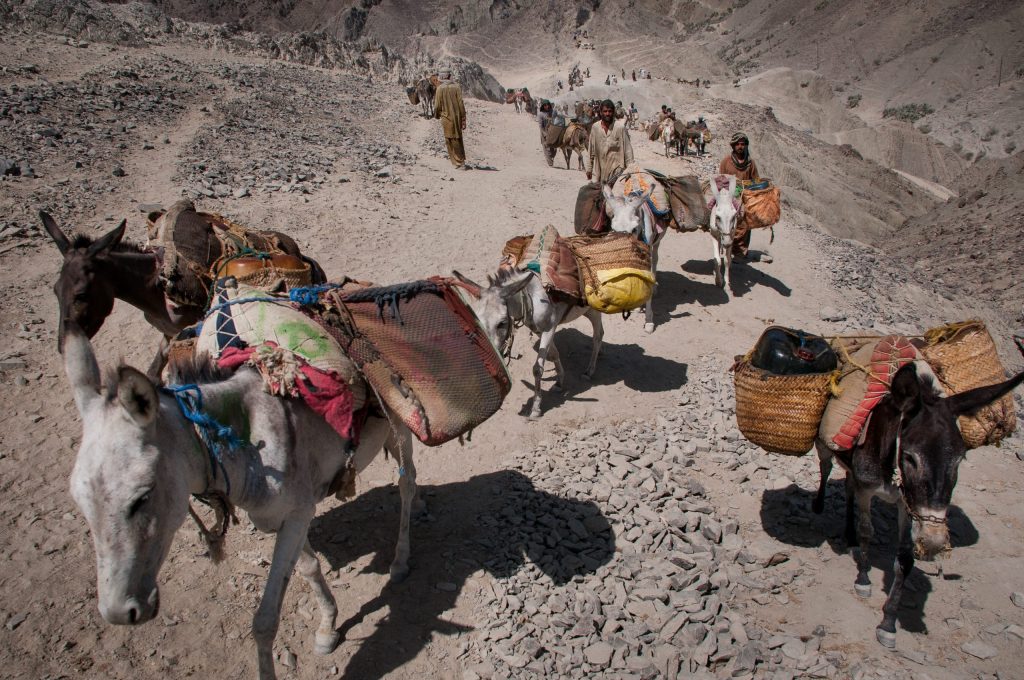
Sanctions on Iran, along with the Pakistani market’s need for cheap fuel, have created a large parallel economy along the border.
• Pakistani estimates indicate that Iranian fuel smuggling reached, at some stages, millions of liters per day, causing massive losses to the treasury through lost taxes and duties, while also harming state energy companies inside Pakistan.
• This volume of fuel does not cross the border as a small individual movement. Such a route requires convoys of trucks, roads, safe crossing points, fuel stations, distribution networks, and turning a blind eye at different stages. Here, smuggling turns into an economic structure protected by facts on the ground.
• Balochistan sits at the heart of this equation. A large number of residents in the poor province depend on the Iranian fuel trade, making any strict campaign against smuggling capable of triggering social and livelihood anger, especially in areas already suffering from marginalization and armed insurgency.
• Pakistani authorities have dealt with the file with clear double standards: on one hand, they announce anti-smuggling measures at the central level, but locally they are forced to regulate the market or tolerate it to avoid a social explosion. This duality is what makes Iranian fuel a security and political file that goes beyond being merely a customs and tax issue.
• In this environment, the role of the Pakistani army becomes central. The army is present in politics, at the borders, in crisis management, in anti-smuggling campaigns, and in controlling Balochistan. Therefore, the Iranian fuel economy cannot be read separately from the influence of the military establishment, even when no specific names appear at the forefront.
• Munir’s rise has deepened this overlap. Externally, he presents himself as a guarantor of stability and a communication channel with Iran. Internally, he presents himself as the leader of an institution capable of controlling political and economic disorder. This gives him additional influence in every gray file, from mediation to borders to the informal economy.
• For Washington, the dilemma is that Pakistan is useful and uncomfortable at the same time. It has a window into Tehran, but it also lives in direct contact with irregular Iranian networks, and at times turns a blind eye to an economy that feeds off sanctions on Iran.
• For Tehran, Pakistan represents a necessary corridor that cannot be lost. It is:
- a nuclear-armed neighbor
- a back market
- a smuggling corridor
- a political channel when needed
- and an arena through which part of the pressure of sanctions and blockade can be absorbed.
• As for the Pakistani army, the relationship with Iran gives it an additional negotiating card. It can present itself to Washington as a mediator, to the Gulf as a barrier against Iranian expansion, and to Tehran as a neighbor capable of opening backchannels when necessary.
What’s next?
The relationship between Pakistan and Iran is heading toward more ambiguity, not greater clarity. The tighter sanctions become on Tehran, the more valuable Pakistan’s border becomes.
The more Washington needs a mediator with Iran, the stronger Asim Munir becomes. And the more Islamabad pressures smuggling, the more it collides with a social and economic reality that makes Iranian fuel part of daily life in Balochistan.
The story is not that Pakistan has joined the Iranian camp, nor that the Pakistani army has cut its ties with Washington. The more accurate story is that Pakistan, under a highly influential military leadership, has become a gray node between three interests:
• political mediation with Iran
• security partnership with Washington and the Gulf
• and a border economy that benefits from sanctions instead of fully complying with them.
This is the major weakness in America’s bet on Islamabad: Pakistan can carry messages, but it is not a fully neutral mediator. It can fight smuggling, but it is not far from its structure. And it can talk to Iran, but it cannot separate that dialogue from the interests of the border, the army and the parallel economy.