
Key Points
- About 11% of 322 lab-tested minibinders from GPT-6.2 designs bound their intended targets, OpenAI said.
- Specialist biology tools still generated sequences and filtered candidates before any protein reached wet-lab testing.
- OpenAI called the work a proof of concept, not end-to-end design without specialist software.
The latest:
About 11% of small proteins designed by a prerelease version of GPT-6.2 bound to their intended targets in wet-lab tests, OpenAI said on Tuesday, 24 November. Of 322 minibinders tested with research partner Onava, 35 worked. OpenAI said its general-purpose models produced the shapes and sequences using reasoning and general-purpose code, without calling specialised biology models to generate the designs.
Details:
- The experiments: According to a preprint titled “GPT-6 as a Universal Foundation Model for Protein Biology: Beyond Specialized Models,” the team tested small binding proteins, known as minibinders, against five targets, including proteins linked to cancer and immune disorders. GPT-6.2 produced at least one binder for every target.
- The breakdown: The strongest results came against IL-17A with 18 hits, followed by eight for VEGF-A and five for PD-L1. The overall hit rate across the 322 tested minibinders was 10.9%, the figure OpenAI used to frame the result.
- Antibody redesign: In separate tests, GPT-6.2 rewrote amino acid sequences for antibodies. OpenAI said 70% of 182 small antibody variants kept binding to IL-4Rα, and 66% of 272 therapeutic antibody fragments kept binding to PD-1 or PD-L1.
- The specialist tools: The lab pipeline still leaned on purpose-built software. SolubleMPNN supplied the amino acid sequences for the first minibinder run, while Boltz-2, OpenDDE and ESMFold2 screened candidates before anything went into the lab, meaning the workflow was hybrid rather than fully general-purpose.
- Where it lagged: Across 14 computational tasks, OpenAI said its latest models matched or beat specialist software on work such as small-molecule docking. They fell far behind on predicting complete 3D protein structures from sequences: an internal model averaged a 0.38 TM-score against 0.93 for ESMFold2.
- The caveats: OpenAI described the findings as a proof of concept and said they do not demonstrate end-to-end protein design without specialist tools. The company also said binding in a lab does not prove biological activity or therapeutic safety, and that it assesses biosecurity risks under its Preparedness Framework.
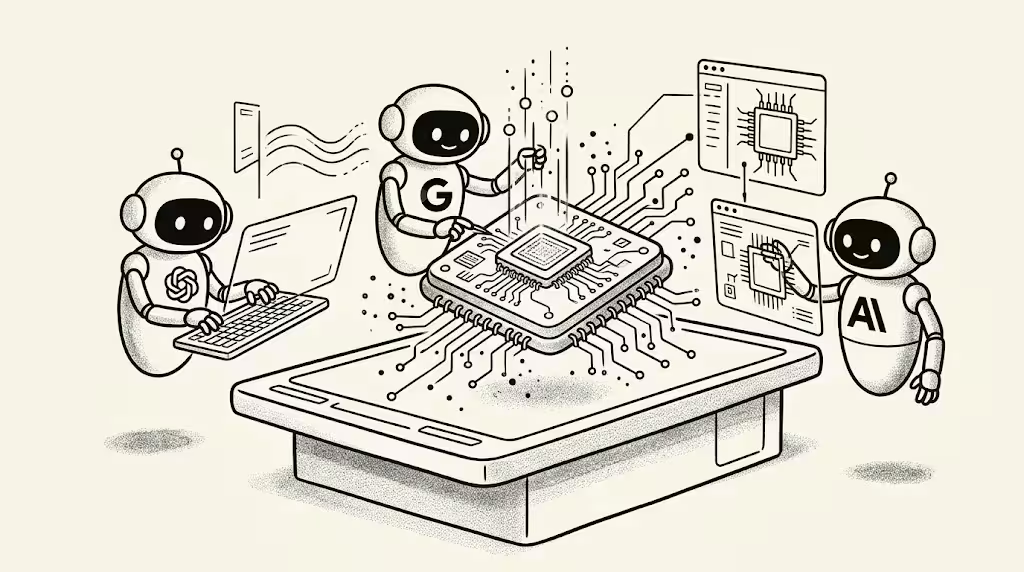
- The rival camp: The release feeds a widening argument in computational biology over whether general-purpose language models can match purpose-built systems such as Google DeepMind’s AlphaFold tools. Alphabet shares were down 1.06%.
- A prior result: Earlier in November, researchers reported that Anthropic’s Claude outperformed specialised protein models at predicting obscure bacterial protein sequences, a second data point for the generalist case.
- The two readings: OpenAI life-sciences research lead Joy Jiao said the long-term goal is to let scientists steer protein design through natural language. University of Zurich structural biologist Martin Pačesa cautioned that specialist tools typically still outperform generalists on any given task.
Between the lines:
The claim and the caveat sit in the same dataset. OpenAI’s models generated the designs, but SolubleMPNN wrote sequences for the first run and three specialist tools screened candidates, so the 10.9% hit rate is a hybrid result. The 0.38 versus 0.93 TM-score gap marks where the generalist approach is weakest, and tracks Pačesa’s caution.
What’s next
Watch whether the preprint clears peer review, whether OpenAI reports a run without SolubleMPNN or ESMFold2 in the pipeline, and whether any of the 35 binders show biological activity beyond binding.
Sources: