Key Points
- Dubai Marina Vertiport has been completed and certified, creating a permanent route to Dubai International Airport.
- Joby Aviation's electric aircraft is expected to fly the link in under 10 minutes, against 35 minutes by road.
- Commercial service still depends on operational approvals, with two more vertiports under development.
The latest:
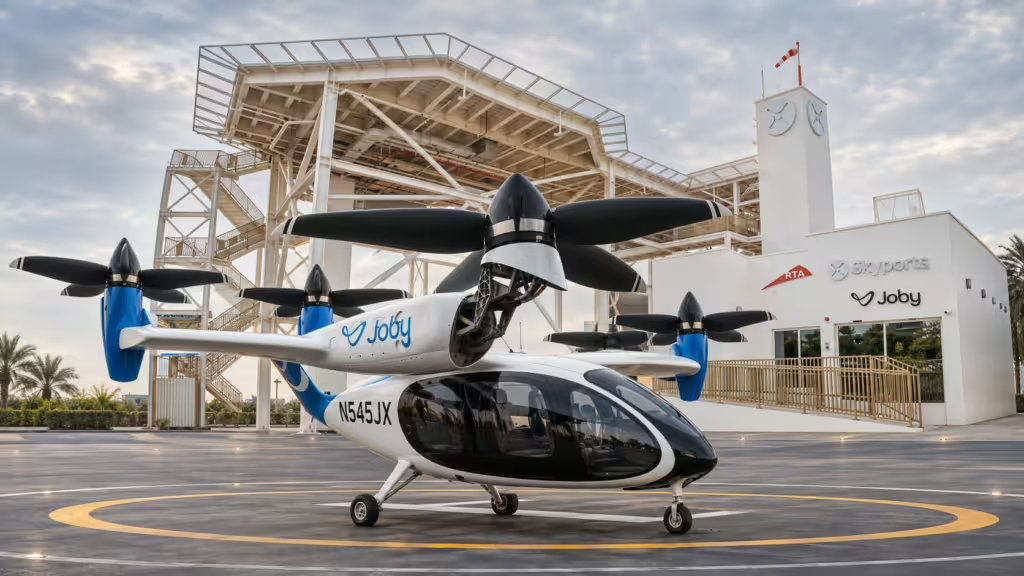
Dubai has completed and certified a second vertiport, establishing what developers describe as the world’s first permanent electric air taxi route between two dedicated sites. The Dubai Marina site, built by Skyports Infrastructure and certified by the UAE’s General Civil Aviation Authority, carries the call sign VMR and pairs with VDX at Dubai International Airport. Commercial flights still await operational approvals.
Details:
- The route: VMR at Dubai Marina links directly with VDX, the network’s primary vertiport at Dubai International Airport, which Joby Aviation will operate. The emirate has not announced a start date for paying passengers, saying only that commercial services remain subject to relevant operational approvals.
- Capacity: The site has a single elevated touchdown and lift-off area, a passenger terminal and a charger, according to the developers. Combined, they can handle up to 21,000 landings and 84,000 passengers a year, with no breakdown given for how that capacity ramps up.
- Journey time: Joby Aviation’s electric aircraft reaches speeds of up to 322kph with zero operating emissions, and is expected to cover the Marina-to-airport leg in under 10 minutes. The same trip takes about 35 minutes by road, a comparison the company used to frame the service’s appeal.
- Location: The vertiport sits next to the American University of Dubai and within walking distance of Al Fardan Exchange Metro Station. Authorities have presented the siting as part of an effort to tie air taxis into existing public transport rather than run them separately.
- Design: The facility borrows features from offshore aviation infrastructure, including a dedicated area where a parked eVTOL can charge without blocking the landing zone. That layout is intended to keep turnaround moving on a site built around a single touchdown area.
- Flight testing: Joby, based in California, has run piloted test flights in Dubai since June 2025. In November 2025 it completed the UAE’s first point-to-point air taxi flight, flying from its test site at Margham to Al Maktoum International Airport.
- Expansion plans: Two further vertiports are under development, in Downtown Dubai and on Palm Jumeirah. No completion dates were given for either site, nor any indication of how many aircraft will serve the network once the first commercial route opens.
- Official framing: Ahmed Bahrozyan, chief executive of the Corporate Technology Support Services Sector and chair of the Autonomous Transport and Aerial Taxi Committee, called the completion “a significant milestone in Dubai’s journey towards shaping the future of smart, sustainable and integrated mobility”. He said it complements the existing public transport network.
- Operator’s pitch: Anthony El-Khoury, general manager for the UAE at Joby Aviation, said Dubai is building a new way to move around the city, and that an airport trip becomes part of the experience rather than time lost in traffic. He pointed to Downtown and Palm Jumeirah as the next steps.
Between the lines:
The two certified vertiports sit at opposite ends of a single high-value corridor: an international airport and a dense waterfront district. Pairing the airport hub with a metro-adjacent Marina site, rather than two leisure locations, suggests the launch is aimed at airport transfers first, with Downtown and Palm Jumeirah positioned as later additions to an existing spine.
What’s next
The operational approvals needed before commercial flights begin are the next concrete signal, along with completion dates for the Downtown Dubai and Palm Jumeirah vertiports and any announced fare or schedule for the Marina-airport link.