Key Points
- Trump, Xi and Putin met Thursday in Shenzhen in the first trilateral summit of its kind.
- The three command the world's largest nuclear arsenals; New START expired earlier this year.
- U.S. officials played down breakthrough prospects on Ukraine, Iran and nuclear arms control.
The latest:
The leaders of the United States, China and Russia sat down together Thursday in Shenzhen for the first time, a gathering of the stewards of the world’s three largest nuclear arsenals on the sidelines of the APEC meeting hosted by China. The Wall Street Journal reported there was little advance indication of progress on the wars in Ukraine and Iran or on nuclear proliferation.
Details:
- The format: The Wall Street Journal reported that Trump met Putin bilaterally on Thursday on the APEC sidelines and separately with Xi before the three-way sit-down. Putin first proposed a trilateral alongside the APEC meetings, pitching it as a venue to discuss ending the Ukraine war.
- The arms-control file: Trump offered little indication of what he wanted from Shenzhen beyond opening talks on nuclear arms control, according to the Journal. New START, the last treaty capping U.S. and Russian strategic arsenals, expired earlier this year, and Trump has pushed for a broader deal that would also include China.
- Trump’s own caveat: Trump acknowledged in a Fox News interview before the meeting that cutting arsenals would be difficult, saying a demand to reduce by 2,000 weapons would be hard for him and probably for the others too. U.S. officials played down any prospect of a breakthrough.
- Beijing’s reluctance: Xi has been the reluctant party among the three, the Journal reported. Beijing has long argued it does not belong in arms control talks because its arsenal is dwarfed by those of Washington and Moscow, while it faces mounting domestic economic problems.
- The competing asks: Each leader wants room to operate unchecked in his own sphere, per the Journal: Putin wants Washington out of his way in Ukraine, Xi wants U.S. acceptance of his claim to self-ruled Taiwan, and Trump wants Chinese and Russian influence pushed out of the Western Hemisphere.
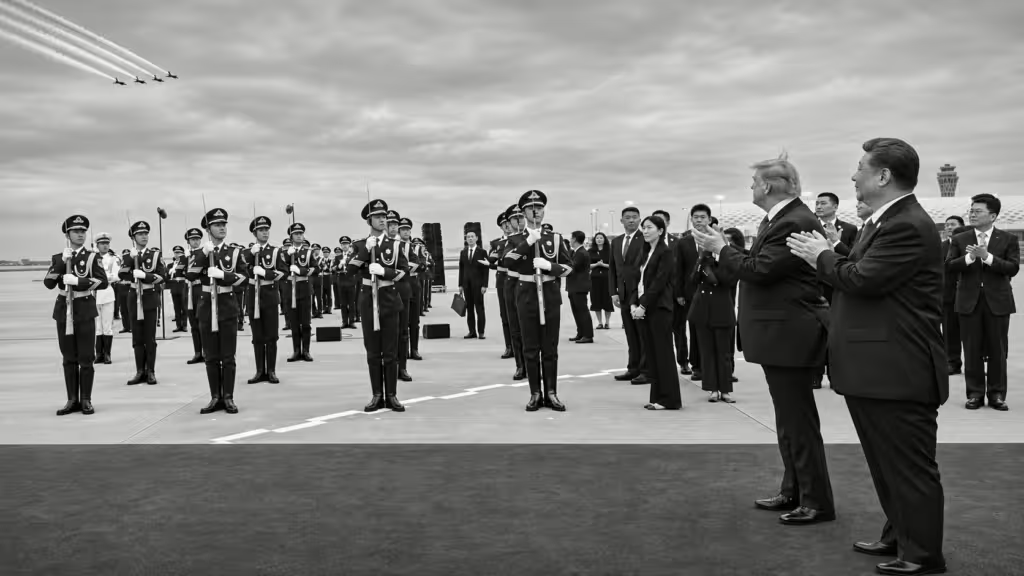
- The welcome: Xi greeted Trump personally on the tarmac when he landed Wednesday, a first by a Chinese president, and arranged a military flyover. Trump had staged a comparable reception for Xi in the United States in September, and described his relationship with Xi as the cornerstone of U.S.-China stability.
- Putin’s rehabilitation: The summit marked a diplomatic comeback for Putin nearly five years after the invasion of Ukraine made him an international pariah, his seat beside the leaders of the world’s two largest economies underscoring the limits of Western isolation efforts. The Kremlin said his meeting with Trump focused primarily on Ukraine.
- The analyst read: Julian Gewirtz, a China-focused official on the Biden-era National Security Council, assessed that Xi gains the chance to look like “the pivot player in international politics,” convening a would-be G3 on Chinese soil beside Putin and facing a friendly American president.
- Trump’s timing: Trump left Washington with his party reeling from midterm defeats and is seeking to use his final two years to cement a legacy as a global peacemaker, the Journal reported. He traveled first to a meeting of Southeast Asian leaders in Manila, then to Shenzhen.
Background:
APEC is an annual gathering of Asia-Pacific leaders, hosted this year by China. It is the third time in 2026 that Xi has appeared on equal footing with a U.S. president, and Shenzhen brought Putin into that frame for the first time.
Between the lines:
The Journal frames the meeting as a marker of the end of a unipolar order led by Washington, with no settled replacement. The evidence in the room points the same way: no announced deliverables, an expired New START, Beijing refusing the arms-control table, and three leaders whose stated asks — Ukraine, Taiwan, the Western Hemisphere — are claims to separate spheres rather than a shared agenda.
What’s next
Watch whether Washington and Moscow open formal talks on a New START successor, whether Beijing shifts its refusal to join arms-control negotiations, and any Kremlin or White House readout detailing what was agreed on Ukraine.