Key Points
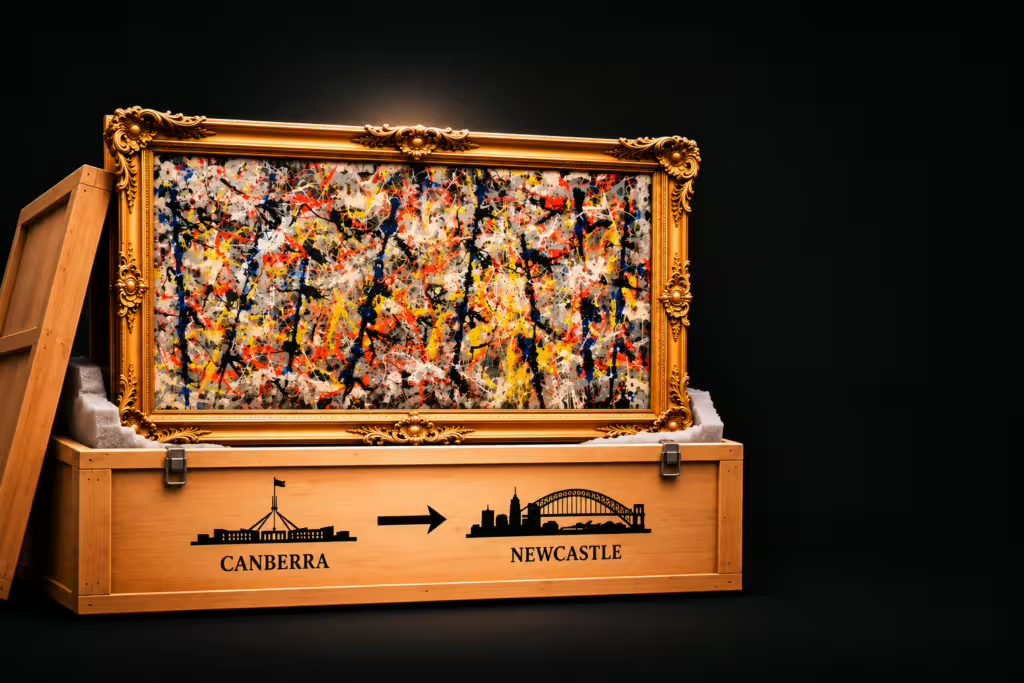
- Jackson Pollock's Blue poles will hang at Newcastle Art Gallery from 5 February to 30 April 2028.
- The National Gallery has loaned the 1973-purchased work to an Australian venue only twice since 2003.
- Capital works in Canberra mean the loan keeps the painting on public view rather than in storage.
The latest:
Blue poles, valued in 2023 at $500 million, will travel to Newcastle Art Gallery for a three-month showing starting 5 February 2028, under the federal Sharing the National Collection program. Arts Minister Tony Burke said the 1973 purchase, attacked at the time as a waste of money, had proven one of the smartest investments the National Gallery ever made.
Details:
- The dates: The painting will be on display at Newcastle Art Gallery from 5 February to 30 April 2028, according to the joint ministerial release. No touring stops beyond Newcastle were named, and the announcement did not set out how the work will be transported or insured for the loan period.
- The rarity: This is only the third time the National Gallery has loaned Blue poles to an Australian venue since 2003, the release said. The work by American Abstract Expressionist Jackson Pollock was bought by the Australian Government in 1973 and carried a 2023 valuation of $500 million.
- Why now: Critical capital works are already under way at the National Gallery in Canberra. The government said the Newcastle loan will ensure the painting remains on public display rather than being sent into storage during that work. The release did not give a completion date for the building program.
- The program: Sharing the National Collection runs under Revive, Australia’s National Cultural Policy. As of 30 September 2026, more than 2.6 million Australians had engaged with over 375 loans of Australian, First Nations and international works sent to 47 galleries and cultural venues in every state and territory.
- The numbers: Partner venues have reported visitor increases of up to 51% for exhibitions featuring works from the national collection, the government said. The release did not identify which galleries recorded that figure or give an average across participating venues.
- The minister: Burke argued the greatest works in the world should not be seen only in private collections, and said Australians have a right to expect the national collection will not live solely in Canberra but be shared across the country.
- The local case: Federal Member for Newcastle Sharon Claydon called the loan a vote of confidence in the city and said the exhibition would boost local businesses, hospitality and tourism. She offered no projected visitor numbers or economic estimate, but said Gough Whitlam took a political risk in acquiring Blue poles because he believed Australians deserved access to the very best art.
- The gallery: National Gallery of Australia director Nick Mitzevich said the Pollock has a remarkable ability to draw people in, and that taking it to communities across the country reflects a shared commitment between the gallery and the government to circulate the national collection as widely as possible.
Background:
Blue poles was bought by the Whitlam government in 1973 for a price that triggered a national political row over public spending on art. It has since become the best-known work in Australia’s national collection and a recurring reference point in debates about cultural funding.
Between the lines:
The timing ties two things together: a building program in Canberra that would otherwise put the painting out of sight, and a touring program the government is measuring in reach — 2.6 million people, 375 loans, 47 venues, visitor lifts of up to 51%. Sending the collection’s most recognisable asset to a regional gallery gives that argument its strongest single data point.
What’s next
The exhibition opens 5 February 2028 and closes 30 April. Watch for Newcastle Art Gallery’s attendance against the up-to-51% uplift reported by other venues, and for the completion schedule of the National Gallery’s capital works.