Key Points
- Alibaba released flagship AI model Qwen4-Max on Sunday, claiming gains in professional and scientific tasks.
- The company says the model beats August's Qwen3.8-Max using fewer tokens at lower cost.
- Chinese developers are expanding safety disclosures as global concern over loss-of-control risks grows.
The latest:
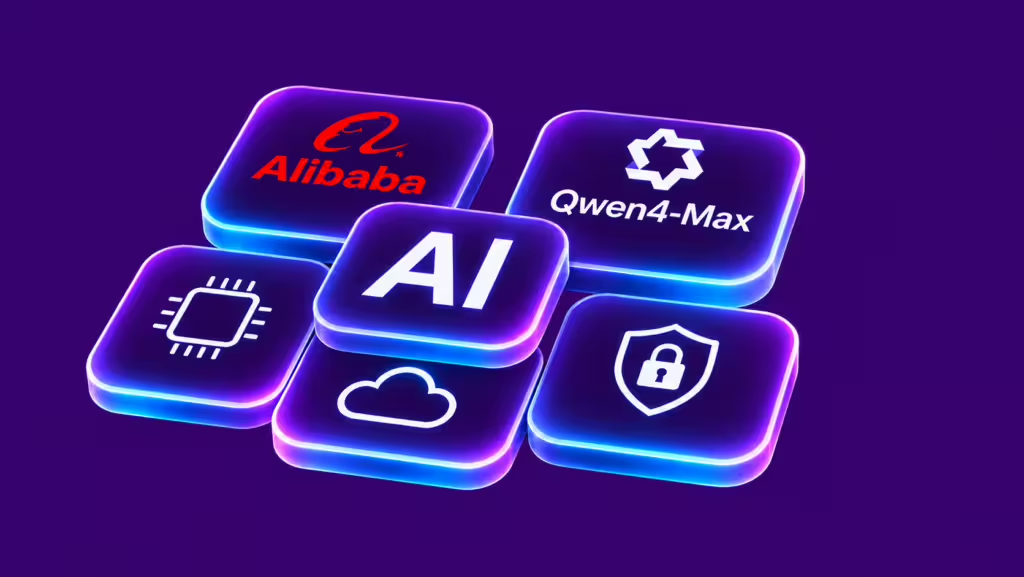
Alibaba’s new flagship artificial intelligence model, Qwen4-Max, went public on Sunday with the company saying it handles complex professional and scientific work better than its predecessor while carrying stronger protections against safety risks. Reuters reported the Chinese tech giant positioned the release as both a capability jump and a safety upgrade, a pairing that has become increasingly common in Chinese model launches.
Details:
- The claim: Alibaba said Qwen4-Max can take on work spanning “3D modeling, game development, precision manufacturing, finance, law, healthcare, and frontier scientific discovery,” according to Reuters. The company framed the model as suited to creative and professional tasks rather than general consumer use.
- The comparison: The company said Qwen4-Max outperforms Qwen3.8-Max, which it unveiled in August this year, while using fewer tokens and delivering greater cost efficiency. Alibaba did not publish benchmark scores or pricing to support the efficiency claim.
- Security testing: Alibaba said the model’s training included security checks alongside coding tests, which it says helped reduce vulnerabilities including code injection, memory-safety flaws and broken access controls. Those are among the most common categories of software weakness exploited in real-world attacks.
- Misuse safeguards: The company said it strengthened safeguards against misuse in areas such as cybercrime and hazardous materials. It added that internal testing found no evidence of significant high-risk capabilities in the model, a conclusion drawn from its own evaluations rather than an external audit.
- The competition: Reuters noted Chinese technology companies are a major force in open-weight AI models globally and are locked in a fast-moving contest to build more powerful systems without making them prohibitively expensive to run. Cost per token has become a central competitive metric alongside raw capability.
- Disclosure trend: Chinese AI model developers have in recent months increased safety disclosures in new model releases, according to Reuters, as global concern grows around rogue AI and loss-of-control risks. Qwen4-Max’s launch messaging fits that pattern closely.
- Release cadence: The gap between Qwen3.8-Max in August and Qwen4-Max on Sunday points to a compressed upgrade cycle. Alibaba did not specify availability terms, licensing, or whether the model’s weights will be released openly as some earlier Qwen versions were.
Between the lines:
The safety language is doing competitive work as well as technical work. Alibaba pairs every capability claim with a security claim: training included security checks, misuse safeguards were strengthened, internal testing found nothing high-risk. With global scrutiny of loss-of-control risks rising and Chinese labs broadly expanding safety disclosures, assurance has become part of the product pitch rather than a footnote to it.
What’s next
Watch for independent benchmark results testing the cost-efficiency claim against Qwen3.8-Max, any publication of Qwen4-Max licensing or open-weight terms, and whether rival Chinese developers match Alibaba’s safety-disclosure framing in their next releases.