Key Points
- Rubio said denying Iran a nuclear weapon permanently is Washington's definition of victory.
- He cast Tehran's leadership as expansionist, unlike a North Korea focused on regime survival.
- The framing sets a red line that weakening Iran alone would not satisfy.
The latest:
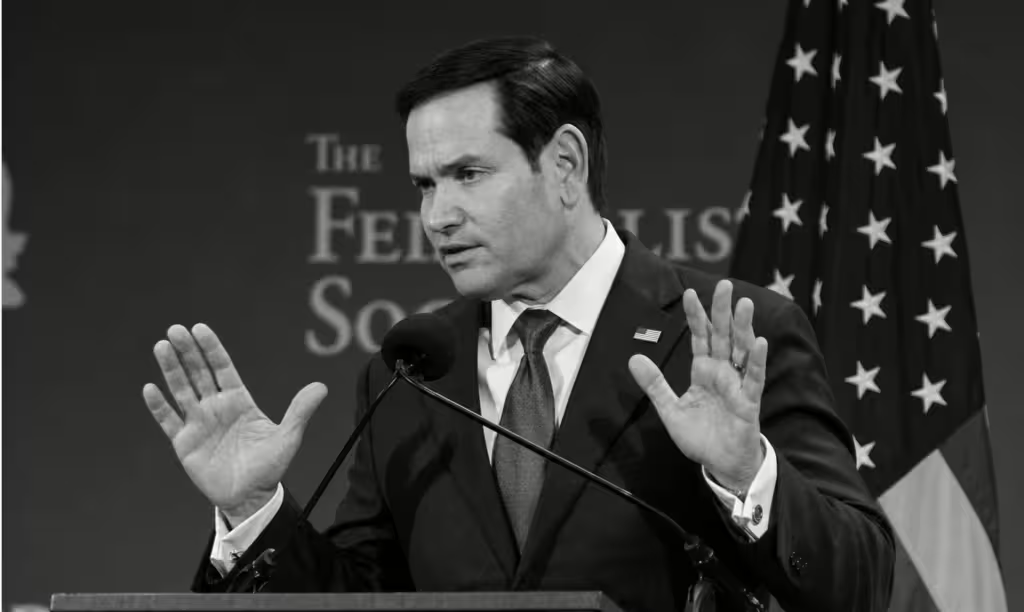
Preventing Iran from ever acquiring a nuclear weapon is how Washington defines victory, U.S. Secretary of State Marco Rubio said, warning that such a capability would let Tehran hold the region and the United States hostage. He spoke on November 13 at the Federalist Society’s National Lawyers Convention in Washington, defending President Donald Trump’s decision to confront Iran despite the economic and political costs.
Details:
- The objective: Rubio defined victory as ensuring Iran never obtains nuclear weapons, pursued through military deterrence, economic restrictions or denial of access to essential equipment. He did not set a timeline or name the specific measures Washington would use next.
- The North Korea contrast: Rubio described Kim Jong Un as primarily concerned with preserving his own regime rather than seizing territory. Iran’s leadership, he argued, is revolutionary and expansionist by design, which he presented as the reason a nuclear Tehran would behave differently from a nuclear Pyongyang.
- Regional proxies: He accused Iran’s clerical establishment of driving instability through Hezbollah in Lebanon, Shiite militias in Iraq, the Houthis, and forces that backed Syria’s former Assad government.
- Why no new strikes: Rubio said economic pressure had weakened Iran enough that further U.S. military action is unnecessary at present, tying the current pause to the cumulative effect of sanctions rather than to any negotiation.
- Trump’s choice: Rubio argued the president could have deferred the nuclear question to a successor and avoided the confrontation entirely, but accepted the political and economic costs of addressing it now.
- Protest allegations: Rubio accused Iranian authorities of killing tens of thousands of protesters and of targeting wounded people and medical staff inside hospitals.
- Outside evidence: Amnesty International documented mass killings and hospital raids, and the Associated Press reported interference with medical care. Iran’s Health Ministry denied the accusations.
- Disputed toll: Casualty figures from the January 2026 crackdown diverge sharply. Iranian authorities reported 3,117 deaths, while the Human Rights Activists News Agency had confirmed more than 7,000 by February, with further cases still under investigation. Communications restrictions have complicated independent verification.
- Inspections blocked: Reuters reported the International Atomic Energy Agency raised concern on November 13 over Iran’s refusal to admit inspectors to facilities damaged in the June 2025 strikes. The agency said it could not verify the highly enriched uranium stockpile or whether the declared Isfahan enrichment site still holds nuclear material.
- Tehran’s position: Iran maintains its nuclear program is peaceful and says talks on restoring inspections cannot move forward while U.S. military threats remain in place.
Between the lines:
By placing the ideological character of Tehran’s leadership at the center of the case, Rubio makes the argument about intent rather than capability alone — the same logic that lets him treat North Korea’s arsenal as a different kind of problem. His framing also separates military success from strategic victory: his own account of Iran as sufficiently weakened does not, by his standard, close the file while enrichment remains unverified.
What’s next
The immediate test is whether Tehran readmits IAEA inspectors and accounts verifiably for its enriched uranium stockpile. Washington’s next moves on sanctions and military posture will show how it intends to enforce the stated red line.