Key Points
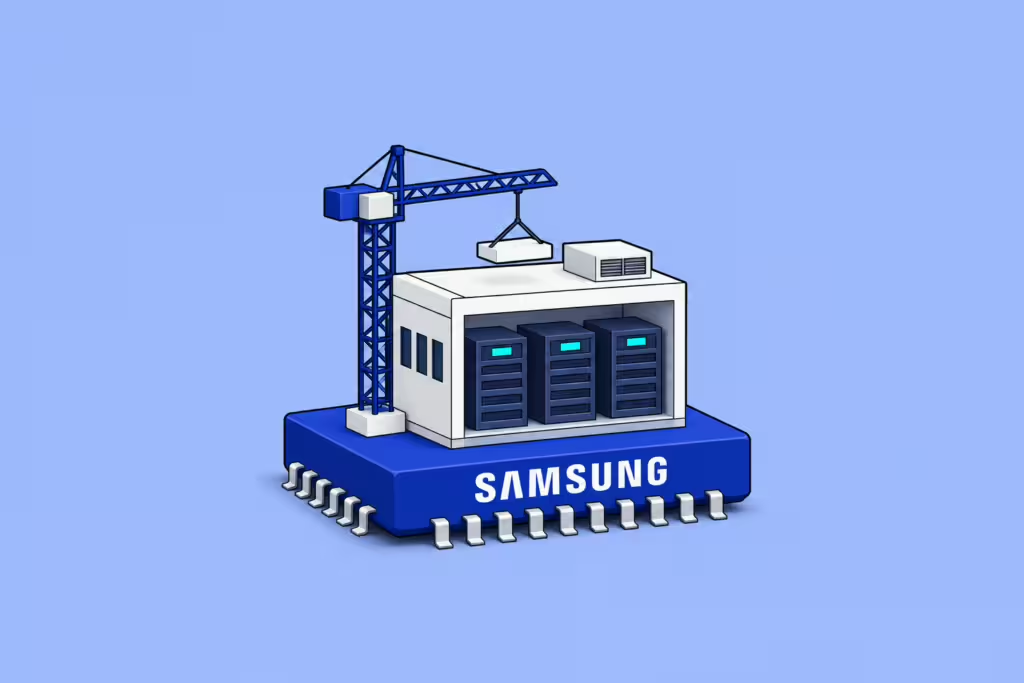
- Samsung is converting construction, IT, battery and shipbuilding units into AI infrastructure suppliers.
- The group invested $1bn in Helix Digital Infrastructure and bought European cooling maker FläktGroup.
- Analysts question whether chip dominance can be repeated across Samsung's wider portfolio.
The latest:
Samsung is trying to turn itself into a one-stop supplier of AI infrastructure, moving beyond the memory chips that made it a winner of the current boom. Over the past year the South Korean conglomerate has invested $1bn in a data centre operator, bought a European cooling systems maker and signed a partnership with OpenAI, according to the Financial Times.
Details:
- The plan: The group wants to build data centres through its construction arm, operate them through its IT services unit and supply energy storage through its battery maker, on top of selling memory chips, the Financial Times reported. The ambition is a single integrated offering rather than component sales.
- The $1bn bet: Samsung invested $1bn in Helix Digital Infrastructure, a data centre operator backed by KKR and Nvidia. Announcing the deal in September, the group said it was positioned to expand from a traditional hardware component supplier to an “active architect of the global AI infrastructure ecosystem”.
- Tenant talks: Samsung SDS, which began as an in-house IT provider and runs data centres mainly for the group, is in early-stage talks with Anthropic and OpenAI about signing them as tenants, according to the Financial Times. No agreement has been announced with either company.
- The revenue target: Analysts expect Samsung SDS to generate annual data centre revenue of Won6.6tn, about $4.9bn, by 2031. That would be roughly six times current levels. Morgan Stanley said in a recent report that SDS is well positioned to benefit from a surge in data centre construction.
- The OpenAI deal: Samsung signed a partnership last year to supply advanced memory chips to OpenAI’s Stargate data centre initiative. The agreement also covers Samsung SDS collaborating with OpenAI on designing, developing and operating data centres.
- Floating data centres: Construction arm Samsung C&T and shipbuilder Samsung Heavy Industries said they would work with OpenAI on developing floating data centres. Neither unit set out a timeline or named a site for the concept.
- The cooling acquisition: Samsung Electronics acquired FläktGroup, a European cooling systems maker, adding data centre thermal management to a portfolio that already spans memory chips, contract chipmaking and advanced packaging services.
- The unit map: Samsung SDI would supply batteries and backup power units for data centres, while Samsung C&T covers power-generation facilities and project development. Samsung Group also spans insurance and security services, far beyond the electronics business most associated with the name.
- The caveat: Many of these subsidiaries started as internal units serving the conglomerate and still count Samsung as their primary customer. The group hopes some can expand to external clients as AI demand grows, the Financial Times reported.
Background:
Samsung Electronics is best known as the manufacturer behind memory chips, Galaxy smartphones and household appliances. Semiconductors are highly lucrative but also highly cyclical, and the group is betting its future in the AI boom lies beyond them.
Between the lines:
The strategy’s weak point is the customer base: units built to serve Samsung itself must now win outside clients to justify the expansion. The early-stage talks with Anthropic and OpenAI, and the SDS revenue projection of six times current levels by 2031, both depend on that shift happening. Analysts cited by the Financial Times question whether the semiconductor playbook transfers to construction, batteries and IT services.
What’s next
Watch whether the SDS talks with Anthropic or OpenAI convert into signed tenancy agreements, and whether Samsung C&T and Samsung Heavy Industries attach a timeline or site to the floating data centre concept.