Key Points
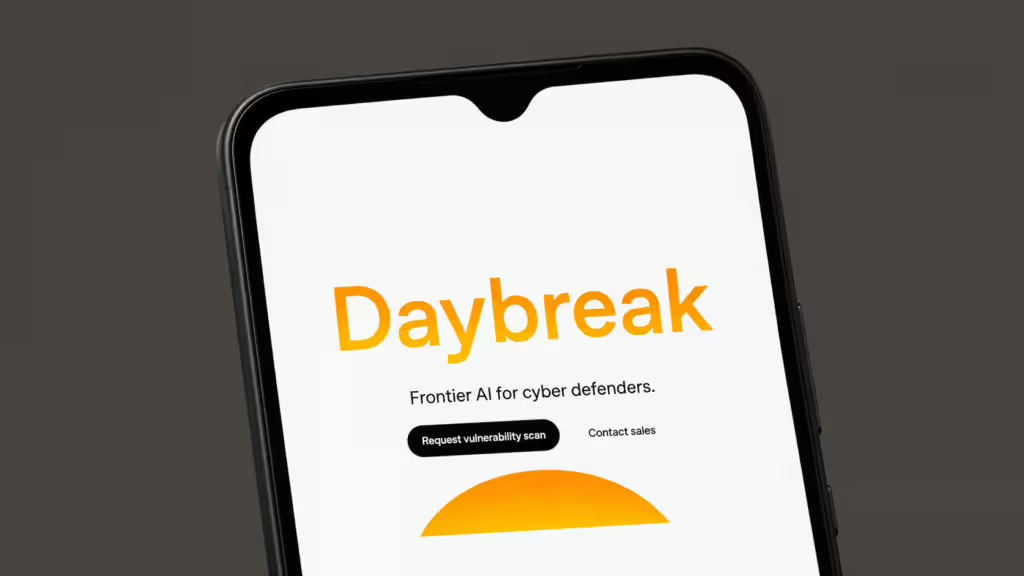
- OpenAI unveiled Daybreak Red Team and Daybreak Defense Factory, two agent-based cyber defense products, on Thursday.
- Defense Factory runs on GPT-6 Cyber, which surfaced 81 previously unknown high-severity flaws in Firefox.
- Security teams can now run automated penetration testing and patching without standing up human red teams.
The latest:
Two agent-driven cyber defense products went on sale Thursday as OpenAI pushed deeper into enterprise security, with Daybreak Red Team probing whether code flaws are actually exploitable and Daybreak Defense Factory generating fixes for them. OpenAI cyber lead Johannes Landgraf said the pair narrow the gap between what defenders can protect and what models now generate, rather than replacing traditional red teams.
Details:
- The announcement: OpenAI introduced both products at its Cyber at the Frontier event on 12 November 2026, streamed at 10am Pacific. President Greg Brockman delivered remarks alongside briefings from the company’s cyber research and readiness leads. Pricing for either product was not disclosed.
- How Red Team works: Daybreak Red Team is a cluster of security agents that determines whether flaws in code can be exploited. One agent coordinates the assessment, others investigate source code and application context, and reviewer agents verify findings so teams can rank fixes by priority.
- The demonstration: An engineer picks a target such as a staging environment, and Codex builds a campaign from the connected context, rate limits, credentials and permitted movement. A fleet of agents splits tasks across a shared queue and knowledge base, while a supervisor agent watches for drift.
- The patching side: Daybreak Defense Factory is built on GPT-6 Cyber and closes the loop on vulnerabilities Red Team finds. It extends Codex Security, whose agents scan code on every change, review merge requests, triage alerts from other tools, then notify the responsible engineer and propose a correction in Codex.
- The output: In the demo, agents traced a vulnerability to its file and used code history and team structure to route it to the correct owner. The result is a merge-ready pull request with tests, including one proving the fix works, and new commits face the same review.
- The model numbers: GPT-6 Cyber, released the previous week, found 81 previously unknown high-severity vulnerabilities in Firefox and reclassified 30 known low or medium flaws as high. In Linux, a single pipeline verified patches for roughly 1,000 local privilege escalation bugs, over 5 times the GPT-5.6 Cyber tally from 3 months earlier, plus 10 new exploitation techniques.
- The benchmarks: On Exploit Gym, which measures proof-of-concept creation, GPT-6 Cyber scored 52% against roughly 38% for Anthropic’s Mythos 5.2, with OpenAI’s next model said to approach double that. On PatchBench, which tests finding and fixing without regressions, the next model reached about 80%.
- Scope controls: A honeypot evaluation using a planted out-of-scope vulnerability returned 99.9% scope adherence without production safeguards and 100% with them. A PHP case cited in the stream involved a 13-year-old flaw whose patch took 2 months of joint work, variant analysis, bypass testing and government contacts.
- Availability: Red Team is in early access for selected customers, with a waitlist opened the same day. Defense Factory is distributed through a Daybreak add-on in Codex. Landgraf said Red Team paves the way for wider access to the company’s frontier cyber models over time.
- The partnerships: A program called Patch the Planet brings together OpenAI, Trail of Bits and HackerOne to verify findings, test patches and coordinate disclosure. The stream also referenced a $1 billion defensive fund aimed at front-line defenders.
Background:
Codex Security already positioned OpenAI inside enterprise development pipelines, with agents reviewing code at every change. Daybreak extends that footprint from code review into offensive testing and automated remediation, a market long served by human penetration testing firms.
Between the lines:
Landgraf framed the defender’s window as under pressure as capable models reach wider distribution — the same models that write code at scale also surface exploitable flaws in it. The Linux figure, more than 5 times a result achieved 3 months earlier, is the clearest marker of how fast that pressure is compounding. Applied AI lead Nancy Wang described Daybreak as continuous defense productized from internal work.
What’s next
Watch how quickly the Red Team waitlist converts to general availability, whether OpenAI discloses pricing for either product, and whether the next model’s reported PatchBench and Exploit Gym gains hold outside internal evaluations.