Key Points
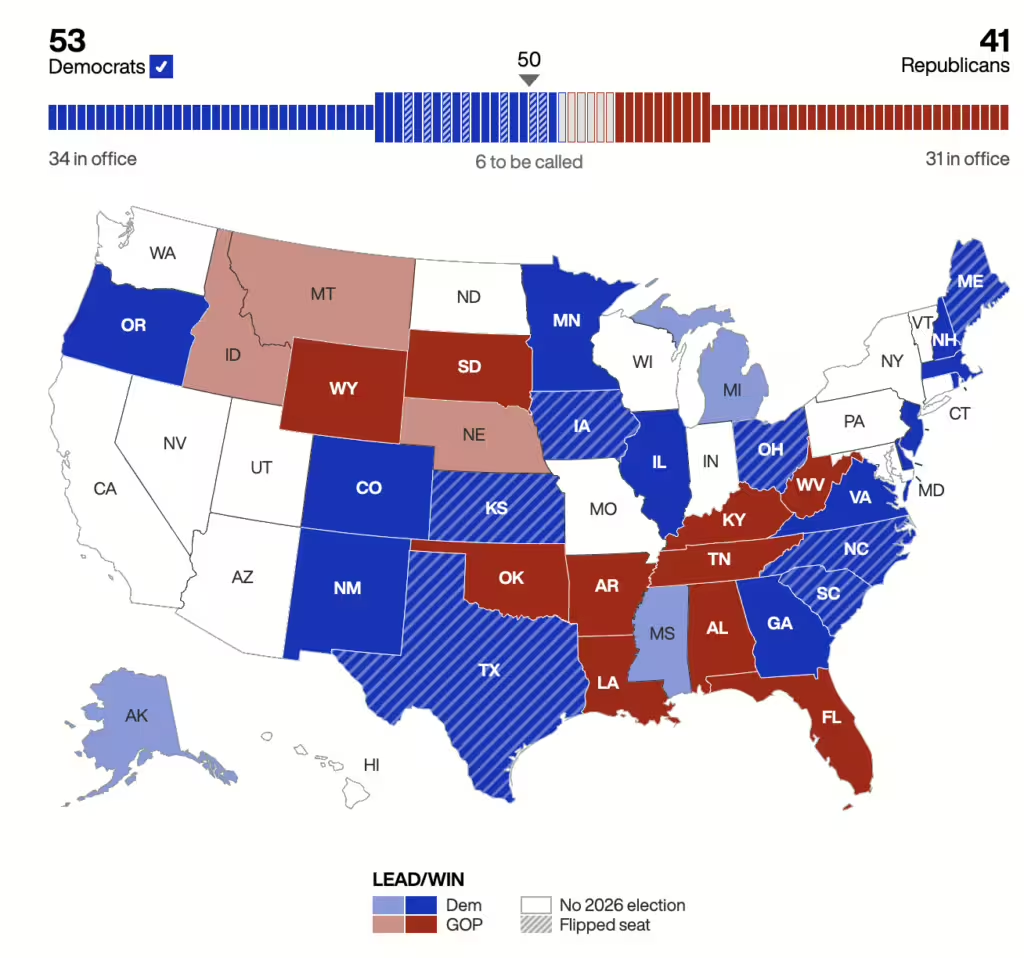
- Democrats won the Senate and secured a House majority in the midterm elections, American media reported.
- The confrontation centers on five files: legislation, the budget, judicial nominations, investigations and the Iran war.
- Trump keeps the veto and executive powers, turning electoral rivalry into a two-year institutional standoff.
The latest:
Republicans lost control of Congress after midterm results handed Democrats the Senate, with American media confirming the party also secured a House majority. The outcome arms the opposition with tools to block President Donald Trump’s legislative agenda and to investigate his administration, without stripping him of the powers of the presidency itself.
Details:
- Legislative blockade: Democrats can now stop Trump’s priorities from advancing, according to published analysis. Their own bills, however, run into the presidential veto and the 60-vote threshold that governs most legislation in the Senate, leaving the new majority stronger at obstruction than at enactment.
- The budget weapon: Control of federal spending gives the majority leverage over the administration on funding for institutions and programs, according to Vox. The same leverage carries the risk of disputes over keeping the government open, a recurring pressure point between the two branches.
- Judicial nominations: A Senate majority lets Democrats block or delay Trump’s candidates for federal courts and for executive posts requiring confirmation. No timetable has been set for how aggressively the chamber intends to use that authority.
- Congressional investigations: Democrats intend to subpoena officials and demand documents concerning the administration and the business interests of Trump’s family, according to Vox, with possible court fights over compliance. Investigations in themselves do not establish wrongdoing.
- The Iran file: ABC News reported that Democratic legislative plans include a bill to end the war with Iran. Such legislation would face constitutional and political obstacles, foremost the presidential veto, leaving defense appropriations as an alternative route to review military policy.
- Declared priorities: Beyond Iran, the proposed legislative agenda covers repealing tariffs and lowering health insurance costs, according to Vox. There is no guarantee any of it becomes law given the Senate threshold and the White House veto.
- What Trump keeps: Vox noted that the Democratic win does not transfer executive authority to the opposition. Trump retains the full use of his presidential powers and the right to reject legislation, making negotiation and obstruction the two realistic modes of the coming relationship.
- The subpoena risk: Committee powers to summon witnesses and obtain documents could place administration officials before repeated public hearings, per the same analysis. Refusal to cooperate with subpoenas could open prolonged litigation rather than quick disclosure.
Between the lines:
Vox argued the victory raises Democratic voters’ expectations without granting the party the power to deliver on them. The gap is structural: blocking Trump’s decisions requires only a majority, while lowering prices or ending the Iran war requires surviving a veto. That turns the next two years into a mutual-obstruction arrangement in which each side can stall the other, and both absorb the political cost of deadlock before voters.
What’s next
Watch the count of remaining seats, the election of House leadership, and the new Congress taking office in January 2027. Its opening choices on legislation, investigations, nominations and the budget will define the first clash with the White House.